3 Things to Say to Yourself When You Feel Like a Failure | Ep. 530
In this episode, I’m sharing three powerful, practical skills to help you navigate feelings of failure, break free from self-criticism, and change the way you respond to setbacks with more self-compassion.
In this episode, I’ll share:
- Why failure is just one chapter of your story, not the end, and how changing this perspective can help you move forward.
- How to recognize the difference between your thoughts and the facts, so you don’t automatically believe everything your mind tells you.
- Why the shame we attach to failure is often more painful than the failure itself.
- How my personal challenge to fail 100 times in one year completely changed my relationship with failure and success.
- Why treating mistakes as opportunities to learn, rather than reflections of your worth, can help you grow.
- One small but powerful step you can take when you’re feeling defeated, discouraged, or afraid to try again.
Content
Feeling Like a Failure? 3 Powerful Ways to Change How You Think About Failure
Have you ever made a mistake, fallen short of a goal, or looked at where you are in life and thought, I’m such a failure?
Maybe you tried something, and it didn’t work out. Maybe you’re watching other people achieve things you thought you would have accomplished by now. Or maybe you’re just feeling disappointed in yourself, and no matter how hard you try, you can’t seem to shake that feeling.
I know how painful this can be. I’ve been there more times than I’d like to admit.
And I know what you might be expecting me to say.
“You’re not a failure! You’re doing great!”
And while I absolutely believe that, I want to give you something more useful today.
Because here’s the thing. When you’re feeling like a failure, simply telling yourself that you’re not one doesn’t always help.
You might feel better for a few seconds, but then your brain jumps right back in with all the reasons it thinks you’re wrong.
Yeah, but remember that mistake?
What about everything you haven’t accomplished?
What if you really aren’t good enough?
Sound familiar?
Instead of trying to convince yourself that you’re not a failure, I want to teach you three practical skills to help you change your relationship with failure, respond differently to self-critical thoughts, and move forward with more self-compassion.
These skills build on each other, so I encourage you to practice them in order.
Let’s get started.
1. Remember That Failure Is a Chapter, Not the End of Your Story
I want you to think about your life as a book.
Every good story has a beginning, a middle, and an end. And somewhere along the way, there are challenges, setbacks, disappointments, and unexpected turns.
But here’s something I want you to consider.
What if the thing you’re calling a failure is simply one chapter in a much bigger story?
When we make a mistake or something doesn’t go as planned, our brains often treat it like the ending.
We think:
- I’ve ruined everything.
- I’ll never get where I want to be.
- I should have figured this out by now.
- This proves I’m not good enough.
But what if this is only chapter three of a 300-chapter story?
What if there’s still so much more to come?
The truth is, you get to decide whether this experience becomes the end of your story or simply part of it.
The Year I Decided to Fail 100 Times
I want to share something personal with you.
Back around 2017 or 2018, I set a goal for myself that probably sounds a little strange.
I decided I was going to fail 100 times in one year.
Yes, you read that correctly.
I intentionally put myself in situations where I might be rejected, told no, or make mistakes.
I reached out to people I thought were way out of my league. I pitched ideas I wasn’t sure would be accepted. I asked to be on podcasts where I didn’t think I had much chance of being invited.
And I got plenty of no’s.
But something really interesting happened.
The more I practiced failing, the less afraid of it I became.
I stopped treating every rejection as evidence that something was wrong with me.
Instead, I started seeing failure as something I could experience, learn from, and move through.
Looking back, that year was a turning point in my life.
It changed how I approached my career, my relationships, and even my mental health.
And it taught me something incredibly valuable.
Failure doesn’t have to stop your story. Sometimes it’s what helps your story move forward.
A Skill to Practice When You Feel Like Giving Up
The next time you find yourself thinking, I’m a failure, try asking yourself:
- Am I treating this experience like the end of my story?
- What if this is just one difficult chapter?
- What might the next chapter look like?
- What is one thing I could do to keep moving forward?
You don’t have to know exactly how everything will work out.
You don’t even have to feel confident.
Just remind yourself that this moment doesn’t have to define the rest of your life.
2. Learn to Separate Your Thoughts From the Facts
This second skill is one of my favorites, and it’s something I teach often when working with anxiety, OCD, and overthinking.
I want you to remember something really important.
Just because you feel like a failure doesn’t mean you are a failure.
And just because you have the thought that you’re a failure doesn’t make that thought true.
In cognitive behavioral therapy (CBT), we talk about something called emotional reasoning.
Emotional reasoning happens when we assume that because we feel something strongly, it must be true.
For example:
I feel guilty, so I must have done something wrong.
I feel embarrassed, so everyone must be judging me.
I feel like a failure, so I must be one.
But feelings aren’t always accurate reflections of reality.
And neither are our thoughts.
A Thought Is Not a Fact
I want you to notice something about the way I’ve been talking throughout this article.
I’m not saying, “You are a failure.”
I’m saying, “You’re having the thought that you’re a failure.”
That distinction is intentional.
There’s a powerful skill called cognitive defusion, which helps us create some distance between ourselves and our thoughts.
Instead of getting tangled up in a thought and treating it as the absolute truth, we learn to observe it.
Here’s what that might look like.
Instead of saying:
“I’m a failure.”
Try saying:
“I’m having the thought that I’m a failure.”
Instead of:
“Nobody likes me.”
Try:
“I’m having the thought that nobody likes me.”
Instead of:
“I’m terrible at everything.”
Try:
“I’m noticing that my mind is telling me I’m terrible at everything.”
Do you notice the difference?
We’re not trying to force ourselves to think positively.
We’re simply acknowledging that a thought is something our mind produces, not necessarily something we need to believe or act on.
Why This Small Change Matters So Much
Let’s imagine you make a mistake at work.
Your brain immediately tells you, I’m such a failure.
If you believe that thought completely, what might happen next?
Maybe you withdraw.
Maybe you spend the rest of the day scrolling on your phone.
Maybe you avoid your responsibilities, isolate yourself, or give up on something that matters to you.
You’re responding as though the thought is an established fact.
But what happens if you pause and say:
“I’m having the thought that I’m a failure.”
Suddenly, you have a little more room to choose how you respond.
You might decide to take a break.
You might acknowledge that you’re disappointed.
You might go for a walk, do the dishes, work in the garden, or return to the task when you’re ready.
The important thing is that you don’t have to organize your behavior around every painful thought your mind produces.
But What If You Really Did Fail?
Now, I know some of you are thinking, “Okay, Kimberley, but what if I actually did fail?”
That’s a great question.
Let’s say you took an exam and received an F.
That’s a fact.
You failed the exam.
But here’s where we need to be careful.
Failing an exam and being a failure are two very different things.
You can acknowledge what happened without turning it into a judgment about your entire identity.
For example:
“I got an F on my exam. That’s what happened. And I’m noticing that my brain is telling me this means I’m a failure.”
See how we’re separating the event from the story we’re telling ourselves about it?
This allows us to take responsibility for what happened without adding unnecessary shame and self-criticism.
How to Practice Cognitive Defusion
The next time a painful thought shows up, try these three steps.
Step 1: Notice the thought.
Pay attention to what your mind is telling you.
Maybe it’s “I’m not good enough” or “I always mess things up.”
Step 2: Name it as a thought.
Try saying, “I’m having the thought that…”
You don’t need to argue with it, prove it wrong, or make it disappear.
Step 3: Redirect your attention to what matters.
Ask yourself, “If I didn’t have to treat this thought as a fact, what would I choose to do right now?”
Maybe you’ll try again.
Maybe you’ll rest.
Maybe you’ll spend time with someone you love.
Maybe you’ll take one small step toward something meaningful.
This is exactly the kind of work we explore in my course, Stop Overthinking and Start Living, where I teach you how to change your relationship with your thoughts and redirect your attention toward the life you want to live.
Because the goal isn’t to eliminate every negative thought.
The goal is to stop letting those thoughts make all your decisions.
3. Change Your Relationship With Failure and Shame
Okay, this third skill is a big one.
And I could probably talk about it for hours.
I want you to think about your relationship with failure itself.
Because after years of working with clients and teaching students, I’ve noticed something important.
Often, the most painful part of failure isn’t what happened. It’s the shame we attach to it.
We live in a world that constantly encourages us to achieve more.
More success.
More money.
More promotions.
A better body.
A bigger house.
More accomplishments.
There’s this underlying message that we should always be improving, progressing, and winning.
And when we’re not?
We start to believe we’re falling behind.
But I want you to question that idea.
What If You Didn’t Have to Be Winning All the Time?
Think about how much pressure you put on yourself to succeed.
Maybe you believe you should be further along in your career.
Maybe you think you should have figured out your mental health by now.
Maybe you’re disappointed that your relationships, finances, or personal goals don’t look the way you imagined.
But who decided that every part of your life needs to be moving upward all the time?
And who decided that anything less than success means failure?
When I spent that year intentionally collecting 100 failures, something shifted for me.
I wasn’t just becoming more comfortable with rejection.
I was changing how I viewed myself.
My worth was no longer dependent on whether I was winning.
And that was incredibly freeing.
What My Dad Taught Me About Taking Risks
I grew up on a large farm in Australia.
We had dairy cows, pigs, chickens, corn, and all kinds of things happening on that farm.
My dad built an enormous farming business, and every single year, he faced the possibility of failure.
The weather could destroy the crops.
Too much rain could affect the livestock.
Circumstances completely outside his control could threaten everything he’d worked for.
But every year, he kept going.
He kept planting.
He kept growing.
He kept taking risks, even though there was no guarantee things would work out.
And watching that taught me something I didn’t fully appreciate until later in life.
People who accomplish meaningful things are often the same people who are willing to risk failure.
When I started paying attention to people who had achieved things I admired, I noticed that many of them had experienced plenty of rejection, mistakes, and setbacks along the way.
They weren’t necessarily succeeding because they never failed.
They were willing to keep trying even when failure was possible.
And that’s a very different way of looking at success.
Stop Turning Failure Into a Personal Attack
Here’s what I really want you to understand.
When something doesn’t go well, your brain may immediately turn it into a statement about who you are.
You might think:
“I’m stupid.”
“I’m lazy.”
“I’m not capable.”
“I’ll never get this right.”
Sometimes that harsh inner voice is actually trying to protect you.
It’s trying to make sure you never make the same mistake again.
It thinks that if it criticizes you enough, maybe you’ll do better next time.
But that self-protective response can create so much additional suffering.
Instead of helping you learn, it leaves you feeling ashamed, defeated, and afraid to try again.
So I want to offer you a different approach.
What if you treated failure as information instead of evidence about your worth?
Failure Is Data, Not Your Identity
Let’s say you tried something and it didn’t work.
Instead of immediately asking, “What’s wrong with me?” try asking:
- What went well?
- What didn’t go the way I hoped?
- What did I learn from this experience?
- What could I do differently next time?
- What would be a helpful next step?
Notice how different those questions feel.
We’re not attacking ourselves.
We’re gathering information.
We’re learning.
We’re giving ourselves the opportunity to grow.
And here’s the most important part.
Your worth does not increase when you succeed or decrease when you fail.
You don’t become more valuable because you got a promotion, reached a goal, or received praise.
And you don’t become less valuable because you made a mistake, experienced rejection, or didn’t accomplish something you hoped to.
Your worth stays the same.
On the days you’re winning.
On the days you’re struggling.
And on all the ordinary days in between.
Bonus Skill: Take One Small Step When You Feel Defeated
Before we finish, I want to give you one more skill.
Because I know that when you’re feeling like a failure, you can feel absolutely exhausted.
Sometimes you don’t want to get out of bed.
You don’t want to try again.
You don’t want to face another disappointment.
You just want to hide from the world for a little while.
I understand that feeling.
And I’m not going to tell you to suddenly become motivated, confident, and ready to conquer the world.
Instead, I’m going to ask you to do something much smaller.
Can you take just one tiny step?
That’s it.
One thing.
Maybe that means getting out of bed and taking a shower.
Maybe it means responding to one email.
Maybe it means opening the book you’ve been avoiding.
Maybe it means making a plan to try again tomorrow.
Whatever it is, make it small enough that it feels manageable.
You Don’t Have to Feel Ready to Begin Again
Growing up on a farm, I learned that when you get bucked off a horse, eventually you have to decide whether you’re going to get back on.
And getting back on can feel terrifying.
You remember what happened.
You know there’s a chance you could fall again.
But you don’t have to jump back on at full speed.
You can take your time.
You can approach it gently.
You can start small.
The same is true when you’re recovering from a setback.
You don’t have to make some enormous comeback.
You don’t have to prove anything to anyone.
You just have to be willing to take the next step when you’re ready.
And when you do?
I want you to celebrate it.
Seriously.
Celebrate the fact that you showed up.
Celebrate the fact that you tried.
Celebrate the fact that you took action even though it was uncomfortable.
Because sometimes that first small step is the hardest one.
How to Stop Feeling Like a Failure: Putting These Skills Together
Let’s bring everything together.
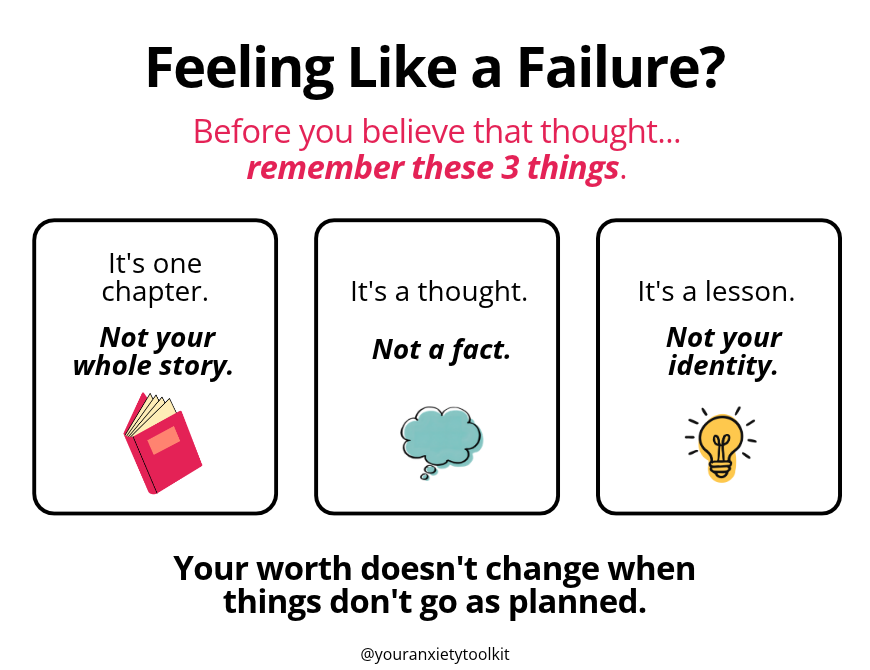
The next time you make a mistake, experience a setback, or notice that familiar thought of I’m a failure, I want you to remember these three things.
- This is a chapter, not the whole story.
What happened today doesn’t have to determine what happens next. Your story is still unfolding.
- Your thoughts and feelings are not automatically facts.
You can notice the thought that you’re a failure without believing it or allowing it to control your choices.
- Failure is an experience, not an identity.
You can learn from what happened without attaching shame to it or questioning your worth.
And if you’re feeling completely overwhelmed, remember the bonus skill.
Take one small step.
That’s enough for today.
Final Thoughts: You Can Be Kind to Yourself and Still Keep Growing
If you’re reading this while feeling disappointed in yourself, I want you to know that I understand how much it hurts.
I know how vulnerable it can feel when things haven’t gone the way you hoped.
And I know how convincing that self-critical voice can be.
But I hope you’ll begin to see failure differently.
You can make mistakes and still be worthy of kindness and self-compassion.
You can experience setbacks and still have a meaningful future ahead of you.
You can acknowledge what went wrong without making it mean something terrible about who you are.
And you can learn, grow, and move forward without punishing yourself along the way.
So please, be gentle with yourself.
Remember that this is just one chapter.
Notice your thoughts without automatically believing them.
And when you’re ready, take one small step forward.
I’m cheering you on.
And as always, it is a beautiful day to do hard things.
Please remember that this article and the resources offered through CBT School are educational and are not a replacement for professional mental health care. If you feel you would benefit from additional support, please reach out to a qualified mental health professional.
Transcription: 3 Things to Say to Yourself When You Feel Like a Failure
So you made a mistake, or maybe you’re not as far along as you would like, and you’re having the thought that you are a failure. I know, this can be such a hopeless, painful place to be, and I’m so glad you’re here, because we’re here and we’re gonna talk about it today. Now, I know what you’re probably thinking.
You’re probably thinking I’m just gonna say to you, “You’re not a failure. You’re doing great.” And that’s true, 100%, but that is not the skills I wanna give you today. Often, when we replace the thought, “I feel like a failure,” with, “You’re not a failure,” sort of that cognitive restructuring, that literally lasts for a couple of seconds at the most, and before you know it, you’re thinking, “Yeah, but what about this?”
And, “I could have done that.” And, “Kimberly maybe doesn’t know all about it.” And it doesn’t land. And so what I wanna do in this video is give you three concrete skills that you can practice if you feel like you’re a failure.
I have been there. I know this feeling. I’ve been there more times than I would like. But I’ve done a lot of push-ups in this area, a lot of reps in managing this feeling. It’s something I’ve talked about on your Anxiety Toolkit before. But today I wanna give you three really concrete skills on how to handle it, so let’s get going.
For those of you who are new, my name is Kimberly Quinlan. I’m an anxiety and OCD specialist. I have spent 15 years specializing in anxiety and OCD and intrusive thoughts and uncertainty, and this is what I love to do. This is what I’m on a mission to help you manage, little pesky thoughts like this that feel like huge, huge mountains that you can’t climb.
So before we get to these three main points, I want you to remember that these points build on each other. So I would encourage you to practice them in the order that I’m explaining, but hey, you do whatever works for you. The first skill I want you to use when it comes to the thought that you’re a failure is to understand that when we think about failure- It usually is the end of a story, meaning like, you know, with narrative stories, there’s like, there’s the beginning, the middle, and the end, and the end is where everything falls apart.
But I want to give you some power back here, is you can either decide this mistake you made or where you’re at in your life right now is the end of your story, or it’s one of the chapters in your story, that it’s a part of this bigger story, and you only really fail if you let it be the end of the story.
My goal for you is to remember that this feeling that you’re having right now, that you’re a failure, is just chapter three out of probably 300 chapters of your life, and your job is to recognize that while you might feel like a failure, the only way it actually is a failure if you end the story here and you don’t keep trying.
I, in, ooh, gosh, 2018, maybe ’17, I, for a whole year, made it my goal that I was going to fail 100 times, and that helped teach me that failure is something that we can actually get really, really good at. And what happened is I refused to let the failure, the people saying no, the declines, the rejections, the total screw-ups, I refused to let that be the final chapter.
I just kept going. And to be honest, that was the year… When I look back now, and it’s nearly 10 years ago, that year pivoted so much for me. It helped me with my mental health, it helped me in my career, it helped me in my marriage. That year of really leaning into failure and practicing it and having a different perspective towards it was actually like the hockey stick.
I don’t know if you know the term hockey stick, but it’s like everything im- started improving when I changed how I looked at failure. Now, the second thing I want you to know about the feeling when you’re sitting there and you just feel like you’re the worst, you have just amounted to the worst, and I get it
It’s like we’ve hit rock bottom. I want to remind you that it is a feeling or a thought That just because you feel like a failure doesn’t mean you are a failure. In CBT, we call that emotional reasoning, that if you feel something, you believe that the feeling is true. Now, just because you have the thought that you’re a failure also doesn’t mean you are a failure.
A thought is not a fact. We have thousands and thousands of thoughts every single day that are not true, and this one is one of those. And so it’s going to be about your relationship with your thoughts. Your homework here is when you have a thought, you acknowledge that it is a thought. So you would put the…
You may have noticed at the beginning of this episode, I said, “For those of you who are having the thought that you’re a failure.” Did you notice that I said that? That was on purpose. I didn’t say, “You’re a failure, and so let’s talk about how to not feel like a failure.” I said, “You’re having the thought that you’re a failure.”
And when you can diffuse from your thoughts and have some distance from them, you can start to see where there may be errors in your thinking. So we want here, and this is what we teach in our online course called Stop Overthinking, is we teach you how to have a better relationship with your thoughts, and then learn how to redirect your attention to what matters to you.
Now, let me explain why that’s so important. Let’s say you have the thought, “I’m a failure.” You don’t diffuse from it, so you don’t acknowledge that you’re having the thought that you’re a failure. You think it’s a fact. Then when you think it’s a fact, you’re going to act from the place from that fact that you’ve perceived, and you’re gonna act from the place that, “I am actually a failure.”
Usually, what that looks like is you go and lay in bed, you nap, you avoid, you doom scroll, you isolate because you’re acting as if you have actually big time failed, and you’ve acted as if it is the final chapter instead of chapter 3 out of 300. However, if you can learn the skill of observing, “I’m having the thought that I’m a failure,” then you have some choices in how you respond.
You can go, “Do I wanna respond as if that is a thought, or do I want to respond as if that is a fact? What would it look like if I responded if it was just a thought? Oh, I wouldn’t give it all my attention. I would go and plant the garden, or I would go and do the dishes, or I would try again.” Or if you really have, like, made a big error or s- you tried something and it totally didn’t work, you might give yourself a day to be like, “Oh, I’m gonna kinda be disappointed for a day.
I’m gonna take a day off or a break from this for a couple days, and then in a few days I’ll come back and reassess what didn’t go well. What could I have done differently? What do I want to do moving forward?” But that ability to observe a thought and then make a choice on like, “I’m actually not going to treat that thought like it’s important or true.
Instead, I’m gonna redirect my attention to right here, right now. What do I want to be doing?” Or even if you actually… Like again, if let’s say you have hardcore evidence that you failed, meaning like you took a test and you got an F on it, like that’s not just a thought, that you actually did fail that test.
But you w- could then recognize that just because you failed a test doesn’t mean you are a failure, and you can say to yourself in your most wisest, kindest mind, “I got an F on the test. That is objectively true, but I’m having the thought that that means I’m a failure.” And so you can see I’m trying to give you as many examples as I can here on how you can practice defusing.
I wanna say it again. Just because you think it doesn’t mean it’s true. You can have the thought “No one likes me,” and that might feel terrible, or you can have the thought, “I’m having the thought that nobody likes me.” That gives me some time and some space and, like, the capacity to sort of wrangle with that and decide, do I want to treat that thought like it’s true, and am I going to start to act from a place that nobody likes me?
So there are so many ways I want you to practice that. This skill is not just for the feeling of being a failure. It’s for any feeling or any thought that you may have. The same goes for guilt. Often people, when they feel guilt, they assume they are guilty. They personify or personalize it. And again, we would go, “No, I’m having the feeling of guilt,” instead of, “I am guilty and I am bad.”
Again, that’s … Again, it becomes a personal attack. Often with our self-critical voice, and you know I’m often talking about self-compassion, when we haven’t defused, when we fuse with a thought, we kinda lock in and we believe our thoughts are true, we tend to then engage in self-criticism and self-punishment as a way to sort of, like, make sure we don’t fail anymore.
It … That’s a self-protective mechanism that happens when we have done something wrong, or we haven’t done so well, or we’re in a stitch about something in our life, which, to be honest, is almost every day for all of us. There’s something that happens that doesn’t work well. There’s that part of us, our
part of our … deep, deep part of our brain that wants to step in with a very aggressive voice and be like, “Don’t do that again. Why did you do that? That was ridiculous. You shouldn’t have.” And all that part of you is doing is trying to prevent that from happening again. It’s trying to protect you, but it’s creating suffering at the same time.
Now, before we move on, if you’re interested in learning about this in depth with a 28-day implementation plan, click the link below and I’ll send you directly to our new course called Stop Overthinking and Start Living. It’s going to give you a very, very structured way of learning these skills, and I think you’ll love it.
The reviews have been amazing, and it just brings me so much joy to have people take that course and get so much out of it. Okay, so now we’re up to the third one, and this one is a biggie. And this one I probably need to talk about more. This could be its own three-hour podcast. But the main point I wanna make here, the third thing I want you to remember when you feel like you’re a failure, is I want you to explore what is your relationship with failure, because what I have learned from sitting across from hundreds of clients- thousands of students is that most of the time it’s not the failing that is so painful, it’s usually the shame we have about it.
Our society has built up this idea or this story that our goal in life should be to only be winning. We should only be checking off boxes. We should only be succeeding. We should be climbing that ladder all the time, getting more and more and more successful, more promotions, more money, a bigger retirement savings, more in your bank account, a better body.
It’s constantly, constantly pushing us to win. And what’s the opposite of winning? Often we would say failing. And so often when I hear a client say, “I’m a failure,” it’s because it’s not even that they’ve failed. My guess is the thing you’re telling yourself that you’ve failed at isn’t even an actual failure.
Even if it is, the problem is that you have put pressure on yourself to be always winning And if it’s anything except winning, it feels like a failure. This shifted everything for me. When I practiced that year of failing over and over 100 times, getting 100 nos, I was on purpose trying to seek out nos. I was asking to do things that was way above my level of professionalism.
I was asking to be on people’s podcasts that I had no right asking to be. I was pitching to people I had no right to be. I was trying to do things that I knew I probably would never be able to do. But what shifted for me is not just my ability to fail, but it was the view of myself. I was no longer ashamed of failing.
I was no longer… I didn’t feel like me, Kimberley, the whole totality of my worth was no longer built on only winning. And what I learnt is, and this is where I want you to come in really close because this is, was like a huge like in my brain, like I couldn’t believe it, is the more I studied people who failed a lot, the more I realized they’re the ones who were succeeding.
Now yeah, there were the people who were kind of playing it safe and like, uh, bumping along and winning here and winning there. But the people who were doing really cool stuff and had really succeeded in their life were the ones who were willing to fail. Now, I will give you a personal example of this, and it’s actually my dad.
My dad is a farmer. I don’t know if you guys knew this about me, but I grew up on a farm in Australia, a very large farm. We had dairy cows, we grew corn, we had chickens, we had pigs, we had the whole thing. But it was this huge industry farm that my dad had built from nothing But every year they ran the risk of failing because of the weather.
The weather could wipe out the whole year of crops. The rain could wipe out the how well their stock was, their, like, livestock. And this made me realize every year he was willing to risk failing ’cause there was a good chance … I don’t know if any of you grew up in a rural area, but failure on a farm is so likely because of the weather, because of things out of their control.
But every year he just kept going and growing. That rhymed. But he would keep going and growing in the face of knowing that, yeah, we very well may lose everything this year. We may not make a cent. And that, I think, helped me. And when I actually did this experiment, I actually started to ask more people about, like, the risks they were willing to take and how they handled risk, and it was life-changing.
Truly, truly life-changing. Now, I know right now you feel so sad. You feel so scared. You feel vulnerable and sensitive, and, like, your heart is just hurting. But I want to remind you that this failure, this thing you’re struggling with, whether it’s a real failure or not, has nothing to do with your worth That if you can change the way you look at failure and go, “Okay, what did I learn?
What went well and what didn’t?” It’s just data. It’s not personal. It’s just data. This went well, and this didn’t go well, and it means nothing about me. If I was just to look at it from an objective standpoint, what do I need to do next? That’s the point here, is we have to learn how to be in this world with the ups and the downs that come with it, and not personalize what it means about us.
And we have to remember that even on the days when you’re winning, and even on the days where you’re not winning, your worth stays the same. It’s not like your worth is high the day that you win and your worth is low the day you don’t win. No, it’s always the same. The failure is just something that happened and is chapter three.
It’s not chapter 33 or 333. It’s chapter three. It’s more about what do you do next. Now, let me give you a bonus point, and I won’t make this the fourth point. I’ll just call it the bonus point, which is please remember, when we fail, we’re exhausted. It’s usu- when we’re f- when we feel like we’re a failure, we’re usually so exhausted.
We’re so tired. We don’t wanna get up. We just wanna crawl under a rock and have the world just swallow us, and I get that. I totally, totally get that. But here is what I’m gonna challenge you to do. Could you get up and take one small step? Can you imagine me here, Kimberley, with my big smile and my bright eyes, me saying, “Just do one thing”?
And then we’re gonna celebrate the heck out of you. That’s all we wanna do. Because when you’re at that low point and you feel like it can’t get much harder than this, that first step is actually the hardest one, to just stand back up. Again, let’s bring the metaphors in. I grew up on a farm. You get bucked off a horse, my dad’s gonna stand right next to you and he’s gonna say, “Get back on that horse.”
And getting back on is going to feel terrifying. It’s gonna feel absolutely like life and death. You just got bucked off this wild, gigantic creature, but you get back on. But take it slow. Take it easy. Do something so tiny that it doesn’t feel too hard, and then please celebrate the fact that you got up, ’cause that’s what this is about, okay?
Please know that I’m cheering you on. Please know that I am sending you so much love. Be as gentle as you can here. Please recognize that just because things are hard does not mean you’re a failure, and that thoughts are not facts, okay? As always, I hope you have a beautiful day. It is a beautiful day to do hard things.
I am so grateful for your time. I am sending you nothing but shiny happy love, and I’ll see you in the next one.
Please note that this podcast or any other resources from cbtschool.com should not replace professional mental health care. If you feel you would benefit, please reach out to a provider in your area. Have a wonderful day, and thank you for supporting cbtschool.com.
