Why Depression Is on the Rise (& Powerful Skills to Help Manage) | Ep. 446
In this episode, Kimberley Quinlan dives into the rising rates of depression, its underlying causes, and shares practical, evidence-based strategies to help you feel like yourself again.
What you’ll learn in this episode:
- Why depression rates have skyrocketed in recent years, and how societal pressures, isolation, and the pandemic play a role.
- The powerful science of Behavioral Activation and how small steps can help you regain momentum and improve your day-to-day functioning.
- How to practice Cognitive Diffusion to separate negative thoughts from your true identity and stop believing the lies depression tells.
- The importance of Self-Compassion and breaking the cycle of rumination to reduce the grip of depressive thoughts.
- The vital need to reduce isolation and reach out for connection, even when it feels difficult.
- Practical tips on creating a thriving life, including quality sleep, movement, and time spent in nature to support mental health.
Understanding Why Depression Is on the Rise: Causes and Practical Strategies for Recovery
Depression rates have surged, leaving many wondering why this is happening and how to overcome it. It’s not about being overly sensitive or not trying hard enough; the truth is, the world has changed in ways our nervous systems haven’t quite caught up with. In this article, we’ll explore why depression is on the rise and, more importantly, share evidence-based strategies that can help you regain a sense of control and hope.
The Startling Statistics: A Clear Picture of Depression in the U.S.
Depression rates have risen dramatically in the last decade. According to the CDC, depression in both adolescents and adults has increased by 60% over the past ten years.
- Prevalence: 16% of females and 10.1% of males are affected by depression.
- Impact on Functioning: Nearly 88% of individuals with depression report difficulty functioning in work, social settings, and home life. For some, these challenges are so severe that they struggle with basic daily tasks.
If you’re struggling with depression, know that you’re not alone, and your feelings of hopelessness are valid. This is not a reflection of your worth, and you are not weak or lazy for experiencing this.
Why Is Depression on the Rise? Exploring the Root Causes
Several factors contribute to the surge in depression rates, many of which are deeply rooted in our cultural and societal environment.
1. Cultural Pressures and Social Comparison
In today’s world, the pressure to constantly produce, succeed, and appear “perfect” is overwhelming. Social media exacerbates this, pushing individuals to compare their lives to others, often leading to feelings of inadequacy.
2. Nervous System Overload
Chronic stress is a major contributor to depression. Many people today live in a constant state of anxiety and busyness, without adequate time for rest or recovery. This leads to burnout, dysregulated dopamine levels, and nervous system overwhelm.
3. The Aftereffects of the Pandemic
While COVID-19 may feel like a distant memory for some, its lingering effects, such as isolation, grief, and trauma, are still being felt by many. The pandemic has left emotional scars that are only now becoming fully apparent.
4. Economic and Climate Anxiety
Uncertainty about the economy, the political landscape, and the state of the environment has caused widespread anxiety. The constant bombardment of negative news only adds to this stress.
5. Existential Dread
For younger generations, questions about life’s meaning and purpose, combined with fears about the future (like job loss due to technology), create deep feelings of existential dread.
Practical Strategies for Managing Depression: Science-Backed and Compassionate Approaches
If you’re struggling with depression, there are proven tools and strategies you can use to help ease your symptoms and start feeling better.
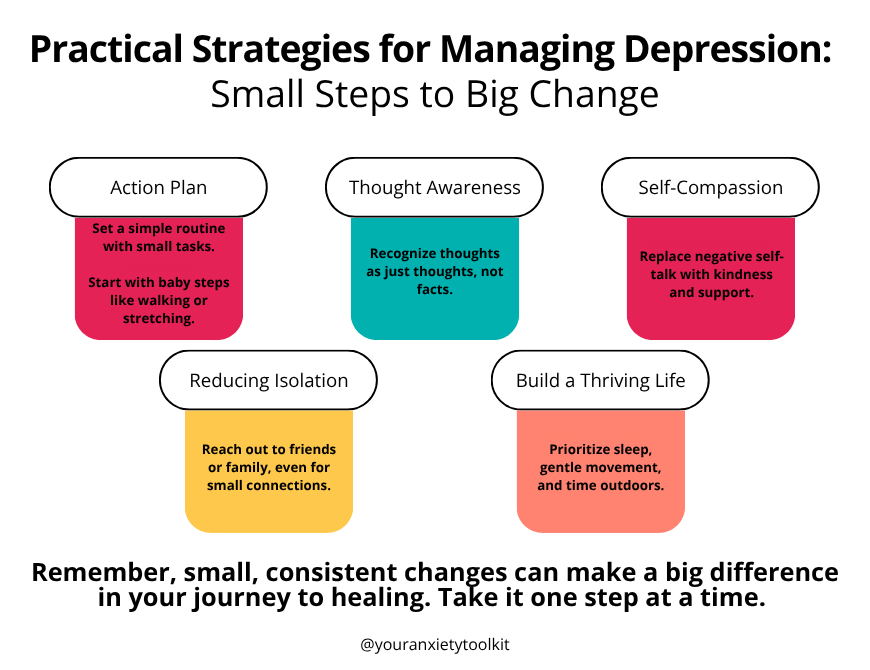
1. Behavioral Activation: Starting Small and Building Momentum
Depression often convinces you that there’s no point in doing anything. However, behavioral activation is about creating structure and engaging in small, manageable activities each day. Even the simplest tasks, like brushing your teeth or getting outside for a brief walk, can break the cycle of inactivity.
Tips for Implementing Behavioral Activation:
- Set a Routine: Plan your day in advance with small tasks like getting out of bed at a specific time and completing a simple activity.
- Focus on Baby Steps: Start with small, achievable goals like stretching or making a meal, and gradually increase the complexity of your activities.
- Get Moving: Even light physical movement, like stretching or walking, can help regulate your nervous system and combat depression.
2. Cognitive Diffusion: Distancing Yourself from Negative Thoughts
One of depression’s most dangerous lies is that your thoughts are facts. Cognitive diffusion helps you separate your thoughts from your identity, teaching you that just because you think something, doesn’t mean it’s true.
For example, if you’re feeling like a failure, you might think, “There’s no point in trying.” Cognitive diffusion teaches you to observe that thought without buying into it. Recognizing that negative thoughts are just thoughts—and not truths—empowers you to act in line with your values, not your feelings.
3. Self-Compassion: Breaking the Cycle of Rumination
Depression often leads to rumination, where you repeatedly focus on negative thoughts and self-criticism. A powerful way to disrupt this cycle is by practicing self-compassion.
Ways to Practice Self-Compassion:
- Be Kind to Yourself: Treat yourself with the same care and understanding you’d offer a friend who’s struggling.
- Radical Kindness: Challenge your inner critic and replace negative self-talk with compassionate, supportive language.
By doing this, you shift from an internal dialogue that perpetuates depression to one that nurtures healing.
4. Reducing Isolation: The Power of Connection
Isolation is one of depression’s most insidious side effects. It can feel like you’re all alone in your struggle, but the truth is, connection is vital for healing. Even if it’s hard, reach out to friends, family, or online support groups.
How to Reduce Isolation:
- Reach Out: Send a text, make a phone call, or take a walk with a friend. Even if you’re not in the mood to talk, just being around others can lift your spirits.
- Create New Rituals: As a personal example, I decided to break my own cycle of isolation by moving my office out of my home and into a larger workspace. This new environment has helped me reconnect with others and reduce feelings of loneliness.
5. Building a Thriving Life: Small Changes for Big Impact
Finally, it’s important to build a life that supports your mental health. Start by focusing on:
- Quality Sleep: Aim for 7–9 hours of restful sleep each night.
- Movement: Incorporate light exercise, such as stretching, walking, or yoga.
- Sunlight: Spend time outdoors each day, as natural light can have a positive impact on mood.
The Road to Recovery: Take It One Step at a Time
It’s important to remember that there is no quick fix for depression, but with consistent effort, you can start making progress. Practice these strategies slowly, with compassion for yourself along the way. Healing is a journey, and every small step counts.
Final Thoughts: You Are Not Alone
Depression can feel isolating and overwhelming, but the good news is that there are proven strategies to help you regain balance. Whether you’re managing depression yourself or supporting someone else, it’s important to know that you’re not alone. By applying small, manageable strategies and practicing self-compassion, you can begin to reclaim your life.
If you’re ready to take your next step, explore more tools through resources like CBT School’s Overcoming Depression Course. It’s time to stop beating yourself up and start healing with kindness, one step at a time.
The podcast is made possible by NOCD. NOCD offers effective, convenient therapy available in the US and outside the US. To find out more about NOCD, their therapy plans, and if they currently take your insurance, head over to https://learn.nocd.com/youranxietytoolkit
Transcription: Why Depression Is on the Rise (& Powerful Skills to Help Manage)
Rates of depression have skyrocketed, and no, it’s not because people are too sensitive or they’re not trying hard enough. It is because the world has changed in ways our nervous systems. Haven’t even caught up with yet. Today we are unpacking why depression is on the rise, and more importantly, I’m going to teach you the practical evidence-based skills that are helping people feel like.
That are helping people feel like themselves again, welcome back to your anxiety toolkit. My name is Kimberly Quinlan. This podcast is your go-to resource for all things anxiety, OCD, and mental health. This is a place where you can leave all the fluff behind and access specific. Effective and compassionate tools that are science backed and tested by me and my clients in my office.
Whether you are, whether you’re struggling with depression yourself, or you’re supporting someone who is, this episode is here to give you the tools, hope and fears, compassion. So let’s go.
So before we get started, let’s talk about the actual statistics. I have the notes right here. I printed them out. This is directly from the CD, C. And what they’re saying based on their research is that depression in the unit. What they’re saying is that depression in the United States with adolescents and adults has increased by 60%, six zero in the last decade.
The overall prevalence is that females have a depressed rate of 16%, so 16% of females are depressed and 10.1% of males. Are depressed. That is a large, large number of people who are dealing with depression day in and day out.
Now, what’s really important to understand is the functional impact of depression. 87.9% of people with depression reported difficulty functioning at work. Home or socially, and 31.2% reported extreme difficulty performing daily activities due to their depressive symptoms. If that is you, you need to know that you’re not alone.
You’re definitely not lazy. You’re definitely not weak. This is an important topic that we have to keep touching on so that you feel less alone and you stop beating yourself up.
So let’s now talk about why depression is on the rise. Why all of a sudden is it that we’re having these high, high extreme rates of depression? Well, number one, we know that there are cultural pre. Number one, we know that cultural pressures are crushing us. There is an overwhelming hustle culture. You have to be in constant productivity to prove your worth.
Now, this is not true. We don’t actually believe this to be true, and it’s not a fact, but we. In our deepest, darkest place, we’ll believe this. We will also be spending a lot of time comparing ourselves on social media to other people, making us feel like we’re not enough, that we need to be more. We need to be better.
We need to be more beautiful. We need to be more productive. We need to be more successful. Adding to this ongoing feeling of depression, hopelessness, helplessness, or worthlessness. We also have a massive loss of community here. We’re experiencing the highest rates of loneliness we have ever experienced as a human race that we can document.
And this altogether has definitely come to increase Our depressive has come to increase the rates of depression. Now. The second thing here is our nervous system is on total overload. We are chronically stressed. We’re being asked to achieve more than we ever have. We do not have enough recovery time in our day to day.
We tend to work, work, work, work, work. Then achieve, achieve, achieve, and we don’t have enough quality rest. And we have a massive dopamine dysregulation issue because of the high level of technology that we are consuming. We are constantly being fed and stimulated by technology causing us to feel over overwhelmed, overstimulated, and in often cases, causing us to feel complete nervous system overwhelm.
Now the third thing, and this is where it really hits deep for me, is the pandemic aftershocks. We are experiencing massive degrees of grief and trauma and isolation from the effects of COVID-19. Now you might think, Kimberly, it’s 15. Now you might think, Kimberly, it’s five years ago, like surely we’re over it.
I cannot tell you how many of my clients are only now starting to recognize the impact that COVID-19 has had on them. Let me let you in on a little secret of mine. Only recently. I’m still working from home, and only recently did I realize. That I’m still living like it’s COVID-19. I still work in a sort of makeshift office that I created downstairs in our home.
Since that first week of COVID-19, I’m still using a table that. I don’t really love. We just whacked it together and put it there. And I sat in a corner and I started to work and I’ve been working there ever since. And I don’t think I realized how much staying in that environment has caused me to feel lonely, misconnect disconnected.
Um. Depressed in some, some days I leave my office feeling gloomy until I realized, wait, I’m still here five years later in the same room that hit when COVID-19 hit
a for me and like a lot of my clients. And I’m guessing you, you might be still realizing this sort of delayed impact of, so you might be sorry.
So if you’re anything like me, you might be having that delayed emotional response to that experience. We also have massive degrees of rising rates of substance use, burnout, procrastination, addiction. From COVID-19. So I think there are so many reasons why you might be feeling more depressed now than you did even five or 10 years ago.
Now the next piece here is the economic and climate anxiety. We are so uncertain. There is so many people who write into me every single week saying, I have so much anxiety about our economic situation, the climate situation, our political situation. Internationally, there are wars and this has created a deep sense of loss, a deep sense of trauma, a deep sense of grief for people, um, around the world and in our country.
It is everywhere. It’s on the news. It goes everywhere with us. It tells. So I can’t even go to the grocery store without someone making some kind of political statement. I can’t go to a dinner party without it getting awkward because of political, um, disagreements. It’s everywhere. And it is heavy on our nervous system.
And we are afraid. We are scared for our race, our beautiful human race. And this can massively. Increase the chances that we struggle with depression.
One last thing that a lot of my young clients are reporting, even my children and my children’s friends, is this sort of deep sense of existential dread. Um, what is real, what’s valid? What is the point of life? What are we here for? I feel so much pressure. What is my purpose? It wasn’t that long ago that my 10-year-old CR came to me and cried ’cause he was afraid that AI was gonna take all the jobs he had heard someone at school say, it doesn’t matter because by the time we finish our school, AI will take all the jobs.
And he started crying and I can’t blame him. It’s very, very uncertain times. Um, and so again, to validate you, there are many reasons why depression is on the rise.
So I don’t list all those off just to make you feel worse. You already feel heavy with grief and loss and sadness and hopelessness. My goal here is to validate you so you don’t feel so alone so that you can stop beating yourself up for having depression. And next we’re gonna get to some skills and tools and strategies you can use to get you back on track.
There are. Evidence-based strategies, you can start to apply in baby steps, a small baby steps one at a time, and get you back to a degree of functioning that you feel is good for you or to bring some joy and pleasure into your life.
So. So what can you do? What are some powerful science-based skills that you can use, uh, to help you in the day to day, really things that you can actually practice in the day to day and get you up on your feet, literally and figuratively. Well, let me tell you something here I thought was really interesting.
The CDC did say that only 40% of individuals age 12 and up with depression were actually receiving. Counseling or therapy. It said that 43% of females were receiving therapy who had depression and 33% of males. And it got me thinking, what are the other, you know, 50% or 66% of people doing out there? Are they struggling alone in silence?
And do they have those skills? So. Let’s do it here. If you know someone who’s struggling with depression or if you are, share this with anybody that can help us to spread the word so that they can get the help that they need as well. Here we go. Thing to remember as we move forward here with these skills is none of these are going to be a silver bullet.
These are going to be things that you will practice in time with patience, with compassion, knowing that baby steps lead to middle-sized steps and middle-sized steps leads, leads to massive, massive progress. So here we go. Number one is, uh. Behavioral activation, you guys, I talk with my clients about behavioral activation.
Every single day, and it may seem like it’s not that big of a deal, but it is a huge, huge deal. This is the science of doing, of doing and engaging in your life, so let’s look at it. Depression is always going to convince you. There’s no point. Don’t even worry, or it’s going to make you feel physiologically.
Physically so heavy that it’s gonna feel like getting out of bed and getting to the day. Brushing your teeth, brushing your hair, feels absolutely. Impossible. When we do behavioral activation, we create a schedule that gives someone enough structure so that once they have momentum and they’re up, it’s easier to keep going.
So behavioral activation is starting with. Tiny baby steps. Maybe it’s setting an alarm to get you out of bed at a certain time in the morning and doing one activity in the morning. Maybe it’s brushing your teeth. Maybe it’s brushing your hair, maybe it’s making a meal, maybe it’s getting outside. It’s creating a degree of structure that helps you.
Um, know what’s gonna happen next. You don’t have to use up a lot of mental space to figure that out. And when you have depression, even deciding when to brush your teeth can feel like an emotional overload. And so it’s setting a schedule ahead of time and having support to help you maintain that schedule so that you can.
Get back to a degree of functioning. Once you’ve mastered those few baby steps, then you add a few extra and you move on and on from there. We talk about this with all of our clients. Me, myself, all of my employees that work for me in my private practice. When someone reports that they have depression, the first thing is, let’s look at your schedule.
Does it have any variability? Has it got pleasure involved in your schedule? What are you doing to get out and move your body? It doesn’t have to be crazy busy exercise. It could be just a light stretch or maybe just rolling your neck and getting your, your shoulders loosened up a little. Anything helps.
The benefit of these two is sometimes when people feel depressed, they don’t feel motivated, and so often it’s not that we have to wait for motivation to come, it’s that we. Get going, and then the motivation comes. So often it’s just having a few routine activities that happen in the morning, in the afternoon, in the evening that help people stay in that movement of motivation.
The ball starts rolling, and then it’s easier to stay going. Often I’ll have rules with clients that they’ve agreed to. Like maybe we have the rule that you don’t lay down during the day. ’cause they’ll say, once I lay down, I can’t get out of bed. Or Once I pick up my phone, I can’t put it down and I lose a lot of hours.
So we create a behavioral system that helps them get unstuck with those behaviors.
Now the second thing that we’re going to practice is a skill and a tool called cognitive diffusion. This is the ability to observe your thoughts and recognize that just because you think something. Doesn’t mean it’s true. Depression is a big fat liar. It will tell you the most painful lies about who you are, the world you live in, the people around you.
It will lie about your future. And it will tell you only bad things are coming for you and that you are not worthy or you nothing is going to be able to help you get out of this depressive rut. Now, the thing to understand here is that just because you think it doesn’t mean it’s a fact. And what we wanna learn to do with this cognitive diffusion is learn to just observe.
The thought that you are having, we are going to learn to acknowledge that all that’s happening right now is that my brain is telling me a story. This story is not factual. It is not something that is going to make the Guinness Book of Records. You are not as bad as your brain is telling you you are, and that if we can acknowledge and observe those thoughts.
We don’t have to let those thoughts dictate what we engage in. An example of this might be if your brain says, what’s the point? You aren’t worthy of good things from happening, you’re gonna be a failure anyway. There’s no point even trying. When you have that thought and you don’t practice diffusing with it, you are more likely to give up, lay down, totally, avoid, procrastinate, and not do the things that you desperately want to be able to achieve in your lifetime.
However, if you have that thought, because you cannot control that thought, that is out of your control. If you have that thought and you observe. Oh, I’m having the thought that I’m a useless person or that I won’t have a good life, and that that’s just a thought. And I have thousands and millions of thoughts every day and year, and most of them, a lot of them aren’t true.
And you can learn to just label that as a depressive thought and not engage in its lies. You are more likely to then go back and engage in the things that you value that are beneficial for you and are in line with what’s important to you most. The cognitive diffusion is a metacognitive skill that you can use with any condition, including anxiety, depression, um, any kind of OCD, any kind of intrusive thoughts.
Um, you can use it at any point and it can be so beneficial. Not to take everything you think as a fact.
Now, of course, one thing we mention in all of our courses over@cbtscore.com is that we must practice compassion first. Always, we say this in all of our courses. We actually have a course called Overcoming Depression. It is a step-by-step course that’s going to take you through an in-depth explanation of a lot of the tools that we’re using here.
You can head over to cbt school.com to learn about that. Um, you’ll go to cbt school.com/overcoming depression.
The cool thing about this course is it is a step-by-step course. I’m going to show you exactly what I do with my clients. It’ll help you to reduce rumination. It’ll help you to improve how kind and gentle you can be with yourself, and it’ll help you get a rhythm and a system down that works for you. If you’re interested, again, head on over to cbt school.com/overcoming depression.
Now, as you know and I’ve said it already, depression is a liar. It’s going to say some pretty cruel things to you, and so you are going to need to have a self-compassion practice to that again, if you’re being fed lies. All the time, over and over repetitively. It’s very easy to start to believe it.
Remember, a thought is not a fact, and often a belief is a thought that you’ve had so many times that you do start to believe it and you do start to treat it like it’s a fact. And most of the time all of the things I hear my clients say, or my loved ones say, who have depression. Is not true. They might be the most wonderful people.
In fact, a lot of my clients or people I know with depression are sometimes the most beautiful human beings I have ever met. They bring so much joy and wonder to the world, and yet their brain is telling them that there’s no benefit to them, that there’s nothing good for their future, and this could not be more heartbreaking for me to witness.
What we wanna do here is we wanna learn how to practice radical kindness. Radical unkindness could be in the words you use. It could be in the tone of the voice you use towards yourself. It could be in the actions you engage in the kindness, most gentleness, respectful actions towards yourself. It could be your general expectations on yourself.
Often people are depressed. As we mentioned at the beginning of this episode. They’re depressed because of the expectations they have placed on themselves and the pressure that our society has put on them. And so a compassionate act would be to have more realistic expectations and give yourself some slack, open up some space for you to rest, to rejuvenate, to breathe, um, to be good enough instead of being perfect all the time.
It is too much and we have to. Commit to being radically compassionate towards ourself.
Now, a really important thing that I’m going to encourage you to really practice is to break the cycle of rumination. Depression is a. Depression is a disorder that is maintained by depressive rumination. That is the behavior where you ruminate on how bad you are, how bad your future will be, how much they hate you, how much you don’t deserve good things, and that rumination.
Only creates that narrative and strengthens it again, it makes it so you start to believe your thoughts. And so what we wanna do is we wanna learn how to intercept that rumination, catch it, and redirect ourselves back to either something we value. Or this present moment, what do you hear? What do you see?
What do you smell? What do you taste? Now that might seem so simple, but it’s not. It’s very, very difficult and requires a lot of repetition, but with practice and good strategy, it is something that will benefit you. And it will help you break that cycle of depression. Again, in our mind, it might be a very scary place, and so we need to have some mastery over not going down the spiral of whatever depression says and treating it as if that is true.
So there are a couple of. So there are two more points that I wanna make here, and these are probably the most important. Number one, it’s to reduce isolation. As I mentioned to you, I’ve recently realized I am living a pretty real. I am living a pretty isolated life here in my home office, and CBT school has so much room to grow.
I’ve personally made the decision because of this episode. As I was reading my notes, I thought, you know what? I need to follow what I’m saying. So I’ve made a decision and I’m going to reduce how much isolation I’m engaging in. I got an office in a big office building and I am building out CBT score.
Headquarters. We are going to have a podcast studio there, a YouTube studio there. I’m going to see some clients there. I am going to do all of my admin there. I’m going to write a book. I’m going to have retreats. I have decided I refuse to engage in this isolation game anymore. We have to, no matter how depressed or how sad and alone we feel.
Sometimes the best thing we can do, even though it’s very hard, is to push ourselves to get back into connection. Who can you call? Who can you text? Who can you take a walk with? Even if you don’t talk, if you’re not in the mood for talking, maybe you could ask them, could we take a walk together? Just side by side.
Whatever you can do to be in connection with people, even if it’s on online forums, that’s fine. My hope is that if you could take a baby step and reach out to someone, ask for help, ask for a therapist, a support group, whatever it might be, we can hopefully reduce that isolation and that in and of itself will reduce your significant that in and of it.
That in and of itself will reduce the, that in and of itself will reduce your experience of depression. Now, the. Okay, now the last thing goes back to that behavioral activation, and it is building out a life that you feel you can thrive with. This involves getting enough sleep, getting a little bit of body movement.
Doesn’t have to be exercise. That’s very intense. It could be just stretches, it means, um, getting enough sunlight. Research shows that even getting out in nature. That in and of itself can help reduce the degree of depression. Some people feel, again, none of these are going to be a one one hit wonder, but building it together as a part of a long-term plan will helpful.
Will help you create a depression recovery plan that you can maintain and over time, reduce those symptoms. It is so important that you build small baby steps. You don’t throw yourself into all of these. Maybe you take one or two to start and you build on them over time.
So folks, that is what I want you to leave with today. Let’s review what we’ve learned. There are so many reasons why depression is on the rise, and one thing we know the reason is not is because there is something wrong with you. It is not because you are lazy. It is not because you are weak. It is not because you are not worthy.
There are real. Cultural and societal and environmental stresses that have increased the rapid rate of depression. But that doesn’t mean we have to lose hope. There are many helpful skills that you can use, like behavioral activation, like cognitive diffusion, getting outside, moving your body, mindfulness, compassion work.
Going to see a therapist if you have access. If you don’t, again, please do reach out to cbt school.com and see if there are any resources there that would be appropriate for you. Do not feel alone here. There are so many people going through this. Chances are if you are willing to let someone know that you’re having a hard time, that they know someone or they themselves are going through the same thing, so you’re not alone.
Be as gentle as you can. And remember, as we always say, it’s a beautiful day to do hard things. This is not gonna be easy, but with practice and with kindness every step of the way, we can do those hard things. And I say this to all my clients. I’ve never had a client say they regret doing this hard work because the long-term benefits.
Are way wider than just your mental health. They can impact so many areas of your life. Okay guys, thank you so much for being here. If you enjoyed this, please do subscribe, share it with anybody you think may get one nugget of helpful information because if we can, we might be able to reduce somebody’s, we might be able to reduce someone’s suffering, and that is the biggest gift we could ever give.
Have a great day.
