What If I’m Not Enough” Is Not a Confidence Problem (It’s an Anxiety Trap) with Paul Gilmartin | Ep. 486
In this episode, I sit down with Paul Gilmartin to talk about the hidden fear of “not being enough,” how it quietly fuels anxiety and shame, and what actually helps us heal from it.
- I share how the fear of “not being enough” can drive perfectionism, overworking, people-pleasing, and even disordered behaviors
- Paul and I talk honestly about shame, compulsive productivity, and the exhausting pressure to constantly prove your worth
- We explore why reassurance, success, confidence, and achievement never fully quiet the fear for long
- I discuss how vulnerability, connection, and self-compassion can help loosen shame’s grip
- Paul shares powerful insights from his own recovery journey and what support groups taught him about worth and healing
- We unpack the myth that there is a final destination where you suddenly feel completely “enough” forever
Content
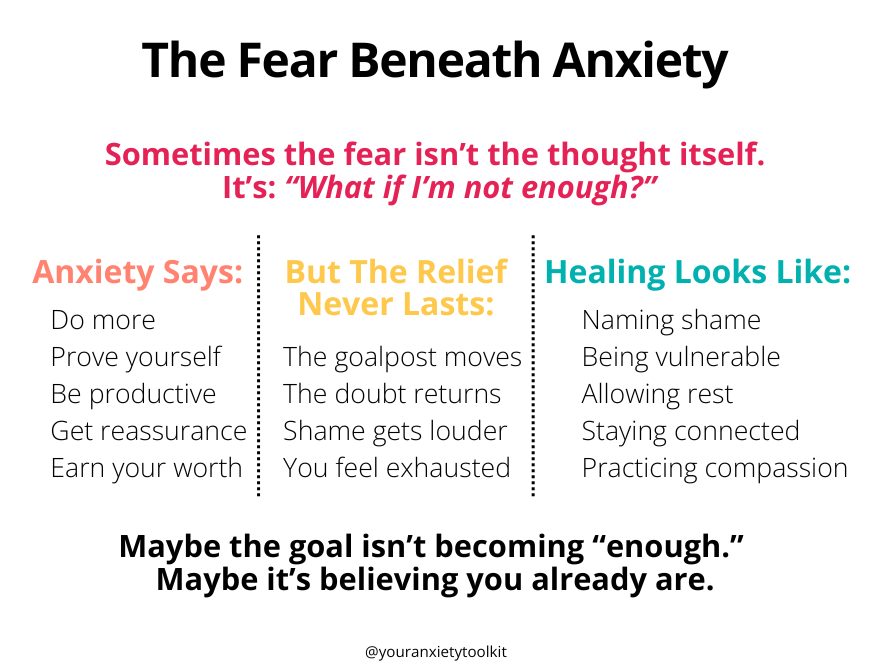
The Fear Beneath Anxiety: “What If I’m Not Enough?”
There is a fear that sits underneath almost every anxiety symptom I have ever seen. It’s not just panic. It’s not just intrusive thoughts. It’s not just fear about health, relationships, or whether you locked the front door.
It’s this:
What if I’m not enough?
What if I’ll never do enough, achieve enough, give enough, or be enough?
In this episode, I sat down with Paul Gilmartin to talk about the hidden fear that fuels so much anxiety, shame, perfectionism, compulsive productivity, people-pleasing, and self-punishment.
Because the truth is, many of us are not just afraid of failure. We’re afraid that failure would confirm something terrible about who we are.

The Core Fear So Many People Carry
During our conversation, Paul shared something that I think so many people will recognize immediately:
- “I don’t have enough.”
- “I don’t do enough.”
- “I’m not enough.”
And for many people, there’s also the flip side:
- “I’m too much.”
Too emotional.
Too anxious.
Too needy.
Too flawed.
It’s like living with two opposite fears at the same time:
- Not enough of the “good”
- Too much of the “bad”
I hear this in my clients all the time. Someone may come into therapy talking about panic, OCD, relationship anxiety, or perfectionism, but underneath it all is often this deep fear that they are fundamentally inadequate.
Why Trying to “Fix” Not-Enoughness Keeps You Stuck
One of the biggest traps we fall into is believing we can finally solve this fear once and for all.
So we try to:
- Achieve more
- Be more productive
- Get reassurance
- Build confidence
- Earn approval
- Look better
- Please everyone
- Become successful enough
And for a moment, it works.
You feel relief.
You feel accomplished.
You feel validated.
But then the fear comes back.
Usually louder.
Because anxiety doesn’t actually want resolution. Anxiety wants certainty. And certainty around self-worth is something humans can never fully achieve.
When Productivity Becomes a Coping Mechanism
One thing Paul and I both talked about was how this fear can fuel compulsive productivity.
For me personally, this showed up in my eating disorder and in periods of overworking and overachieving. There was this constant drive to prove my worth through accomplishment.
And the tricky part is that sometimes the world rewards that behavior.
People praise you for working hard.
They compliment your success.
They admire your discipline.
But underneath it can still feel like:
- “I should be doing more.”
- “I haven’t earned rest.”
- “I’m falling behind.”
- “I need to prove myself.”
The relief never lasts for long because the goalpost keeps moving.
The Hidden Cost of “Never Enough”
Living with this fear can take a huge toll emotionally, mentally, and physically.
It can lead to:
- Burnout
- Anxiety
- Depression
- Self-loathing
- Disordered eating
- Perfectionism
- Workaholism
- People-pleasing
- Compulsive self-denial
Sometimes we become so used to depriving ourselves that it starts to feel normal.
Paul shared a beautiful story about simply allowing himself to buy breakfast tacos after physical therapy instead of denying himself something enjoyable. To someone else, that might sound small. But for people who constantly feel they have to “earn” care or pleasure, moments like that can feel incredibly meaningful.
Many people who struggle with not-enoughness are constantly trying to justify their existence through productivity or sacrifice.
The Myth of “Arriving”
For a long time, I believed there would eventually be a moment where I would finally arrive at feeling enough.
Like one day I would:
- Heal enough
- Grow enough
- Achieve enough
- Become confident enough
And then the fear would disappear forever.
But honestly, I think chasing that destination actually slowed down my healing.
Because every time the fear returned, I interpreted it as proof that I had failed.
What I’m learning now is that two things can exist at the same time:
- I can genuinely feel confident, grounded, and fulfilled
- And I can still have moments where I feel not enough
Both can be true.
Shame Often Sits Underneath the Fear
For me, shame is deeply connected to this struggle.
Sometimes there’s this quiet underlying message that says:
- “You should be better by now.”
- “You shouldn’t still struggle.”
- “You’re failing.”
- “Something is wrong with you.”
One thing that has helped me is simply naming it.
Instead of fully fusing with the feeling, I can pause and say:
- “Oh, shame is here.”
- “Shame wants me to isolate.”
- “Shame wants me to hide.”
- “Shame wants me to stay silent.”
Naming shame doesn’t necessarily make it disappear, but it can create a little bit of space between you and the emotion.
And sometimes that space matters.
The Healing Power of Vulnerability
One of the most meaningful parts of healing for both Paul and me has been vulnerability and connection.
There is something profoundly healing about being able to tell another human being:
“This is what I’m struggling with.”
And instead of being rejected, criticized, or abandoned, you are met with presence.
Not fixing.
Not rescuing.
Not judging.
Just being seen.
So many people believe they must hide the parts of themselves they are ashamed of. But shame grows strongest in secrecy.
Connection weakens shame.
You Cannot Shame Yourself Into Feeling Worthy
Toward the end of our conversation, Paul said something incredibly powerful:
“Nobody has ever shamed themselves into being the person they want to be.”
And I truly believe that.
No amount of self-criticism will finally make you worthy.
No amount of punishment will finally make you enough.
No amount of achievement will permanently erase insecurity.
Because worth is not something you earn through perfection.
Worth is inherent.
What Actually Helps?
Healing from not-enoughness is not about eliminating every insecure thought forever.
It’s about changing your relationship with those thoughts.
Some things that can help include:
- Practicing self-compassion
- Building safe relationships
- Allowing vulnerability
- Reducing compulsive reassurance-seeking
- Letting go of impossible standards
- Resting without earning it
- Engaging in meaningful hobbies
- Connecting with supportive communities
- Learning to identify shame when it shows up
- Allowing yourself to be human
For many people, healing begins when they stop trying to prove their worth and start allowing themselves to exist without constantly earning it.
Final Thoughts
If you recognize yourself in this conversation, I want you to know something important:
You are not alone in this fear.
So many people walk around carrying this quiet belief that they are somehow behind, flawed, failing, or fundamentally inadequate.
But your worth is not dependent on:
- Your productivity
- Your achievements
- Your appearance
- Your perfection
- Your anxiety symptoms
- Or how “together” you seem
There is no magical finish line where you finally become worthy enough to deserve rest, love, care, or compassion.
You are already worthy because you are human.
Transcription: “What If I’m Not Enough” Is Not a Confidence Problem (It’s an Anxiety Trap) with Paul Gilmartin
Kimberley: There is a fear that sits underneath almost every anxiety symptom I have ever seen. It’s not panic, it’s not intrusive thoughts, and it’s not the worry about health or relationships or whether you’ve locked the front door. It is this: What if I’m not enough? What if, at the end of it all, I’m just fundamentally not enough, not as a partner, not as a parent, not as a person?
And here is what makes this fear so insidious. The harder you try to answer it, the worse it gets. You seek reassurance. You collect evidence. You build a case for your own self-worth, and it works, but just for a little while, and then the doubt comes right back, and this time louder. Today, we have Paul Gilmartin.
He’s the host of The Mental Illness Happy Hour, and someone who has sat with thousands of people in their darkest places, and we are going deep into this fear, where it comes from, and why trying to answer it keeps you stuck, and what actually moves the needle. Paul, welcome to the show.
Paul: Thank you. Thank you so much for having me.
I always, I always enjoy talking to you.
Kimberley: For years, you have been interviewing people on The Mental Illness Happy Hour, which is, like, a very successful mental health podcast. Sitting with people in those really honest moments, is this a fear you’ve heard other people suffer from?
Paul: Yes, and in my support groups as well.
Even if they don’t quite say that, you know, of all the experiences I’ve shared and heard other people share, you can kind of distill it down to one of- three things, if not all three at the same time, which is some version of, “I don’t have enough, I don’t do enough, I’m not enough.” Yeah. And, and maybe even a fourth one at the same time, which is, “I’m also too much.”
Kimberley: Yeah. “I’m
Paul: not enough of the good, I’m too much of the bad.”
Kimberley: Yeah. It’s like the same, it’s a different side of the same coin.
Paul: Yeah.
Kimberley: And you said that to me in a conversation you and I had privately. You know, this core fear of you’ll never have enough, I’m repeating what you said, you’ll never do enough, and you’ll never be enough.
And I so deeply resonate with that. You know, just being this, like I said, this insidious fear that just is lurking at the basement of your brain- Yeah … all the time. I hear it in my clients, like, all the time. They might be worried about relationships or career, but there’s that underlying fear of that I just, it’ll never be enough.
Paul: Yeah. And, and questioning it, um, I, I really like what you said, and I needed to hear that, about looking for an answer just feeds it.
Kimberley: Yeah. So l- before we get to that, you’ve been open, even publicly, about your own struggles. What does it feel like? Like, can you kinda give me a little snapshot of what does it feel like in the day-to-day to have this as your core fear?
Paul: Exhausting. You know, there are times that it takes a vacation, and it’s mostly around my productivity, which I know isn’t healthy, that, that my self-esteem should not be contingent on how much I’m doing, but there it is And that’s is influenced by how other people talk to me or treat me. But I also do go to my support groups, and I’m in therapy, and I’d like to think that I’m a fairly emotionally seeking person.
I was gonna say evolved, but I’m not sure I’m ready to use that word yet. Um, so it’s a roller coaster. I have moments where I’m, like, so at peace with life and everything else, and then, you know, I’m beginning to realize that it is the insidious thing that drives my addictive behaviors because I’m, I’m not even questioning it.
I’m just assuming, yes, I am lazy. Yes, I have blown it. Yeah.
Kimberley: You use the word drive, and that, that actually is quite compelling to me because that’s how it feels for me, too. Like, if I was to explain it for myself, and I have struggled with this, like, I think this was underlying my eating disorder. A lot of what I have done in my life, even though it’s created a lot of success, was, was driven, like you used the word drive, was driven by this fear that it– you will never be enough.
Like, it is a driving force But the pr- like, I think that piece that for me, I’m not gonna put words in your mouth, but if I’m not being driven or driving in that direction, it’s like an emptiness for me. Like, a not enough-ness is like a empty void of nothingness, is the only way I could describe it.
Paul: And also kind of itchy.
Yeah. Like, just r- restless. You know, there, there’s a- Mm-hmm … a saying in recovery, “Restless, irritable, and discontent.” And I don’t necessarily relate to the irritable so much anymore, but the, uh, restless and discontent, I feel that. Yeah. So when I find something I enjoy, whether it’s woodworking or guitar or whatever, or an unhealthy coping mechanism like pornography, I run the wheels off it, because, oh, I’m out of the room that feels like it’s burning.
Why would I wanna go back in the burning room?
Kimberley: Yeah. I think my eating disorder was that unhealthy coping with not enoughness. It’s,
Paul: it’s so shocking for me to hear that from you, because every time I see you, I always feel like, oh my God, Kimberly has it so together. She’s so peaceful. She’s so knowledgeable.
She’s so pleasant without being phony. She’s so real and grounded. And it’s a combination of, like, awe and also, like, God, I wish you were my mom.
Kimberley: But I think
that’s the funny… You saw me, I burst out laughing when you said like, “Oh, I’m surprised you feel that way,” because I think for me, and this is where it gets complicated, is I’m a very confident person.
I feel very whole and fulfilled and enough and worthy, while at exactly the same time feeling not enough and like I’m not doing enough, and like I’ll never be enough. Like, they’re at the same time now. And so it’s like, uh, for me, it’s like even in my absolute peace with my body, myself, like c- like confident, genuine confidence, not arrogant confidence, it’s still there.
For me …
Paul: that, you know, that makes sense. And yet another thing that I needed to hear, and I, I suppose that’s, uh, probably why it’s good that I downloaded the book No Bad Parts- Yeah … and have it, have it on my reading list. Yeah. And I have therapy in about a, an hour and a half, so, um, maybe, maybe we’ll talk about this.
Yeah.
But yeah.
It, it’s… The concept of two seemingly opposite things being held in our mind or our bodies at the same time was news to me a few years ago. Mm. And that we didn’t have to arrive at a decision of this was good or this was bad- Yeah … or this person is good or this person is bad.
Kimberley: Yeah.
Paul: But there’s the light and the dark, and they’re actually one.
Kimberley: Well, and you bring up a good point, is I think that we have maybe… A- and I’m working this out in real time, just so everyone knows. Like, I don’t wanna seem like I’m, like, an ad- expert in this area. I’m working this out in real time, as, you know, I’m guessing we all are in, to some degree. I used to feel like there was an arrival at when you felt enough and worthy, and that is the goal, the destination.
I actually think that that goal slowed down my work in this area. Like, it made it feel like you were not enough because you could never be enough, if that makes- Right … any kind of sense. Right.
Paul: And it’s that very mind frame is the thing that’s pushing you backwards- Yeah … you know, to u- to use air quote, uh- Yeah
you know, whatever backwards means. Yeah. Rather than just saying, “Oh, this is a part of me,” that, that- Yeah … that voice, and it’s not something I need to extinguish to move forward. It’s maybe something that I need to have compassion and curiosity about. Yeah. But those are hard for me, ’cause I’ve been a catastrophizer my whole life.
Kimberley: Right.
Paul: And a people pleaser. That’s interesting. Yeah.
Kimberley: Yeah. Why d- do you think, and what’s your opinion on why some of us struggle with this and some of us don’t?
Paul: That’s a good question. I, I think some people aren’t self-aware. I think some people go through life believing that the thing on the surface is actually the thing that’s also underneath.
Mm. Whereas any of us who’ve delved into therapy or support groups know the thing on the surface is very rarely what it’s about. You know, the argument with your spouse about who put the forks away wrong is not about the forks. Mm-hmm. You know? Mm-hmm. Uh, it’s a, it’s about a conversation that happened two months ago that was never discussed because we didn’t want confrontation or to identify our needs or stand up for ourselves or have an uncomfortable moment.
So I think a lot of people really think that when they’re pissed off in traffic, that it’s just about traffic.
Yeah.
Rather than, you know, for instance, if I get in, in traffic and I’m anxious, which I don’t think is unusual or, like, sick if you’re feeling like that. Yeah. But I try to ask myself, “Is there something more underneath this?
Am I afraid of something? If I am late, if I don’t get there on time, if this takes an hour longer than it’s supposed to, is my life gonna be ruined? Is my friendship with the person who’s, you know, potentially waiting there for me, is that gonna be ruined? Will they not be understanding? What is eating at it?”
Yeah. And almost all of these things always come back to those, those three things that may be fundamentally so flawed and lazy and incapable and doing life wrong that I’ll never get it, quote-unquote, right, and I’ll never hit that goal of peace.
Kimberley: Yeah. I agree. It’s funny. I wonder sometimes, like, is it just us anxious folks who just, because we care so much about being a good person and making an impact in the world, is that why?
You know, is it the messaging we got as children? I think the big trap that some people fall in, that I see in my clients, is they think that fact that they’re having the thought must mean it’s true, that people who are enough don’t have these thoughts because they’re enough, and the reason they’re having the thought that they’re not enough is because they’re not enough.
Yes. Which is absolutely not true.
Paul: I forget that all the time, and I need people like you who I- look up to. I need to hear you talk about your struggles. Uh, you know, it’s, it’s one of the reasons why I started the podcast was because when I found these conversations in my support groups, they were so soothing to me.
I looked back at my darkest moments before the support groups and thought, “God, I could have used that, hearing that.” And I thought, “Well, why don’t I do a podcast that kind of brings comfort to people and it won’t be like, oh, you know, we’re, we’re teaching down to them. We got it all figured out. It’ll be more like a waiting room where people crack fucked up jokes and, you know, cry and laugh and cringe and all the other shit that we, that we do- Yeah
when we’re having coffee with a friend or … Yeah.
Kimberley: Yeah, I think we, you and I had this, started this conversation because we were just telling about what our biggest fears were,
right? Like, we were like, “What’s your biggest fear? What’s your biggest fear?” And it’s like, “Well, mine’s just that I’ll never have enough, be enough,
you know, do enough.”
So yeah. For sure. Absolutely. Okay. So I think you touched on this already, and I see a lot of people do this, I did this myself, is we try to fix the fear of not being enough by building confidence, getting people to like us, having your therapy maybe focus on self-esteem or succeeding in material things or career things, productivity, like these things outside of us.
Now, as you know, I have a private practice. I have six amazing therapists in Calabasas, California. However, we do not take insurance. Now, if you are looking for insurance-covered OCD or BFRB treatment, I want to let you know about NOCD. NOCD provides face-to-face live video sessions with specialized licensed OCD therapists.
Now, their therapists use exposure and response prevention. We know this is the gold standard for OCD, so you can be absolutely confirmed that you’re in the right place there, and they have a clinically proven app that helps you stay connected to your therapist and others who have OCD between sessions.
So you’ll always feel supported. Now, the cool thing is NOCD is available in all 50 US states and even internationally, and they accept most insurance plans, making it affordable and accessible.
We love that.
Now, if you think you might have OCD or you’re struggling to manage your symptoms, you can book a free call.
Just click the link in the show notes at nocd.com. I am honored to partner with NOCD. I want to remind you that recovery is possible. Please do not forget that. Now, big hugs, and let’s get back to the show. I, I actually, I’ll tell you a personal story which is really funny is, and I still have been doing this and, and my husband laughs when I do it, is I’ll say, “Oh, by the way, I did the dishes.”
And he’ll be like, “Thanks.” Like, I have– I was announcing that I did the dishes, not because it was, like, such a big surprise, but I wanted him to go, “Thanks, Kimberly. You’re amazing for doing the dishes.” I’ll,
Paul: I’ll put it on the tote board.
Kimberley: Here is your medal for doing the dishes. And, and so it’s this product- it’s this compulsive productivity to relieve us of our not enough-ness.
That’s for me, maybe not for you. Oh,
Paul: no, absolutely. When my girlfriend comes home from work, I’ll often, especially if I had a day where I, you know, checked things off the to-do list, I can’t wait to tell her about it because I have a fear in the back of my head that she’s always thinking, “Wow, how did I wind up with this fucking loaf?”
You know?
Kimberley: Yeah. And so how has that shown up for you in your li- I mean, this is more like we’re talking about the costs of having this core fear, is that it, for me, like let’s, if we did a tally, like it caused me to engage in some pretty bad eating disorder behaviors. It’s caused me to work beyond my capacity and cause a, like, a s- a significant degree of exhaustion and even some me- medical illnesses of just because that drive that you talked about before, like that’s something that I think I’ve done.
Like, a lot of sort of maybe even like workaholic behaviors sometimes used to show up a lot, and sometimes I can catch them now even. What does your tally list look like?
Paul: Depression, anxiety, self-loathing, a lack of self-care. Today I got out of physical therapy, and there’s this restaurant across the street from it that I would look at every time I would come out of physical therapy and I would say, “God, that food looks good over there.
I shouldn’t spend the money on it. Uh, I’ve got food in the refrigerator. I’m, I’m gonna go home and eat.” And I eat probably 95% of my meals at home, mostly for financial reasons, but, uh, also ’cause I don’t leave, like leaving the house. But a little voice in my head said, “Go take care of yourself. You are worthy of having a couple of breakfast tacos.”
And I did, and I felt really proud of, of myself for doing that. And I suppose to some people listening, they’re thinking, “What’s the big deal?” But if you’re somebody who doesn’t, who isn’t familiar with self-denial, it’s such a sickly comfortable place to be because it feels right. Like, like I’m living right, life right.
If I can’t accomplish, at least I can deny. myself stuff. Mm. It’s like a backdoor way of trying to make up for the lack of- Yeah … productivity. Um-
Kimberley: Compulsive self-punishment.
Paul: Yeah. Yeah, those, those are some of the ways.
Kimberley: Yeah, you, you, you bring a, a really good point there, and I’m wondering, just for the sake of curiosity, is did eating out, eating those really lovely tacos make you feel like you deserve them?
Paul: Yeah. Mm. It, it was a moment like, of course. Yeah. Why wouldn’t I do this? Isn’t this why I work and earn money- Yeah … and live my life to, to have moments of pleasure? Yeah. You know, especially moments of right-sized healthy coping mechanism.
Kimberley: Yeah. I, I’ve actually heard quite a few clients say the same thing, which is like, let’s say you’re someone who is hyper-productive or compulsively productive to sort of feed that you have to do enough, be enough, you know, have enough.
But when they actually rest, they feel more enough. Like, they feel better about themselves than if they were pushing, pushing, pushing. Like, it’s, it’s counterproductive. I’m so
Paul: jealous. I’m so jealous of, of that, and I suppose they’re jealous of the person who can go sit in the backyard and look at the sky.
I, I have no problem doing things like that. I feel like my day has too many things, not necessarily where I’m super present and feeling my feet on the ground and stuff like that, but where I’m just kind of being. It’s a little bit- Yeah … in my mind, a little bit too daydreamy, but certainly not go, go, go, go, go.
Um- Yeah … unless I’m experiencing some hypomania, and then I’ll be in the garage making furniture till 2:00 in the morning with the tips of my fingers starting to bleed- Yeah … and don’t even wanna go in and go to sleep because it’s just like this glass of water in the desert that- Yeah … I’ve been thirsting for forever.
Kimberley: Right. So interesting how we do that. So you talked about the breakfast burrito. In your lifetime and in your journey or, like, your s- s- you know, your life, what has helped with this not enough-ness, this fear that you’ll never be enough? Is there anything? You know, of course, I’m not cured of this. I would never, you know, I don’t think that’s- Right
needs to be the goal. But as we move through this process, what has helped you? What has been baby steps, medium-sized steps for you?
Paul: Uh, I think meaning and purpose through, um, my support community, uh, through deep conversations, vulnerability. Vulnerability has really helped because it reminds me that we’re way, way, way more than just what we do, that maybe the meaning of life is about the giving and receiving of love and, and feeling connection.
And for people who’ve experienced childhoods where- A lot of trust was breached. That can be kind of fraught with landmines, whether they’re real or imagined. So when I was forced to stay alive, to begin to go to support groups to save my sanity, I discovered it was this beautiful silver lining where I was like, “Oh, wow, this is amazing.”
And that little clock in my head that was always ticking, you know, kind of telling me, “Oh, you’re, you’re running late for life. You got time to make up,” it just, it quiets for that hour and a half when I’m there or when I get off the phone call with somebody who needed a shoulder- Yeah … to lean on or, or vice versa.
So in those moments, I feel enough. I feel like this is where I’m supposed to be. So I try to find things, create that feeling, this is where I’m supposed to be, regardless of money or this or that. My hobbies are another place where I feel that. When I play hockey, I feel connected to my body, my masculinity, um, my male friends.
It’s… When I woodwork, I feel connected to the analytical part of my brain and the artistic part of my brain. I, I love the presence that’s required to work with your hands, especially around sharp tools. You have to be completely focused when you’re working around- Yeah … razor-sharp tools. Uh, playing guitar, sometimes it’s the only way that I can express melancholy, um- Yeah
things I can’t find words for. I c- I could… Sometimes on the podcast I’ll say, “I don’t know how to put into words what I’m feeling, but here’s a song that I just wrote,” and, uh, it’s just instrumental, but, um, sometimes that’s the best way to describe- Yeah … how I feel. So in those moments I feel authentic.
Kimberley: Yeah.
Paul: I think doing things that are authentic to me, even if it’s canceling plans- Yeah … because I’m just too anxious or exhausted or filled with dread to go do something, um, that I know is not gonna kill me or make me miserable. But oftentimes life, leaving out my front door or even just, like, washing the dishes feels like jumping into a cold pool.
Yeah. And like everybody’s telling you, “Water’s fine
Kimberley: Yeah
Paul: And I’m just like, “No, it’s gonna be brutal.”
Kimberley: Yeah. I think for me, it’s so linked to shame. It’s so linked to just this, like, a- again, we use the word insidious, like this just underlying tempo, consistent tempo of shame that I… What’s been really helpful for me is to actually just call it shame and acknowledge it as shame and be like, “Oh, shame’s here.
Like, shame doesn’t want me to do that. Like, shame doesn’t want me to say that. Shame wants me to be s- like to isolate,” or, “Shame wants me to…” I, I, f- for me, sometimes just that has been super, I wouldn’t say helpful, ’cause it doesn’t lift anything, but it gives me a little distance.
Paul: Yeah. Yeah. Right? And, and y- you’re really good at creating that space for other…
Well, I’ll speak for myself, for me to be able to, uh… ‘Cause I’ve shared some God-awful thoughts in my head with you, and you just are like, “Oh, that’s awesome.” “Thanks for sharing that with me.” And we both kind of laugh together, and I’m like, “Wow, why was I feeling about just thoughts-” Yeah … “that, that I have in my head?
Why am I judging myself?” But I can honestly say I don’t think I’ve ever gone an entire day without some type of shame. Yeah. I think it is my core emotion. Yeah. Yeah. And I think that’s kind of the next level of work for me to do, is to deal with the, the mean voice in my head and the shame, which seem to go hand in hand.
Yeah. And find a way to, I don’t know, live with them, make peace with them. I, I don’t know what the, the words would be for that, but I’m, I’m tired of feeling ashamed because it feels- Yeah … so real. Yeah. And it’s… And I feel shame about almost every single thing in my life. Yeah. I feel shame about, am I a good enough boyfriend?
You know, I didn’t do this right. Uh, oh, that piece of furniture, I fucked up on it, or I overshared with that person, or I missed my support group meeting, and on and on and on- Yeah … and on. It’s so judgmental.
Kimberley: Yeah. No, and I think that that’s, those two go hand in hand. I, I will say, like, and I, I really wanna highlight what you said before, is I have found the most helpful thing for the fear of not being enough is in the sharing.
It, some of the things that have happened to me that I am most ashamed of, and when I felt the most shame, whether I’d done something shameful or not wasn’t even a part of it, is when I would sit across from a friend and I s- I remember saying, “I’m gonna tell you something really hard, but then I don’t wanna talk about it.”
Right? And it was two friends, and I would share with them, and I would tear. And then to both of them looked at me and just nodded and held eye contact, and then one picked up her book- And the other one picked up her phone, and we, we just went into silence. But for me to be held in, like, “I can tell you something and you can hear me.”
Yeah. We eventually talked about it, but just, they understood the assignment. Like, they just understood it. And for them, the fact that they just went back to their book and went back to their phone was a, a learning for me of like, oh, people can hold space for me in my crap. Yeah. Like, I remember when you and I were sharing, and then I was like, “Okay, let’s have a hug.”
And you were like, “Oh my God, you still wanna hug me?” Like- … so relieved.
Paul: Oh, man, sexual shame has, has been at my core for, uh, since I was a little boy. Yeah. Since I was a little boy. Yeah. Uh, I’m c- I’m curious what the shame was, if you’re comfortable sharing, uh, that you shared with your, uh, friends.
Kimberley: It was when I was struggling the most with my own, uh, intrusive thoughts and my own PTSD and, and the…
I think I had… It’s funny. We talk about, like, the, the, the facade we build up. I had built a facade with myself that I wouldn’t emotionally or mentally hit rock bottom ever again. Like, I was so evolved that-
Do I relate to that … I
would transcend some, like, that I’m sort of, um, there’s an insurance policy on me, and I, it’s just impossible to hit rock bottom.
And when I did, I felt like I had failed.
Paul: Yeah.
Kimberley: Um, because I truly think I had to- told myself that I had out, um, performed it, like I had grown beyond it. And I think that with mental health, like, you can do all the work in the world and still have a r- a rock bottom.
Paul: That’s good to be reminded of, because the mean part of my brain immediately goes to, “Well, see, you kidded yourself.
You didn’t really do the work.”
Kimberley: Yeah. “
Paul: You didn’t really heal. You didn’t really take stock of your past and, you know, your foibles and et cetera, et cetera.” And I think the other thing I struggle with, you know, I believe in a higher power. I just often believe that it doesn’t get me. You know what I mean?
Mm-hmm. Like, it doesn’t realize I want more fun than it has planned for me. Mm. The, and that my life, that the life it has laid out in front of me is a life of broccoli, and it doesn’t realize how much I love pizza. You know what I mean?
Kimberley: Yes. Yeah, I know. I think, um, we had a conversation with Drew Linsalata here on the podcast not long ago about how our brains have an exception clause.
They’re like, “No, it’s true for everybody else- Yes … but I’m the exception.
Um, I’m special somehow,” in not the better way. Right. Like, you know, I’m in the special in the negative direction, um, which I always resonated with.
Paul: Uh, the same side of, of s- this other side of the coin of grandiosity. Yeah. And they’re both ways of keeping us obsessed about ourselves.
Kimberley: Y- yes, and focused on just the neg- the negative. So- Yeah … yeah. Yeah.
Paul: I think our egos will do anything to avoid the truth that we’re one of many. Mm. I think it’s terrifying. Mm. And yet that’s where I have felt the most peace- Yep … in my life, sitting in a support group meeting and just feeling like, “Oh my God, they get me and I get them.”
Yep. “This is amazing.”
Kimberley: An equanimity that we’re all the same. Yeah. That we’re all equal in the h- in the worth hierarchy.
Paul: Mm.
Kimberley: Okay. I have loved this. So if for someone who’s listening, and they may have probably recognized themselves in so many areas of this conversation, is there anything that you would want them to hear, or maybe something you need to hear that, you know, that is a main piece of this work?
Paul: I would say nobody has ever shamed themselves into being the person they wanna be.
Kimberley: That’s it. And I would add, no one has ever worked themselves into being, like, unconditionally worthy, right? Like, you… There’s no amount of money or looks or check marks that you will get that will actually land you on the day where you’re like, “I’m finally enough.”
Paul: I used to have this fantasy that… And this was years ago when I was still working in television. I used to have this fantasy when I would drive down Sunset Boulevard, and you’d see the billboards for all the, you know, popular shows. And I used to think, you know, if that means you made it, if your face is on a billboard on Sunset Boulevard.
And one year, the TV show that I was working on, they put my face on a billboard on Sunset Boulevard, and so I got in my car and I drove over the hill, and I got out and I looked at it. And in that moment, I lost respect for Sunset Boulevard. And I’m not making a joke. And that’s when I realized, oh, there is something bottomless- Yeah
inside my soul that I’m trying to fill, and this is never going to be enough. And it wasn’t until I got into support groups years later that I was introduced to the concept of you’re worthy of unconditional love just because you are.
Kimberley: Yes.
Paul: Just because you are alive and you’re- Yes … a human being.
Kimberley: Yes. I resonate with that so much.
I talk with clients with, all the time with eating disorders, ’cause I remember that. You would say, “I’m enough if I e- ma- hit this weight,” a certain weight. And you’d hit there, but then the target would move, and you’d be like, “Oh, okay then. Fine. I’ll get to the next step. I’ll lose the next-” You know, however many And you really believe it And then you bust your butt off, and then you would get there, and then you’d be like, “No, the target moved again.”
Paul: Yeah. I’m still, I’m still restless and discontent. Yes. I must need to do the next step.
Kimberley: Yes. Yes. Well, I am so grateful you’ve been and had this really vulnerable but beautiful conversation. I think the truth is it’s a, it is a moving target and, and it’s a journey, but it doesn’t have to be one that is, like, done.
Paul: Yeah. I, I needed to, to hear all this stuff that, that you had to say and the things you’ve shared with me in our private conversation. It just, uh, it means, it means a lot to me.
Kimberley: Thanks for being here.
Please note that this podcast or any other resources from cbtschool.com should not replace professional mental healthcare.
If you feel you would benefit, please reach out to a provider in your area. Have a wonderful day, and thank you for supporting cbtschool.com.
