The Secret to Calming Climate Anxiety (Even When the News Feels Like Doom) with Sarah Jaquette Ray | Ep. 457
This episode turns climate anxiety from paralyzing doom into doable, feel-good action by blending nervous-system care, compassionate mindset shifts, and practical, community-centered steps.
What you’ll learn:
- The real shape of climate anxiety (it’s more than worry)—and how to name guilt, grief, anger, and solastalgia without spiraling.
- Why “pseudo-inefficacy” makes small actions feel pointless—and a simple ladder for turning tiny wins into collective momentum.
- How to audit your media diet and “feed what you want to grow” with solutions stories that boost hope and agency.
- Mindful, body-based skills to stay regulated (plus NVC and self-compassion) so you can act from steadiness, not panic.
- A smarter question than “What’s enough?” that replaces carbon tunnel vision with pleasure, people, and local power.
- Concrete starting points—neighbor networks, school/work green teams, shade/heat projects, and policy touchpoints—that actually build resilience.
Content
Climate Anxiety: From Doomscrolling to Doing (with Compassion)
Featuring insights from Kimberley Quinlan, LMFT, and guest expert Sarah Jaquette Ray, PhD — author of A Field Guide to Climate Anxiety
If headlines about wildfires, floods, or record-breaking heat leave a knot in your stomach, you’re not broken or dramatic—you’re human. That ache has a name: climate anxiety. In this episode, Kimberley talks with scholar and educator Sarah Jaquette Ray about how to meet those heavy feelings with wisdom, connection, and meaningful action that actually feels good.
What Is Climate Anxiety (Really)?
Climate anxiety isn’t just “anxiety.” It’s a bundle of emotions—grief, guilt, fear, anger, helplessness, even homesickness for places changing before our eyes (what philosopher Glenn Albrecht calls solastalgia). You might notice:
- Doom about the future
- Guilt about consuming or “not doing enough”
- Powerlessness in the face of a global problem
- Cognitive dissonance: “Do I keep living my life as usual… or change everything?”
Therapy take: Naming your emotional mix reduces shame and opens space for choice.
Why It Feels So Overwhelming
The “Pseudo-Inefficacy” Trap
When a problem is massive, our brains tell us: “If I can’t solve all of it, my small actions don’t matter—so why try?” That belief kills motivation.
Reframe: Your impact isn’t measured only in tons of carbon. It’s measured in community trust, resilience, habits you enjoy, and networks that scale change.
Individualism Makes It Worse
We’ve been sold a story that only our consumer choices count. But climate solutions are collective—in neighborhoods, policy, schools, workplaces, and relationships.
Skill: Ask, “Where do I have influence beyond my shopping cart?” (parent, neighbor, voter, volunteer, professional, faith or school community member).
A Listener’s Question: “How do I raise kids with hope?”
Parents often feel climate anxiety more intensely—love makes the stakes feel higher. The tension (keep life as promised vs. pivot everything) is real.
What helps:
- Name the dissonance without rushing to fix it.
- Model values in community: kids learn hope by seeing adults collaborate.
- Advocate up and out: push for systemic solutions where you live (city council, school boards, local climate plans).
- Nourish joy on purpose: hike, garden, read solution stories together; purpose grows from pleasure.
Your Media Diet Matters: Feed What You Want to Grow
Our attention is a garden. If we only water catastrophe, we crowd out agency. Solutions journalism and local wins boost efficacy and inspire action.
Practice:
- Curate a solutions feed (one “do-something” story for every doom story).
- Share what’s working (repair cafes, heat-tree plantings, mutual aid, transit wins).
- Ask weekly: “What else is true?” Hold both the sorrow and the good.
Do You Need Hope Before You Act?
Short answer: No. As Greta Thunberg says, “Do the action first, and hope will follow.” Action produces moral and social reward signals that keep you going.
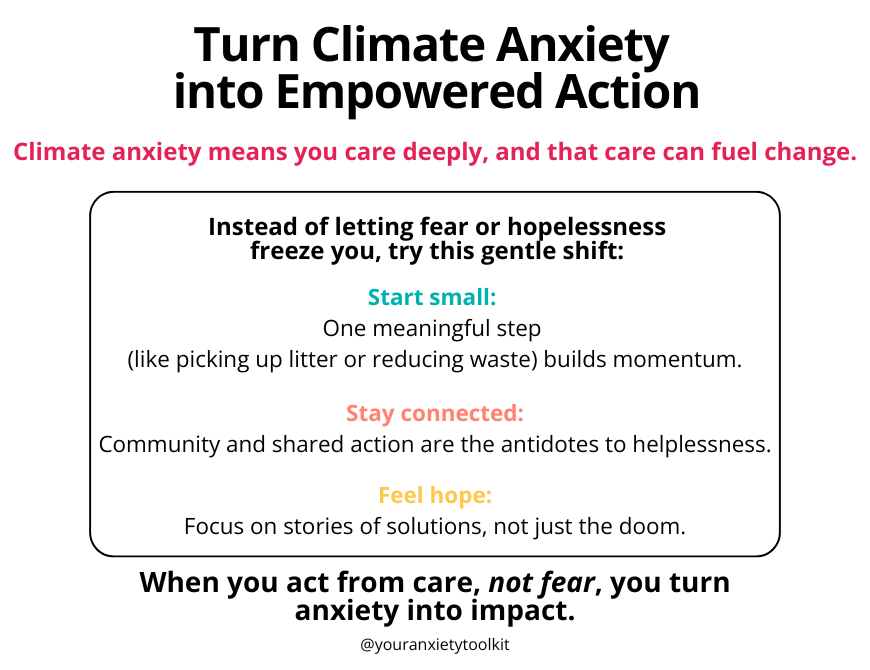
Micro-to-Macro Ladder
- Do one tiny thing you enjoy.
- Repeat until it’s automatic.
- Invite one person.
- Join a group or start a mini-project.
- Aim at local systems (policy, institutions, budget decisions).
Emotional Skills for Climate Wisdom
1) Mindfulness with Two Truths
- Truth A: The risks are real.
- Truth B: Living only in catastrophe immobilizes me.
- Skill: Hold both. Ask, “What perspective keeps me engaged today?”
2) Nervous System Care
- Notice when you want to numb or avoid; offer the body something regulating: breath work, nature time, movement, co-regulation with safe people.
3) Nonviolent Communication (NVC)
- Map intense reactions to unmet needs (safety, meaning, belonging, effectiveness). Then meet those needs skillfully rather than doom-scrolling.
4) Compassion (for you and others)
- Shame burns people out. Compassion keeps you in the game—and softens polarization with neighbors who see things differently.
“How Much Is Enough?”
There’s no cosmic tally. The “enough” framing comes from carbon tunnel vision (and yes, that footprint tool was popularized by BP). A better question:
“What actions feel meaningful, connect me with others, and are realistic to sustain?”
Consider three lenses:
- Pleasure: Make climate work intrinsically rewarding (gardening, biking with friends, community dinners).
- People: Prioritize relationship-building; knowing your neighbors is a top resilience move.
- Power: Go where decisions get made (school site councils, zoning meetings, budget hearings, union/association committees).
Quick-Start Actions That Actually Build Momentum
Personal (but social!)
- Pick one joyful habit: weekly litter walk, “meatless Monday potluck,” bike-bus day, tool-sharing with neighbors.
- Start a solutions thread in your group chat or parent community.
Home & Block
- Map your block: shade, heat, flooding, elders, language needs. Share contacts, create check-in trees for emergencies.
- Plant native shade trees or pollinator strips; apply for free trees if your city offers them.
School & Workplace
- Join/launch a green team; pilot a zero-waste event, heat relief plan, or e-commute policy.
- Advocate for cool roofs, shade, HVAC upgrades, air filtration, and hazard days policy.
City & Policy
- Show up (kindly, consistently) to planning and budget meetings.
- Support measures that fund transit, shade, cooling centers, and safe routes to school.
Rule of thumb: If it builds connection + capacity, it counts.
Mindset Shifts to Keep
- From doom to dignity: We can’t do everything; we can do something together.
- From purity to plurality: Many partial solutions beat one perfect one.
- From solo to social: Individual wellness fuels collective action—and vice versa.
- From scarcity to delight: Make climate work pleasurable; joy sustains effort.
Try This This Week
- Name your climate feeling (one word).
- Choose one 15-minute action you’ll genuinely enjoy.
- Text one person to join you.
- Replace one doom source with a solutions source.
- Notice your body after—any shift in tension, breath, or mood?
Resources & Where to Learn More
- Sarah Jaquette Ray – books, articles, and podcast Climate Magic
- Solutions Journalism Network – stories that spotlight what’s working
- Local city/county climate office – grants for trees, shade, and resilience
There are a thousand joys and a thousand sorrows in this work. Let your actions be small, kind, relational, and repeatable. That’s how we grow courage—and a livable future—together.
The podcast is made possible by NOCD. NOCD offers effective, convenient therapy available in the US and outside the US. To find out more about NOCD, their therapy plans, and if they currently take your insurance, head over to https://learn.nocd.com/youranxietytoolkit
Transcription: The Secret to Calming Climate Anxiety (Even When the News Feels Like Doom) with Sarah Jaquette Ray
Kimberley: Have you ever felt a knot in your stomach where you see headlines about wildfires, floods, or record breaking heat, that sense of grief and guilt and fear, and even Doom has a name. It’s called Climate Anxiety, and the good news is that. This episode is gonna help you move through those heavy feelings and discover a more helpful and hopeful, empowered approach.
Today I’m joined by the amazing Sarah Jaquette Ray, the author of the Field Guide to Climate Anxiety right here. And a leading voice on how to navigate this very real human experience. Now, together we’re going to unpack why climate anxiety shows up, how it impacts our mental health, and most importantly, how we can turn it into resilience, connection, and meaningful action. Um, that actually feels hope. So thank you so much for being here, Sarah.
Sarah: Thank you so much. It’s a pleasure.
Kimberley: Okay. For those who have never heard this term, can you first just clarify what is climate anxiety?
Sarah: Yeah, I think you defined it really well in your intro right there. One of the things that, uh, it is characterized as, as sort of a mixture of a lot of different emotions that oftentimes because people don’t associate their responses to things like climate change as emotional, they don’t necessarily parse it out in the same way that you would if you were thinking about your mental health and categories.
That we’re used to. So the guilt and the doom and the sense of anxiety about the future. Um, the sense of powerlessness that you described so beautifully. I think all of those really capture what climate anxiety is. Um, the American Psychological Association has defined eco anxiety as. Sort of perpetual state of environmental doom.
And of course the fabulous, uh, Australian philosopher Glenn Albrecht is famous for making up a lot of words about the environment and our feelings and emotions about the environment. But he has a great term that’s helpful, I think too called. So nostalgia, which is a feeling of. Uh, homesickness or environmental loss in place, right?
So homesickness happens when you go away and you miss your home. But if you have environmental damage in your home place, you might experience something like that, but in place. And so nostalgia is a beautiful term to try to capture that. What I think is super interesting about climate anxiety though, is that it’s not really just anxiety.
I think people have really done a good job of saying, let’s. Sort of put a lot of emotions under that umbrella of fear and anger too. And, and even sometimes hope and resilience and, and joy can kind of go under that bucket too. Um, and I can explain that, why I would say that in a later answer maybe.
Kimberley: Yeah, I think you’re right. I actually had that same thought as I was looking at your book and, and reflecting a lot on my own. I was like, is not the predominant feeling that I feel. However I can see that’s. True for any anxiety or disorder as well, right? It’s not just anxiety, it could be uncertainty and doom and hopelessness and so forth.
So that makes entire sense to me. Um, I wanted to first, if I was okay with you, Reid, a question that was given to us from one of our listeners, just because I think it’s a. Great intro to our conversation. So they said, I am 37 with two kids. I’m not a scientist, and all I do, all I wanna do is live my life according to my values, but my anxiety makes me worry that I’m bringing up my kids to enjoy a world.
That will cease to exist. I want there to be something for them and all the children around the world, but all this science seems to be doom and gloom for the future. So how can I live with a healthy outlook?
Sarah: Hmm. Yeah. This is a, this is really good question that captures how climate anxiety feels. It often manifests really. Intensely when people, when they start thinking about having children. So that kind of question, being hinged around the role of parent and raising children in a world like this, I think can really bring out intense climate anxiety emotions.
So, uh, yeah, I wanna just validate that, that sense of doom about your children that you might not feel if it was just you, although many people do. Um, so there’s. The living out your values and living out the kinda life that you wanna live. I, I, I hear in that question this kind of, um, what psychologists often call cognitive dissonance, which I’m sure you’ve talked about in your show and other spaces.
I would say cognitive dissonance is one of the biggest emotions that shows up around climate anxiety that really deserves some unpacking. And this is kind of, do I keep carrying on with the life and the status quo that I sort of assumed I was promised and entitled to and didn’t even think of myself as entitled to just the normal life that, you know, I was raised around, that I see on TV that my politicians and my family tell me I’m supposed to have?
Or does climate change based on what these scientists are telling me? Does climate change throw all of that into question and does that mean. Everything is gonna be upended and you know, nothing that I expect to happen is, is gonna come to pass and I have to get ready for something completely, radically different.
That kind of uncertainty or not knowing what. Future. This climate science is telling us we can expect makes, it makes the climate anxiety even more intense. And I think the cognitive dissonance of, should I keep living this life that I thought I was entitled to, or do I have to give everything up because climate scientists tell me that this is really bad.
Um, we’re on this path towards terrible things. That cognitive dissonance is, is what I’m also hearing in, in the question too. This kind of, this pain of which, which reality is true. Um, you know, do I get to keep on living in the status quo or do I need to do something radically different? Uh, and I don’t have an answer for that.
I think that, um, client science, climate scientists are suggesting that something radically different is gonna have to happen. I think more of the social scientists and the folks who are thinking about human systems like economics and politics and culture and that sort of thing, have perhaps maybe more sophisticated answers about what that means for society and what that means we’re gonna have to do.
And I would certainly say that one of the reasons, one of the ways that cognitive dissonance can be eased is if we think that the adults in the room around us. IE the politicians and the lawmakers and, you know, business, you know, owners and corporate leaders are all taking this very seriously and are trying to make the right decisions so that we can sustain life into the multiple generations, our children and certainly children beyond that.
So if we saw that that was actually happening, um, it would ease our cognitive distance a lot, and we could say, okay, I’ll just carry on with my normal life, knowing that the people in power are setting everything up right so that this problem gets solved. But in truth, that’s really not what we’re seeing happening or at this moment, at least not in the US context for sure.
And I think that that increases that sense of cognitive dissonance and the anguish around climate, uh, especially for one’s children and grandchildren. Um, do I have an answer for that? I’d say, yeah, we do have to change everything, but really one cannot do it individually. That sort of idea of what, do you know, what sacrifices will I have to make in order to live in alignment with what the climate scientists are telling me?
I think that’s the wrong question. So I think is we’re gonna need this at a collective societal level, and wherever we can push on making that happen is, is really, is the best any individual can do.
Kimberley: So let me give you a little bit of my own story. I, I don’t know if this is helpful, but, um, where I grew up in Australia. We used to have what we call cleanup Australia Day. They still have it, but I don’t live in Australia anymore. But cleanup Australia Day was one year, day a year, and the um, everyone would be mailed out a bag and to each household, I think it was several, maybe one per person or per household, I can’t remember.
But then we would all go out and fill that trash bag with trash and it was just what you did in Australia, it’s how I was raised. It was so great. And so one thing I have. Tried to do in my adult life is when I, once a week I take the dogs for a walk or I take a walk by myself and I take a target plastic bag or whatever I have and I fill it. what I noticed recently in the last six months is I’ve stopped doing that and. I didn’t think about it until I had scheduled my meeting with you and to prep for this interview, and I thought, why did I stop doing that? And I think it is sort of this subconscious feeling of like, what’s the point?
Like, like
Sarah: Oh,
Kimberley: it really make?
Sarah: we go there? Can we go there?
Kimberley: And that’s why I want to go, that’s why I won’t bring it up because in your book you talk about this and it was a bit of an aha moment for me ’cause you beautifully explained this. Can you share your thoughts?
Sarah: I love this one. This is, you know, when I think about climate anxiety as a phenomenon, I’d say, and, and when I go around talking about it and I think about it with my students and everybody I’m interfacing with it, I’d say that the un, the most dominant quality about it is actually a feeling of, uh, what social psychologists call pseudo efficacious and.
The sense of not having power to be able to affect the conditions of this problem, not being able to tackle it because it is so big and I’m just one person. The scale of it and the, uh, intractability of it with all kinds of other problems just makes it feel so overwhelming. And something like going to picking up one target trash bag just feels like what is good?
I mean, it’s gonna make me touch trash. I’m gonna be unpleasant. I’m gonna have to find some place to put this trash when I’m done and what’s the point of it, right? Like it’s such a little tiny drop in the bucket. Some people also call this the drop in the bucket imaginary, which I think is a fun way of thinking about it.
But our sense of powerlessness makes us think we’re just a drop in the bucket. So whatever we do doesn’t matter. And I think that that’s a product of a lot of really good social justice movements, uh, explaining to environmentalists for a long time that personal change or lifestyle change or consumer change is not the.
Gonna be the biggest way that we’re gonna change all these problems that we really need system change. And so you might remember after Al Gore’s famous film and Inconvenient Truth, he had at the very end a bunch of personal things you can do to be helpful, like picking up trash and that sort of thing.
And. A lot of the kind of social justice or environmental justice movements sort of pushed back on that and said that that’s not gonna change the system. That doesn’t change the, the very system of disposability that’s built into capitalism that would make us need to pick up trash in the first place.
It’s just like putting a bandaid on the problem. And so there was sort of a swing back in climate spaces to saying there’s no such no personal change, no individual scale change matters. And I think we’re sort of in that, we’re in that soup, that byproduct of that, that pushback where a, a lot of people have come to believe that nothing that they can do personally would possibly matter.
And in an individualistic society where the individual is kind of the key agent of change, the key kind of hero of their own story. That is really damaging. If I can’t make a difference, I’m just gonna give up entirely. And pseudo and efficacy is a beautiful term that captures this, that basically says the feeling, the positive feeling that one gets from solving, um, a small part of a big problem is actually outweighed by the negative feeling of not being able to solve the whole problem.
And so we don’t do it at all. We don’t even try to solve the small problem e even like take off a little bite of it and try to fix it in our little corner of the earth. And so we just give up and I’d say, um, capitalist forces would, would want us to do that. It’s kind of a straight out a playbook that’s straight out of the tobacco industry to disempower individuals.
Uh, we saw that. Um, the carbon footprint activity that lots of people have used over, over in environmental education settings to figure out how much consumption they have and they do in this planet. Like, how much does my meat consumption cause carbon emissions into the atmosphere? And that was actually created by bp.
And so this idea of individualizing responsibility and blame instead of corporations taking responsibility and blame has been. Part of the plan all along. And so we are all kind of left feeling very powerless and all of that. And, and part of what I say to, to respond to that. Is, don’t surrender your power, you know, prematurely, we have way more power than we think.
Uh, capitalism defines our power kind of only in terms really as consumers. So we think we don’t have any power unless we have a lot of money, or that the only place to make change in the world is through our dollars and our spending. Um, and so I say, let’s reject that, right? We have all kinds of power and all kinds of other roles that we have in our lives, and I, I really try to get people to think.
Of the scale of the problem of global climate change, not in global scales, right? That we are going to need to build resilience and adaptation projects in the very neighborhood we live in. Uh, local politics have a huge impact on the health of the people who live around us. We can do so much at tiny, tiny, tiny scales.
Even just being able to have good relationships with your neighbors and build trust with your neighbors, or repair, bruised trust with your neighbors is a huge action because it turns out that the number one climate action we can do is to be friends with our neighbors. So things that we think about that are important for climate change, like picking up trash or you know, not driving a car.
Are just a very narrow band of what’s possible for what we could do around climate. So I like to have people really broaden what they think of as possible, as important climate actions. That relationship building is actually one of the number one things we can do around climate action because we really need to build those kinds of relationships so that we can do things together.
Um, something like trash might not even feel like it’s related to climate change. Like, oh, this is just a small thing against this mountain of a problem. But it turns out psychologically, there’s all these positive feedback loops that happen. We, if we pick up trash and it’s a tiny thing, just like nudge behavior psychology, we’re more likely to get pleasure from that and then do it again, or maybe even scale it out or find other people who do that and build a network, what other people are doing that so that we can really scale out the impacts that we have.
So we can either think of the problem as much smaller to tackle so it doesn’t feel so overwhelming that we’re not fixing the whole thing and we can combat pseudo in efficacy that way. Or we can see ourselves as a lot bigger than, than capitalism would like to us to think of ourselves and having a lot more avenues of power and magnifying our impact in a lot of ways.
And I would finally say, this is my favorite topic. I would, I’d say that pseudo efficacy is like the number one feeling that most people, I. I, I think, suffer from, I often say, well, if you have despair about the climate, you’re suffering from individualism. So this is sort of, you know, think differently about yourself in a wide, wide network of people who are trying to do good things and heal the earth and doing their part.
And if you’re not doing your part to pick up your little bit of trash, like they’re all doing it out. There, you know, and, and there is all this sort of, um, effect, psychological effect of if you think other people don’t care, you’re less likely to do stuff about it. And so if we go around only thinking that we’re surrounded by a lot of people who are just trashing the planet and we only look at those people and those are the only people in our consciousness.
We are much less likely to do stuff ourselves. And so we have to surround ourselves with people and stories and media that shows us examples of people, uh, leaning into solutions so beautifully. ’cause that’s what gets us up in the morning to wanna do that ourselves. So yeah, there’s a lot of strategies there.
I packed into a long answer, but thank you for opening that Can of Worms is my favorite question.
Kimberley: Yeah. No, I, I think, I mean, I think it’s really this, this learning about this and thinking about this and preparing for this episode has been really an emotional thing for me. I will add. I will add, and some people, if they’ve gotten this far into the episode, maybe you don’t, didn’t experience this, but I remember scheduling you being so exciting that you were gonna say, say yes to coming on the show and then having this feeling of like, I don’t wanna address this. Like, I don’t wanna deal with this. And I, very good friend of mine is very, very involved in, in, in the environment and climate change. And I remember messaging her and being like. I don’t wanna feel these, I don’t wanna feel this stuff. And I think that is so much a part of it as
Sarah: Hmm. Beautiful. I mean, I think, I think if you look at the nervous system, right? The nervous system receives information, and our bodies wanna either gravitate towards the thing that’s giving the information and say, oh, we like that, that’s, that’s chocolate. That feels good. Or it’s something like climate change, which we just, I mean, what nervous system wants to take that on?
On one level, we can’t even perceive it because it’s not a bear. Coming at us. So in terms of risk perception, theory, it doesn’t really tick the boxes of most threats that we have in our life. So it’s really hard to get our head around it. And then secondly, you know, it’s just so overwhelming that our nervous system, our, there’s nothing about the way our, our brains are wired.
And a lot of people have studied this in terms of cognitive biases. The cognitive biases that are already kind of, I wouldn’t say hardwired in our brain because of course everything is malleable in our brains. But the stuff that we’re kind of given. This, the, the, this, um, infrastructure we’re given in our brains doesn’t really want us to face this.
And, uh, it’s understandable, really understandable that, uh, even I feel most of the time I don’t wanna talk about climate. It’s too depressing. So, and yet I do it all the time. I, I think it’s the kind of exposure therapy for myself actually.
Kimberley: Yeah. Well, I mean, we talk a lot about exposure therapy here on this episode. Your, um, I know from your book you talked about, you know, in, in teaching. Students about this. Can you tell us about, um, maybe some of the, the process that your students go through? Um, I know you did mention what you called the nihilist stage of climate grief. Um, and so can you share like a little bit about how you, what sort of witness people go through this process?
Sarah: Yeah, I think this was the first inklings I had that this was something to study and get a handle on. Um, because I don’t have, I’m not trained as a psychologist either in prac, as a practitioner or as a scholar. And so this has all been stuff that I’ve researched in sort of the last 10 years of my career and put on a very new set of hats and expertises, which has been really fun.
But I’d say my students would come in with this kind of idealistic, you know, I got. Taught about sustainability in my club in high school, and I wanna save the whales and I’m gonna go to college and get a degree so I can do that more. And it’s so beautiful. It’s such a beautiful thing to see students walk into an environmental studies class with that, with them carrying that kind of idealism, and then they slowly start to take these classes and learn in politics and learn in science class and learning.
You know, geography, class, and my classes about how terrible things are because the vast majority of environmental educators have as what I call a scare to care tactic of pedagogy, where they’re like, okay, if we just give them the information about how bad things are, they will turn around and go out and fix the problems.
You know, the urgency and the extremeness and the alarmism will trigger in them the kind of motivation that will get them as the next generation to take up this task. It turns out that that was not working. What was actually happening was they were sort of spiraling off the cliff of nihilism. And so that’s sort of, I had this an emotional arc, like a, kind of like a hero’s journey, like Joseph Campbell’s idea of the Hero’s Journey or you know, various different kind of.
Um, the buildings, Roman trope from literature that there’s sort of a coming of age that happens where you go from being naive to wise and I, I call on this in my book, this sort of call to climate wisdom. You know, we all have to unfortunately grow up into climate wisdom and go through the wilderness experience and come back to society with some, some wisdom to bring to it.
And some dedication and motivation to really rise to the occasion. Otherwise, we’re gonna lose all these students off the, of the cliff of nihilism and they’re not coming back. And, and quite frankly, um, that’s, that’s literal too, right? I mean, the, uh, young people have serious mental health problems. Um, very rarely do we hear their mental health problems being discussed in terms of climate.
It’s mostly talked about in terms of social media and their relationship to technology. And I’d say that that is certainly a pull factor, but a push factor too away from reality is that the reality that they’re living in does not look very good. And if they could live in a reality that the adults in the room had made a little bit more positive for them, or they could.
Trust that their futures would be more stable. Um, they might not wanna go into their phones as much, right? So, I mean, sort of feel like, yeah, social media sucks for our young people’s mental health, but hello, reality doesn’t look that much better, you know? So can we, can we try to work on that instead of just pathologizing young people for wanting to go into their phones?
Um, so, you know, there’s a sense of, um. You know, the missing ingredient in understanding youth mental health is, in my opinion, climate change. Um, and so yeah, there the nihilism there, the mental health crisis around youth. Um. You know, the information that they’re getting often is unfiltered through social media and through all kinds of, uh, spaces that are designed to inflame their nervous systems, designed to make them feel alarmed, designed to make them feel outraged and, and furious, and they’re not, um, done through a lens of, you know, uh.
Child development or brain development or ethical consumption of information and news, much less through psychological understanding of what all this information might do to their ability to actually prepare themselves to address all these problems, which is, you know, in, in. In the end, for me it’s about what do they need psychologically, what do we all need psychologically in order to face these problems in whatever way we possibly can.
And, uh, avoiding it or nihilism, or disassociation, um, are certainly elegant cognitive solutions to the overwhelm we might be perceiving. But, um, they certainly are not gonna solve the problem, so, yeah.
Kimberley: You talk about, um, in your book about scrutinizing the messages you receive. Um, can you share what that looks like?
Sarah: Yeah, I mean this sort of, it is perfect dovetail for the last one too, because when we think about the vast majority of people, where do they get their information about climate change? How do they even come to know that climate change is a problem that they should do anything about or feel anything about for that matter?
And if we start to. Scrutinize where those stories are coming from. The architecture of those stories, the kind of longer traditions in which those stories are built, um, in sort of like the Anglo Western tradition. This is often through sort of the biblical Jeremiah or different types of sort of tropes of like humans have sinned and now we have.
We’ve been banished from the garden and now we have to recover from that in the sort of per perpetual guilt cycle that that causes. So there’s, you know, deconstructing the architecture of these stories is important in large part because the stories themselves give us a sense of what, imagining what’s possible.
We will never even. Try to build something into the future that’s better than what we think we’re getting handed if we don’t even have some compass, some direction, some vision, some radical imagination as to what is possible instead of this. So we need stories to tell us what is even possible, what alternatives to what we have is possible.
And the stories themselves can either leave us feeling completely empowered or completely efficacious. So if we have a story that, for example, tells us that all humans are bad and they’ve done this terrible stuff to the planet, we will likely feel a certain amount of self-loathing as a human. We might feel some misanthropy about other humans.
We might sort of wish ill on other humans. Compassion might be a lot harder for us to tap. We might give up on things like democracy and human systems ’cause we think they’re all failing the planet. Uh, we might do violence towards other people. There’s all kind of ways that a story that tells us that all humans are bad.
Can create a sense of, can actually be a self-fulfilling prophecy and make things worse and spiral even in worse directions. Or a story that, for example, tells us that, um, there’s nobody else out there who cares as much as I do. I’m alone in how much I care will make us really give up. Right? So there’s different ways that the stories that we can.
Consume and are exposed to, um, either empower us or disempower us. I think the biggest one that is most important is if the only story that we’re watching reading Consuming is about the mo big monsters in the room. And right now I consider the big monster in the room, kind of what’s happening in, in the capital of my country, like coming from the federal, from the federal, uh, direction.
This is. Going to make us completely blinded, sort of like a big sunlight. You know, like then the sun is blinding in your eye. You can’t see anything else around you. ’cause all you can see is this light. But if we were to shade out what was coming from that big, bright light of the big monster in the room.
We could actually adjust our eyes to what’s actually happening around all around us. All these beautiful things that are happening, what Paul Hawkin calls the blessed unrest, these hundreds of thousands and millions of people across the planet who are leaning into trying to solve these problems, who care deeply, who have so much compassion, who.
One of my favorite scholars and thinkers and activists is named Adrian Marie Brown. And Adrian Marie Brown says, we really must feed what we want to grow. And she calls on us to think of our attention being like, um, attention on a garden. There’s a parts of the gardens that we, you might, might not want to grow, like the weeds and the bramble and that sort of thing.
So the solution to that is not just to. Attack it and to tear it down and to pull it out. But simply by looking our, putting our attention and our, our affection and our love onto the parts of the garden that we do wanna grow, we will crowd out the monster in the room that way. And so there’s this sort of, you know, it’s easy to wanna go fighting the big, scary monsters in the room as your solution, but I think part of hacking the story or thinking differently about the story is.
Pay way more attention to the stories of all the beautiful things growing around us that we can just turn to anytime we want to and nurture ourselves. And by growing the good things, that is one solution to getting rid of the bad things. And I think the stories that we live in are critical for this.
This is why you have a huge movement happening in journalism called solutions journalism. Just the effect of reading and learning about solutions has an incredible psychological buoyancy, gives us great resilience. Oh, we are not alone. People know how to do this. They’re doing it over here. They’re doing it over there.
Oh, and maybe I could do that in my community. It has a real contagion effect and gives us a lot of empowerment. Um, so yeah, I, I, I call in my book for us to really pay attention to the stories that we consume and that we share. We might feel like we’re getting a big dopamine hit by sharing a story of something terrible and that we’re being politically vigilant by being on top of this bad news.
But it also has a consequence really of adding onto a big pile, like a Sisyphean Boulder for people where they just cannot fix the problem and makes us feel very powerless.
Kimberley: Yeah, I think if for me, just as a, um, as a consumer of social media or media in general, if someone reposts something really scary, I kind of wanna close the whole thing down. Whereas I do remember, and I can never, I’ll never forget this. I don’t know why this one story sticks in my mind, but I remember reading about this like 15-year-old kid who. Created or engineered, or maybe he designed or came up with the idea of this like crawler that crawls in the Pacific Ocean to that middle area where all the trash is just like accumulated. And they created this crawler that sort of circled around it until they could get it and then ship, pick it up with something and take it away.
And, and I, for some reason, that story sticks in my brain and I that makes me want to do. Better, whereas the negative story makes me wanna shut down
Sarah: Hmm.
Kimberley: everything.
Sarah: Yeah.
Kimberley: and so I I, I’ve really feel like I’ve lived that that’s that like you’re sharing, like the scary messaging doesn’t. Equal change. It almost reduces change.
Sarah: Yeah.
Kimberley: But yet hearing a friend of mine saying that they switched from regular washing detergent to, you know, washing sheets, like these little paper things that you come in a, a, you know, a, a decomposing box that excites me, like, that feels doable for me. That feels like a small one, one shift that I can make.
Sarah: Hmm.
Kimberley: I’m going on a different direction and I hope I, you can tell me if it’s not, you’re not comfortable answering this, but are you hopeful?
Sarah: It’s such a funny question because I think your listeners will probably go, oh, that question again. You know, this is sort of like, you know. Okay, if, if this person tells me after they’ve researched it all, they’re the expert on this topic. If they say they’re, that they’re hopeful, then I, then I’m off the hook.
Right? There’s this funny thing that happens with other people’s hope, you know, that, that we, we wanna hold onto it. And I think that the, if we examine our desire to tap other people’s hope to sort of get a hit vicariously off of other people’s hope, it might be that it’s coming from a place of, um, you know, that.
The sort of doom and gloom makes me so uncomfortable, and I just wants to get rid of that discomfort. It’s not actually about solving the problem. And so I think it’s an interest, an interesting question, and I, I find myself asking people it all the time too, despite everything I’ve written about hope.
I’m thinking, why did I ask them this question about hope? You know, it’s, I just wanna feel better. Can you make me feel better? Please? Um, and so, yeah. Yes and no. Say, but I don’t even know if that’s the point. I think that, um, you know, Greta Thunberg, the sort of famous youth climate activists, uh, who, who, who kind of kicked off Fridays for the future and the youth climate strikes in 2019.
She, um, is also doing all kinds of other stuff around Gaza now, and she’s still very active. Um, she has this sort of famous saying that says, you know, do the action first and hope will follow. You know, it’s not like you have to find hope and then it’ll give you the motivation you need to act. And I just think that that raises this question, you know, do we need to feel hope in order to do this work?
Maybe for some people, maybe not for others, but I think. The research, the psychological research on this topic is super interesting. It basically says you will feel more hopeful if you do more stuff. You know, like, so, you know, I, I sort of, I say, go do the stuff, right? And, and to your earlier point about the, the dishwasher, the, the washing detergent, you know, the small, tiny thing that feels doable.
Again, to like nudge behavior and to psychology. If we do tiny things and they feel good and we feel good and, and our bodies, and our minds like to feel good, whether it’s moral goodness or physical goodness, if it makes us feel good, we are way more likely to keep doing it and keep participating it. If we are driven to do our environmental work by negative feelings or so-called uncomfortable feelings like guilt, we are less likely in general to continue on that work for a long time.
This is all just assuming that our individual behavior is what matters the most, right? I mean, I, I wanna put that aside for a minute. You know, this is a big question. How much do our individual behaviors matter in all of this? I would say if, if your willingness to participate in action for the climate.
Is dependent upon you knowing that that action will make some kind of difference, some measurable difference, then you’re not asking a big enough question. You know, I mean, all kinds of, uh, you know, famous, uh, worldwide leaders from like Nelson Mandela to MLK will tell you that, uh, you know, you’re not going to necessarily see the results of your actions when you’re participating in a massive change.
Again, Greta Thunberg called on us to think in terms of cathedral time, cathedral thinking, meaning the people who built whatever cathedral she’s referring to, I can’t remember. Like they were, they knew that the cathedral was not gonna be built in their lifetime. It’s gonna take like four generations of people to build this cathedral, and yet they still felt their part in doing it.
And indigenous people will tell you. Not all indigenous people, but many indigenous traditions would say that we need to think about seven generations, hence our participation in seven generations. Hence, we’re just moving this project forward a little bit in our lifetime. And so I, I would urge people to say, instead of saying, you know, where’s the evidence that this is all gonna work, and then I’ll do it, or where’s the evidence that, you know, anything I do is gonna make a difference?
And then I’ll have hope. I’d say, you know, the answer to it is you’re, you’re, you know, you have to, you’re the one who has to morally go, you know, sleep at night and go to bed at night. And if you are morally, um, feeling like you’re living in alignment with your values, even if it’s at the micro, micro scale of changing your dish, your detergent in your laundry.
Uh, that is the kind of good feeling that will keep you doing it, and more likely to make you do things more at scale and more likely to find other people and build networks and do more of it. And frankly, that is what we need now more than anything.
Kimberley: Yeah, and it’s true too because if I ask you that question, do you have hope? Let’s say you said yes, that would probably last what, maybe 24 hours before I have to feel some feelings again. You know, maybe a week at most. I don’t know, like and so, but, but I. I guess still, I still ask the question.
Sarah: Yeah. Yeah.
Kimberley: Um, you do talk a lot about this idea of having that it, this work is as much emotional as it is. Act active that you have to have some emotional intelligence to, to, I wouldn’t say do this work. I, I don’t, I don’t know if that’s the right wording. Um, but I do agree, and a lot of what we talk about here is learning how to manage strong emotions. You know, some folks have written in and said, I feel so guilty for what’s happened that I myself of pleasure. Right. So as if they’re on the hook for decades before they were even thought of on this planet, or I am so angry, um, that I am become immobilized. You know what I mean? So, so how might we, um, look at this from an emotional standpoint? How do we act? You know, we’re here to talk about climate anxiety. How might we manage the actual emotions that. Go along with this process.
Sarah: That is such a good question and, and I do. It’s so beautiful that you’ve. Frame this in terms of emotional intelligence. And in my book, I talk about it in terms of climate wisdom because I love that so much of the research on this comes out of like spiritual traditions. And it’s not just sort of social psychology with this quantitative, you know, data, ways of saying we’re, we are in fact talking about truth here, um, about brains and emotions.
Um, so, you know, it’s a, it’s a much messier thing to be human, of course. Um, but you know. The practice of this often is very against most activist instincts about this. And I’d say part of the big awakening for me was that many activists, many people who work in environmental and climate spaces are burning out really quickly, including my students.
And I had that kind of experience with my students thinking, Hey, these are the pe, these are the people who wanna go save the planet. They don’t even need to be convinced, but then we’re burning them out or discouraging them, or they feel so immobilized by their anger. All those things you just mentioned.
And so they, they check out or they give up or they, you know, decide to go major in business and like, you know, live out the rest of their lives consuming till they die so they can live in a pleasurable life in that sense. Right. Hedon, hedonistic treadmill as they call it. Um, you know, so there’s the, there’s this kind of awareness of how.
Your confrontation with this information and this news is making your body feel right, that kind of first checking in, right? That stopping, taking a breath. I, I think mindfulness is an extraordinary, useful set of tools for this, um, observing what’s happening with yourself, which can take a lot of months and years to even figure that out, right?
I mean, I’ve been doing this work now for years and thinking, oh my gosh, I never really realized that the reason I do this harmful. Thing is because my ego is threatened in this particular way, that I’m somehow not a good person if I don’t do this thing this way. And you know, sort of you start to peel these layers of the onion back when you observe yourself so much and you start to realize what is at the root underneath all those layers of the onion.
That make me insecure, make me need to have this comfort in this way, or make me feel, uh, triggered or unsafe if I don’t have X, y, and Z in my life. Um, all the kind of basic needs. I think nonviolent communication is another beautiful technique of thinking about how our emotional reactions to things can often be rooted to unmet needs are the perception that needs will be unmet.
Um, doing that kind of inner work so that you can either kind of set that stuff straight. So sometimes that’s in trauma work. We often think, okay, we’re, we’re reacting to a situation, uh uh, that feels like an extraordinary threat. But the situation itself, if we have done the work, we realize it is not proportionate to the reaction that we’ve had.
That kind of like our amygdala and our anxiety detectors, which have, you know, historically and evolutionarily kept us, uh, alive and are, are beautiful things. We can do that work to say thank you, thank you for keeping me alive for millennia, you know, keeping me, getting me where I am. And this unique situation I’m in right now is not.
A saber-tooth tiger and I can be okay. And what is really going on in there? Do I have a need that I need to meet now? And doing that kind of care of the self so that you can show up to the work you wanna do and the stuff you value the most. 150%. And you know, there’s oftentimes this phrase that hurt people, hurt people.
And I would say hurt people, hurt the planet, right? I mean, if we don’t do the kind of work to heal ourselves, um, from the ways that capitalism and colonialism, et cetera, have done a number on us and they’ve separated. And one, one of the things, they’ve separated many of us from nature and, and now we don’t have the kind of radars and detectives and sensory sensory inputs.
Um, that we relied on to survive in the past from nature. And I think, um, you know, repairing that relationship with our own bodies and with the more than human world is part of this larger project of addressing climate change at, at the very minimum, if you wanna do it in terms of carbon in the atmosphere.
Um, much of our consumption habits come from all kinds of desires. Like I said earlier, when we have something comes in our, into our purview, our sense stores, um, you know, we get a stimulus, stimulus from the outside. We either gravitate to it or we wanna be aversive to it. And that kind of like thoughtless being hooked by in the world.
Gets used by marketers and advertisers and corporations all the time to just sell, sell, sell. And, and we’re, we’re stuck in that, um, as ponds. So it’s sort of like waking up out of that trance of, of consumerism and the hedonic treadmill that kind of detaching ourselves from those kinds of hedonic stimulations and thinking of ourselves as getting pleasure from larger purposes in life, or EU ammonia as a Greek root would call it something much bigger than ourselves, whatever that is.
There’s all kinds of ways that a kind of an emotional or spiritual intelligence, I think of the combination as existential, right? Like this is an existential thing and so how are we gonna be in relationship to it? And it came about for me as a very personal thing that I was so upset by all this stuff that I was doing.
Probably self-harming things to cope, right? And I think we cope with discomfort. If we don’t have tools, we cope in really harmful ways that actually. Perpetuate the problem, and then I’m approaching the stuff that I have to do in my life at 50%, 40%, and, and the problems start to get worse and worse, and it becomes a cycle, a downward spiral.
And it was when I kind of came to my own rock bottom of that, where I had to say, I have to deal with my mental health on this. I have to get in right relationship with these problems that I finally figured out that I had to slow way down and tune into my body and figure out what this was all about. So I didn’t keep showing up and harming stuff.
I, I realized. I don’t wanna live in a world where I’m harming. There’s so much harm in the world and, and these systems of harm do their work for me if I’m not intelligent about it. And so emotional intelligence or climate wisdom also has to do with this awareness of how these systems of harm that we, we blame other people for being violent.
We blame other. Countries for being bellicose, we bla we blame other people for being nasty and harming and patriarchal and racist or whatever. Um, but those systems are also showing up in me and, and at any time I want, I don’t have to just, you know, be sad about it happening in other people. I can do that work on myself, um, and, and reduce harm in the world and not just bang my head against the wall and be frustrated that other people are so evil and awful.
You know? So there’s, there’s so many, um, ways, like a kind of either emotional or psychological, even cognitive behavioral therapy. Um, but certainly mindfulness, um, and even spiritual, uh, trajectories, uh, support us in this work of saying, okay, the healing I do myself is going to, is gonna reduce harm that I do in the world and I might not be able to solve climate change, but the minimum I can do is do that.
Kimberley: Yeah, actually asked a really great question because we talk about mindfulness here all the time, about observing thoughts and, and he had said, I struggle with this because. This thought isn’t just a thought, it’s also a fact. Whereas usually his anxiety, he could say, oh, that’s a thought I’m having.
Sarah: Yes.
Kimberley: was like, what if the train crashes? They’d be like, oh, that’s a thought I’m having. Whereas he, he said, that’s really hard to be an observer to a thought, but hold space for some truth of it,
Sarah: Mm-hmm.
Kimberley: maybe some catastrophization of it. Um, do you have any feedback on.
Sarah: Hmm.
Kimberley: That practice of mindfulness in that respect,
Sarah: I, you know, quite frankly, um, I agree with that completely. And I’m there often, I often think we can’t do cognitive behavioral therapy to climate anxiety. These two, you know, like, this is not a mental distortion. This is the apocalypse, you know? Um, so, so there’s this sort of a, you know, misfit there.
Um, however, then I think to myself. Um, that might be reality, but does living in that reality. That story of reality, does that enable me or cause me to, to be sort of, um, immobilized by like, does it enable me to get up in the morning and do this work? And I don’t mean that we should dilute ourselves with alternative stories, you know, in a cognitive behavioral way.
Like, oh, I’m gonna go believe in this story over here, over and over and over again. That tells us something false. But we do need to, um, titrate or, or walk a fine line or hold two truths to be true at the same time that yes, things are really, really bad and those are facts coming at us. And also. If I only live in a story where that’s the only truth, I will not be able to function, and I want that story not to be true.
And in order for that story not to be true, I have to get to work and function and do the things in life that will, might, might mitigate or adapt or help us in some way collectively deal with this problem. And so simply, I have to simply live in a story that gives me just enough empowerment to know that what I’m doing matters and I’m getting up in the morning and feeling efficacious again.
The goal, holy grail of all this is a sense of efficacy, efficacy, beliefs as they call ’em. And so efficacy beliefs, you know, too many stories of the monster in the room in the apocalypse that we’re living in. Undermines our efficacy beliefs. And only you can tell how much, how much of that you can take before, you know, you start to feel, um, you, the, the, the steam leave your, you know, leave you and you can’t, uh, can’t get up and do the work.
Um, and I think that to me that’s the, the punchline. If anyone walked away from this, what is the number one kind of climate wisdom nugget you can hold onto Is that, you know, only you can know. And you need that self-awareness to know. When you’re living in a story that’s so scary that you give up, and the minute that starts to happen, you need to start to remember to calibrate that or balance that out with other truths.
It’s not that you’re giving yourself a delusion or denying that truth, it’s that you’re putting it in also the context of all these other truths. Um, and so one of my favorite teacher often asks me, you know, what else is true? What else is true?
Kimberley: Hmm.
Sarah: there’s some beautiful poems around this. I love Maggie.
Six. Uh, good Bones story poem called Good Bones is a really beautiful one for this. This kind of like, there are a thousand joys and a thousand sorrows comes from Buddhist tradition. Um, this sort of reality that we’re living in a messy world that has all the terrible things and also all the beautiful things.
Um, and we’re here to fight for those beautiful things and nurture them, and make them grow as much as we can on our short time on this planet.
Kimberley: Gosh, that makes me, that’s, that’s the answer right there, isn’t it? Yeah.
Sarah: To me.
Kimberley: That’s the emotional piece of it. So, so I know we’re getting close to being at time, but I still have a couple questions if you’re, if you’re okay. So yes, there is an emotional component that we have to be able to observe, you know, the desire to numb out or deserve the avoidance in my case or so forth. Um, and be able to be aware of that or be aware of our, our use of. You know, the, the earth and the environment and so forth. in terms of action, how much is enough? And I, I asked that question very briefly, like, you know, is that’s a lot of what people are asking, right? Like, what is enough? I know there’s no right answer, but if someone’s feeling so hopeless, like, and I will read the question to you, is, um. One thing they said, one thing I struggle with is feeling very hopeless about the environment because I know rationally as a single person, um, I can do very, very little to help. Um, even if I dedicated my whole life to being a climate activist, I would realistically bear, barely make a dent. Um, so how might we feel that, you know, work through that sense of hopeless and depression, um, but also still what, how much can we move forward in that direction?
Sarah: Oh, I love that. I mean, when I, when you’re reading these letters, I think, oh my gosh. It makes me so, you know, it’s. If, if we all felt these things, we would never do anything. You know, it’s just like, no, we can’t feel these things. But of course you can’t tell someone not to feel something. So, um, so we come up with other ways around this.
There’s two things that I hear in that, two assumptions that I wanna challenge in that statement. One is that it will barely do a dent, um, that. That assumes that the only measure of your success is how much carbon you pull outta the atmosphere that you mitigate. It’s a very difficult thing to measure.
It’s very hard to measure how many lies were saved by taking a precautionary action. It’s so much easier to say how many lives were killed by failing to do so. Right? I mean that the measuring and the sort of thinking about how can I visualize my impact around climate change is al is a fault, is a sort of faulty exercise.
Um, and, and to think that carbon being removed outta the atmosphere is the only thing that we’re going for here. By, by changing our lives is just what folks call carbon tunnel vision, right? We don’t want carbon tunnel vision because it makes us feel like, well, what’s the point of trying anything? I’m never gonna individually get the carbon outta the atmosphere, and it does leave us feeling helpless.
I’ve definitely been at that rock bottom as well. Um, so yeah, I’d say the first thing is to, to challenge the assumption that you won’t make a dent because you’re thinking in terms and to totally, entirely in terms of your carbon footprint, which again, was a framing that was offered to us by an oil company.
So I just wanna remind, remind folks that carbon is not the only part of the story here that we’re trying to fix. Um, so there’s so much good in the world that we can do, uh, by doing this stuff. And so, and the second assumption I’d say, um. Had to do with, um, hang on for a second. This is where you’re gonna cut this out for a second.
Lemme go back to my brain. Um,
Kimberley: The other part was how much is enough?
Sarah: much is enough? Yeah.
Kimberley: what, what would be a realist like I think what I’m asking here is what is a. I think I, I think you’re kind of answering the question because my mind I was thinking like, if I picked up 25 bags
Sarah: Uh, yeah, yeah, yeah.
Kimberley: that offset? Like I, I’m trying to
Sarah: Offset the offset.
Kimberley: trying to,
Sarah: Okay.
Kimberley: yeah, so.
Sarah: I, I would say that this question of like, should I, is the best thing to do is to not eat meat for one day a week, or should I stop flying for the year? This sort of like balancing it out and kind of how having a personal like. Tally or calculator as to like your impact on the planet.
It’s a frame that was given to us by oil companies and it is, is misleading, right? I, I think it misses the point entirely. Um, I think that the far more exciting idea, the far more, uh, far more hopeful direction to go is to think about how much. These kinds of actions that you could take would give you pleasure in your life.
How much would they connect you to other people and create more social infrastructure for maybe expanding those actions out into a larger network? Um, the idea that what we’re gonna be doing for the planet is sort of a cost to us is it is a form of deprivation or sacrifice or renunciation. Means that there’s always a sort of men mindset of scarcity around it.
Like, I don’t think I have enough to give to it. Right? This kind of how much is enough it, you know, so that I can stop suffering and enjoy my life again. Right? And I think that that framework ignores all the ways that pleasure ought to play in this and sort of a, a more of a, um, a framework of abundance around this.
Rebecca Sonet writes about this so beautifully where she talks about, people often talk about, we’re giving up our freedoms in order to fix climate change, and she says no. What about all the freedom too that we will get from that and the freedom from different kinds of pollutions and death? You know, the freedom that we’ll gain.
By doing this kind of work. And, and I think similarly, you know, freedom is a very American framework that it helps to think of it that way. And thanks to Rebecca Sono for doing that, but I often think about, you know, pleasure, our brains like pleasure, our bodies like pleasure. And we and Adrian Ray Brown often says, we have to make justice the most pleasurable thing humanly possible.
And I think to myself, how can we make climate work? Pleasurable because that’s what’s gonna make people show up. That’s what’s gonna make us do it together. That’s what’s gonna make us find friends in it, want to show up to the conversation. When you’re talking about climate change instead of run away from it, you know, there’s so many ways that the climate world has been framed around deprivation and suffering and depression.
That it has actually undermined the movement, right? We are at a place where avoiding it and dissociating feels just easier to do than facing any aspect of it. And collectively, that’s going to bring about the very future. We fear, you know, we have not got to apocalypse yet. We have not arrived at a totally destroyed planet.
There are still many, many, many things to work for. Every ounce that we lean into it is less harm done down the line. And uh, that’s another way of thinking about my individual impact, right? Like every little bit that I do, you know, it’s not just a binary, we’re gonna have apocalypse or we’re gonna avoid apocalypse.
You know, it’s gonna be some messy middle, and this. Slower we can do this. And the more we can, you know, prepare and adapt, if we slow it way down, we can do way more work to do adaptation and thereby reduce suffering too. So there’s all kinds of arguments to be made for thinking about this in much more nuanced ways and in in much more terms of freedoms that will gain and pleasures that we’ll gain by doing the work.
And I think if we think about it collectively, if we think about collective efficacy, we are now. Also hitting all the buttons of what we need for mental health. If we think about the loneliness epidemic, if we think about the lack of social infrastructure and the designed attempt to destroy, um, social infrastructures, at least in the US context, um, to individualize us right, the kind of.
Famous Margaret Thatcher. Society is dead. You know, this kind of, you know, uh, we’re all atomistic individuals on our own trying to pull up our own bootstraps and fight in the rat race that has been designed into our culture with highways and cul-de-sacs and everything else. And, and so the more we can, um.
You know, seek out relationships where other people are doing this kind of stuff with us. The more, not only are we gonna do for the planet, but we’re also gonna do for our mental health.
Kimberley: Yeah.
Sarah: so, you know, I think that there’s a, you know, the, what ails the planet and what ails us is the same thing.
Kimberley: Yeah. No, it’s a, it’s a mindset shift that, that, that’s paradigm shifting what you’ve just talked about.
Sarah: I hope so.
Kimberley: and it’s true, and it’s true for what we talk about here all the time. Like, you’re going to, you know, if we talked about it through the lens of like depression, you’re going to do a routine that’s got pleasure associated more consistently than
Sarah: Yes.
Kimberley: if you’re doing it from a place of, you know, criticism and punishment and, and negative emotion.
And, and I think you’re just, it’s funny how you’re. Saying cognitive behavioral therapy isn’t the technical treatment, but it’s so aligned in, you know, it’s not just about going and picking up new paper. Now it’s, it’s, it’s emotional and it’s active and they play off of each other from what I’m understanding.
Sarah: Beautiful. Yeah. And I even think compassion deserves a mention in there, right? I mean, you, we, we can’t heal ourselves without profound compassion and you know, we’re gonna have to do the same thing. We get so frustrated and angry about the people around us not caring or not doing it, and we, we’ve gotta know compassion.
We have no idea what’s going on with them. And also, it’s really hard. To turn to how bad things are and keep facing it. I mean, it’s, it’s understandable that people don’t do that.
Kimberley: Absolutely. Absolutely. Well, listen, I, I could, I could ask you like another hour’s worth of questions, but I wanna be respectful of your time. Is there anything you wanna mention that I haven’t asked you about or that you feel like we’ve skipped over too quickly? Like, is there anything that you wanna end the session on today that you know, you feel compelled to share, share?
Sarah: Yeah, I guess I would say it’s sort of a thread, a through line that’s been going through all my, my questions, all the questions you’ve asked, which is, um, that the vast majority of the way that I’m proposing that we should think about climate change. And it’s not just me. I mean, this is stuff that lots of people are trying to argue for.
Is really against the grain. It is not what the mainstream is having us think. It’s not what the advertisements that we’re watching would have us think. It’s against individualism. I mean not against individuality. I would distinguish the two. It’s against individualism, sort of as a kind of societal, um, wound on the planet.
And on ourselves. Um, it’s against the grain in terms of like which stories we’re gonna consume and which ones we should try to make viral. And, you know, the, the ways that we give our attention to media, um, all of the things, it sort of asks us to wake up from a trance that, um, that mainstream society might have on us to have that kind of liberation, not just for ourselves, but for earthly reasons, you know?
Um, and that the feelings that we have of inefficacy. Or hopelessness or all the words that you’ve described, IM immobilization. All of those things are by design. And the, the greatest form of resistance to that is actually to not feel those things and define these other avenues and, and paradigm shifts to not feel those things.
And so I, I urge my, my young students, you know, I say, don’t let, don’t let you know, uh, the devil steal your joy. You know, don’t let, um, the systems that you hate tell you how to feel about your reality. You know, you’re surrendering too soon. Um, so I’d say there’s a lot of future to fight for. And why surrender that prematurely?
Yeah.
Kimberley: Yeah. Thank you so much. I, I am so grateful. I, I feel, I feel I will be back picking up my trash by the end of the week. I feel, and not because you’ve convinced me, it’s because it’s, it’s, it, it, what was working was working and I think I went into that. That mindset of like,
Sarah: What’s the point?
Kimberley: and I’m glad that I addressed that, so thank you. Tell us where people can learn about you, your book, all of your things.
Sarah: Oh, thank you for that. You just, um, really lifted my spirits telling me you’re gonna go pick up the trash again. So, uh, yeah, just, yeah, you explained it right there that we do that for other reasons than just will it make some sort of measurable difference. So, uh, tap into those other reasons and that’s beautiful.
Um, okay, so I have a substack of Sarah Git Ray and I also have a website, Sarah git ray.com. I have the, my books are all on my website. All of my articles and interviews are there too. ’cause it’s sort of an archive for me for all that stuff. And then I would say also, um, I have started my own podcast called Climate Magic.
And so I would recommend checking that out. You can get that wherever you stream your podcasts. So Climate magic.
Kimberley: amazing. What an amazing name for a podcast.
Sarah: Yeah. I hope that I really do intend that name to draw people in rather than repulse them.
Kimberley: Yes. No, I think so. That’s the main thing I really get from today is to, to do that. So thank you. I’m so grateful for your time.
Sarah: I’m grateful for yours. Thank you.
