Navigating OCD During Pregnancy: A Compassionate Guide (with Erin Jones) | Ep. 459
This episode unpacks how OCD shows up from conception through postpartum—and shares compassionate, evidence-based tools (especially ERP) to help you move from fear to values-based parenting.
What you’ll learn:
- The four perinatal stages where OCD commonly spikes—and the real-life obsessions/compulsions that show up in each.
- How to use perinatal-adapted ERP (safe, values-based, medically aligned) to stop reassurance loops and checking.
- Practical scripts and micro-skills: delay the compulsion, “maybe/maybe not,” and one-and-done hygiene rules.
- Gentle exposure ideas for postpartum (from being in the room to independent caregiving) that rebuild confidence.
- How partners can help without feeding OCD—validation over reassurance, and sticking to a shared plan.
- Shame-busters: why taboo intrusive thoughts don’t define you, and where to find specialized support and community.
Perinatal OCD: What It Looks Like—and How to Get Help at Every Stage
Pregnancy is a season of big change and even bigger unknowns. For people with OCD, that uncertainty can feel especially intense. In this guide, we’ll walk through how OCD commonly shows up across four stages of the perinatal experience—conception, miscarriage fears, delivery, and postpartum—and the evidence-based skills that actually help (with lots of compassion along the way).
Featuring insights from therapist Erin Jones, LPC, PMHC (Perinatal Mental Health Certified via Postpartum Support International) and host Kimberley Quinlan, LMFT.
Content
Quick Glossary
- OCD (Obsessive–Compulsive Disorder): A cycle of intrusive thoughts/urges/images (obsessions) and attempts to feel safer (compulsions) that temporarily reduce distress but keep the cycle going.
- ERP (Exposure and Response Prevention): The gold-standard treatment for OCD—gradually approaching feared thoughts/situations while resisting compulsions.
- Magical thinking/“just-right” urges: The sense that things must be done a certain way or else something bad will happen, even when it’s not logical.
- Perinatal OCD: OCD occurring during conception, pregnancy, or postpartum (including parents and partners). It’s common—and treatable.
What Makes the Perinatal Period Vulnerable?
- High stakes + low control: Fertility, pregnancy, labor, and early parenting carry real uncertainty. OCD latches onto that gap.
- Amplified responsibility: “If I don’t do everything perfectly, I’ll cause harm.”
- Body changes: New sensations become prime targets for checking and reassurance.
- Taboo intrusive thoughts: Violent, sexual, or blasphemous thoughts can occur in anyone; with OCD they feel sticky, urgent, and shame-provoking.
You are not your thoughts. Having an intrusive thought doesn’t say anything about your character or your fitness as a parent.
Stage 1: Conception
How OCD Shows Up
- What-ifs: What if I can’t get pregnant? What if there’s a problem?
- Magical rules: If I don’t follow my routine, it won’t happen.
- Compulsions that look “healthy” (but are excessive):
- Repeated ovulation/pregnancy testing
- Symptom-spotting and constant body monitoring
- Ruminating, endless planning, forum deep dives
Skills That Help
- Make a “Values-Based Game Plan.” Decide ahead of time what you (not OCD) want to do: e.g., how often to test, what to track, and when to step away. Write it down.
- Name the extra as “OCD-extra.” Anything beyond your plan is a compulsion you’ll practice skipping.
- Scheduled uncertainty time. If your mind spirals, set a 10-minute window later in the day to jot worries—then return to living now.
Stage 2: Miscarriage Fears
How OCD Shows Up
- Hyper-vigilance to sensations: Every cramp or twinge feels like disaster.
- Responsibility inflation: If I don’t eat right/act right, I’ll cause a loss.
- Checking & reassurance loops: Re-reading symptom pages, asking partners/providers repeatedly, using tools (Doppler, apps) outside your plan.
Skills That Help
- Response-Prevention “Delay.” Can you wait 2 minutes before checking? Then 5? Then 10? Delaying is progress.
- Compassionate redirection. Place hands on your belly, breathe, and speak kindly to the baby or yourself while the urge passes.
- Green/Yellow/Red Rules.
- Green: Follow medical guidance.
- Yellow: Gray areas—ask once, then follow your plan.
- Red: Extra checks “just to be sure”—practice not doing them.
Stage 3: Delivery
How OCD Shows Up
- What-if forecasting: What if the birth plan derails? What if harm comes to me or the baby?
- Graphic intrusive images: e.g., tearing, complications.
- Over-planning: Editing the birth plan for every contingency to reduce anxiety (which paradoxically grows it).
Skills That Help
- Two-Column Plan:
- Left: Values & Goals (safety, flexibility, bonding).
- Right: What OCD wants (certainty, guarantees, extra rules).
Return to the left column when anxiety spikes.
- Practice “Maybe, maybe not.” A quick, kind acceptance statement that ends mental debates: Maybe it will go off plan, maybe not—and I can do hard things either way.
- ERP, perinatally adapted. Face fears in ways aligned with medical guidelines (no unsafe exposures), while reducing rituals (e.g., not rewriting the plan again).
Stage 4: Postpartum
How OCD Shows Up
- Harm obsessions: What if I drop the baby? What if they get contaminated?
- Sexual/taboo thoughts: What if that thought means something about me?
- Feelings-checking: Do I feel the “right” bond? What if I don’t love my baby enough?
- Avoidance: Skipping diaper changes, baths, or being alone with baby.
- Emotional contamination: That moment/flower/gift “tainted” the birth or my identity as a parent.
Skills That Help
- Gentle, Gradual ERP (a sample hierarchy):
- Be in the room while another adult changes the diaper.
- You do one step; partner does the rest.
- You complete the change with partner in the doorway.
- You complete it solo, resisting extra washing/reassurance.
- Ritual blockers: One-and-done handwash per guidelines; no “just in case” re-washes.
- Taboo thoughts script: This is an intrusive thought. It’s unwanted and doesn’t require action. I’ll let it be here while I care for my baby.
- Sleep realism + support plan: Identify how you’ll protect some rest (shifts, naps, outside help). Tired and capable can co-exist.
The Heart of Treatment: ERP—with Perinatal-Specific Care
- Same gold standard, tailored to this season. We reduce compulsions and approach triggers without violating medical/safety guidelines (e.g., we won’t break safe-sleep rules).
- Values-based exposures. Choose tasks that move you toward the parent you want to be (bonding, caregiving, flexibility) while tolerating uncertainty.
- Response prevention matters most. Even when exposures are light, cutting reassurance, checking, mental reviews, and avoidance changes the game.
- Pace with kindness. Newborn life is full; we go gradual and celebrate small wins.
Partner & Support Team: How to Help (Without Feeding OCD)
- Agree on the plan. Decide together what counts as reasonable care vs. compulsions.
- Offer validation, not answers. “I get that it’s scary, and I believe you can handle this urge without a check.”
- Limit reassurance loops. If asked again, reflect the plan: “Sounds like OCD wants another answer—let’s do what we agreed.”
- Encourage rest and breaks. Practical support calms a sensitized nervous system.
When and How to Talk to Providers
- Lead with one clear line: “I’m having intrusive thoughts and anxiety that are hard to turn off; I’d like help.”
- Ask about OCD familiarity. “What’s your experience treating intrusive thoughts/OCD in pregnancy/postpartum?”
- Bring a reference. Print a brief resource or share a podcast clip that matches your experience if words feel hard.
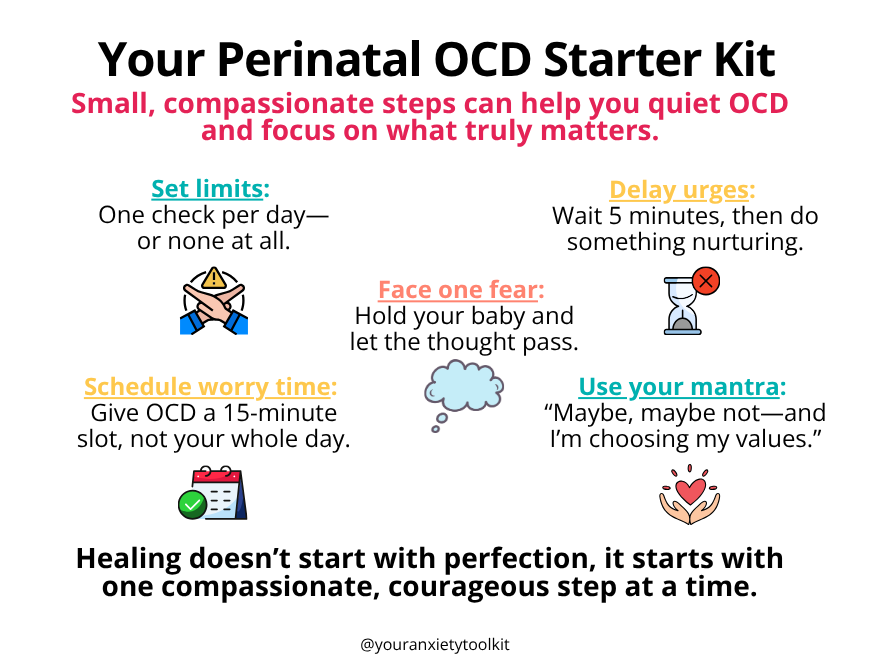
Mini “Starter Kit” You Can Use Today
- Set one boundary with checking (e.g., no more than one Doppler use per day—or none at all).
- Delay one compulsion by 5 minutes; fill that time with a values action (text a friend, sit in sunlight, cuddle baby).
- Pick one exposure that supports your parenting role (hold the baby during a mild intrusive thought and stay).
- Use a one-line script when thoughts pop up: “Maybe, maybe not—and I’m choosing my values.”
- Schedule a 15-minute worry window in the afternoon. Outside that time, gently postpone rumination.
Hope, Always
OCD loves big life moments because they matter. That doesn’t mean you can’t have the pregnancy, birth, and early parenting experience you care about. With ERP, support, and self-compassion, people move from fear-driven rituals to value-driven choices—often becoming deeply thoughtful, attuned parents along the way.
Helpful Resources
- International OCD Foundation (IOCDF): education, provider directory
- Postpartum Support International (PSI): perinatal-informed help and groups
- Community: Therapist-led groups for moms with OCD (as mentioned in the episode)
If You’re Struggling
Reaching out is a strength move. Consider connecting with a therapist trained in ERP and perinatal mental health, talking with your OB/midwife, and looping in a supportive partner or friend. There’s a clear roadmap, and it works—even if this isn’t your first round of OCD.
Big hug for the courage it takes to read this far and take the next step.
The podcast is made possible by NOCD. NOCD offers effective, convenient therapy available in the US and outside the US. To find out more about NOCD, their therapy plans, and if they currently take your insurance, head over to https://learn.nocd.com/youranxietytoolkit
Transcription: Navigating OCD During Pregnancy: A Compassionate Guide (with Erin Jones)
Kimberley: Pregnancy is full of uncertainty. But for folks with OCD, it can be incredibly uncomfortable and distressing. In this episode, we explore how OCD shows up across the four major stages of the perinatal experience, first at conception, then we have miscarriage, fears, delivery, and then postpartum. We’re also gonna offer evidence-based support, including ERP, with lots of compassion along the way.
Today we have Erin Jones. She is A-P-M-H-C, and she’s gonna share with us what that means. And we are here to talk about all of the concerns that you may be having during this very, very vulnerable stage. So thank you for being here, Erin.
Erin: Thank you so much. I’m so glad to be here.
Kimberley: So what is A-P-M-H-C?
Erin: Yeah, well first I’m a licensed counselor, but I also have the uh, PMHC through Postpartum Support International, which is a perinatal mental health certificate.
That means that I’ve done some extra training and have experience with the perinatal population.
Kimberley: Yeah. Amazing. Which just makes you so perfect for this conversation. So let’s get straight to it. So the stage one is conception. This is again the very beginning. So what kind of OCD thoughts and compulsions do people commonly experience when trying to conceive?
Erin: I’m so glad we’re talking about this for, for all of it, of course. But I also feel like when we talk about pregnancy and postpartum, we’re also missing the fact that OCD and anxiety can unfortunately tackle things way before the pregnancy even happens. Mm-hmm. Right? So when people are trying for a baby, of course there’s a ton of uncertainty and not much we have control over.
So OCD loves to latch onto that. I think when people are trying to conceive, they tends to be a lot of what if worries about things like, yeah, what if there’s a problem? What if I can’t get pregnant? And I, I think these things can be common for everybody, but we start to see more OCD when, uh, the fears I think come up as more of just right urges.
Like, if I don’t do things a certain way, then maybe I won’t get pregnant. That could seem logical or illogical, right? Yeah. It could be like, if I don’t set up my day in a certain way, then these results won’t happen. I think we could also see a lot of what we call magical thinking. Yeah. Right? So like, if I have this intrusive thought, then that means this bad outcome will will happen.
Or if I don’t do this thing or I think about this one thing, then this outcome is going to happen or not.
Kimberley: Yes.
Erin: I think also with trying to conceive OCD can really latch onto that just it cause this increased sense of personal responsibility. So what I mean by that is like, what if I don’t do things in just the right way, or if I don’t listen to these obsessions and urges, uh, then it won’t happen.
Or maybe there will be a problem. So I feel like it just takes a lot of the. Pretty normal or common worries of trying to conceive and just amplifies it.
Kimberley: Yeah.
Erin: Even more.
Kimberley: Yeah, absolutely. Absolutely. Oh, it’s so hard. It, it’s so hard. Right on. Again, I think people often feel too sad because they’re like, it’s supposed to be a joyful experience.
It’s supposed to be fun, it’s supposed to be exciting, but. It can be so anxiety provoking and take all of the fun out of it and just make it into this very serious, scary process.
Erin: Yeah, it’s definitely okay if it doesn’t or it doesn’t always feel fun. I am, I’m a mom of two, but before that I had unexplained infertility, which is probably like the worst possible term.
Yeah. For OCD and anxiety to. To latch onto and, and fortunately, eventually I was able to get pregnant and have two kids now. But I know for a lot of people in that position, especially with anxiety, there’s more, even more of a mystery ’cause you don’t know what’s going on. And I think it can lead to a lot of compulsive behaviors that.
Could still be ordinary things. Yep. In trying to conceive, so like taking pregnancy tests, taking ovulation tests, tracking things in your body. If you just said those things on their own, they’re, you know, things that one might do in that process. But I think with anxiety or OCD, that can just be amplified a lot.
So just really ruminating compulsively thinking about. The whole trying to conceive process compulsively, taking ovulation or pregnancy check, uh, tests. I think also symptom spotting or being really hypervigilant to symptoms in your body, which bodies can fluctuate so much anyway. But I know that that can be a really common compulsion for people in that time too.
Yeah. But everybody says just have fun and it’ll happen and um, it’s
Kimberley: not that easy.
Erin: Yeah, I, I don’t want anyone to feel guilty if they’re also like not having fun with that all the time. ’cause it can be hard and then you think, oh great, now I’m doing something wrong ’cause I’m not having fun all the time.
Kimberley: And especially if you’ve had a miscarriage, I think it amplifies too, which I know we’re about to talk about. But, um, yeah, I think, let’s use that as a segue. Miscarriage is deeply painful for. So many people. How does OCD amplify that fear and what might it look like in the day-to-day for someone struggling with this particular anxiety and fear?
Erin: Absolutely. I know it’s such a deep fear and I think, yeah, once one does conceive, I think many people do know that the chance of miscarriage is higher, especially in the first trimester. Think when you, when you know that something is a possibility. And again, that you can’t do much to control whether it happens or not.
OCD and anxiety do not. Like that. Yeah. And then of course, if you don’t want that to happen, your mind might try to think of extra ways that you can try to not make that happen.
Kimberley: Yeah.
Erin: So again, I think kind of similar to how one might experience this in the process of trying to conceive when there are fears of miscarriage, OCD can amplify it by saying like, now it’s your responsibility to make sure that this doesn’t happen.
Yeah. So you need to pay attention to your body, check things all the time. Again, I think it could lead to maybe some just right urges or magical thinking urges. For example, if I don’t eat right in the whole day or do my routine a certain way, then could that cause a miscarriage?
Kimberley: Yeah.
Erin: So I think OCD really tends to really push to that personal responsibility aspect of things.
Again, like what if, where it’s, the worry isn’t only what if a miscarriage happens? ’cause of course that would be. Awful and could happen anyway, but it’s what if you have a miscarriage? And it’s because you did something.
Kimberley: Yeah. Or you didn’t, you didn’t do something. Yeah. I remember when I was pregnant with my daughter and for some reason I decided, which was ridiculous.
I’d look back, but I decided I was going to mow the lawn and it’s not something I would typically normally do. And you know how like a lawnmower vibrates as you push it? Yeah. Oh, I don’t know if you have ever like pushed the lawn more, but it vibrates. And then I experienced a lot of like. Cramping after that.
And I’m sure it was because of the vibration and it was exhausting and it was hot outside. It was a stupid thing for me to like assume that I should do in that moment. But I was like, it’s fine. And I was feeling like I think that that an energy of that soap up. And I remember from that moment feeling those cramps being hypervigilant to any cramping.
No matter what little move my body made, twinge to, you know, itch, everything felt like this is it, this is it happening. And then you become catastrophic and you might go into doing some compulsive behaviors. And I’ve heard a lot of clients talk about that. Just, just being hyper aware of every sensation thinking is this, the miscarriage coming is so terrifying.
Erin: Yeah.
Kimberley: So I think that it’s true that it, if you have a cd, you might even. Go above and beyond that hypervigilance to being hyper aware of your body, constantly checking your body, asking for reassurance. Now we have Chatt, PT asking TBT researching normal symptom of, of miscarriage and so forth. So I. Do you have any sort of thoughts on that that you wanted to add on?
On what kind of behaviors they do when they are having that fear?
Erin: Absolutely, and I, yeah, I can relate to just having like, I don’t know, the sudden urge and adrenaline rush to do something in general, but also while pregnant then, yeah, just that bodies fluctuate so much during that. Time. Yeah. And even trying to conceive while pregnant throughout the, the whole period of time.
So I think there can just be, and then I think I also wanna add that this can be heightened for people who have experienced a miscarriage already Yes. Who have been through that trauma, right? Yes. And, you know, people who may experience health anxiety and things like that where you, you’re feeling real things in your body, but then your brain is just amplifying it to, okay, now something’s wrong.
Something’s wrong, this is, um, that’s it. It’s happening.
Kimberley: Yeah. Right. What advice might you give to someone who is pregnant or trying to conceive? What skills or strategies would you encourage them to use, particularly if they have OCD, um, along that process?
Erin: I think if, if you have OCD, I think you definitely wanna work with, uh, you know, your therapist, your support people, and your, and your medical teams.
Whether that’s your ob if you’re, if you’re informing them that you’re trying to conceive. Because really, if, if you feel that you, you could be prone to this. And I think it’s just good for people to be aware that, um, you know, we’ll get to pregnancy soon, but perinatal OCD is about one and a half to two times.
As common than OCD in the general population. So, you know, it’s not something that we have to live in fear of if we wanna get pregnant and have babies, but just, just to know, hey, I. I already have OCDI could be more prone to anxiety during this time, but I think ultimately you wanna work on, you know, depending how you’re gonna go about trying for a baby, right?
Some people don’t want to track things or, or, you know, use all the tests and everything other other people do. So I think, uh, just knowing what your game plan’s going to be for that, so that you can, if it’s okay, I’m, I’m gonna test to for ovulation or. Use a pregnancy test at this period of time, have those support people in your life where you can keep those tasks to, you know, just kind of, I’ll say within normal limits.
Yeah. I don’t like the word normal, but if it’s okay, I’m gonna test for ovulation and try for the baby and, and to see how it goes and have this period of time where I know I’m gonna be more embracing of the uncertainty of how my body’s feeling versus like, I’m gonna keep it to myself and just think about it all day.
I think that will help. Yeah. So ba kind of like when there’s a medical condition, you wanna know what your general game plan is and then anything outside of that
Kimberley: Yeah.
Erin: Is extra. Yep. Because I imagine that people are still gonna be living their daily lives Yeah. While they’re trying for a baby. Yeah. And trying to conceive doesn’t have to be your new 50 hour a week full-time job.
Yeah. That you’re thinking about all the time.
Kimberley: And I like what you said because what we’re really looking at here is. Determining what would be within your normal, not normal in general, but your normal, and then what you would determine as compulsive based on your values, right? Like we talk a lot about that in your OCD toolkit of getting clear of like.
Yes. Anyone without OCD would maybe check their hormone levels or the pregnancy test, or maybe with the Doppler. What is the thing that where you’re like a, you can have at home ones. So determining what would I do if I didn’t have OCD? And using that as your limits instead of as soon as you feel any anxiety, just going in and doing those compulsive behaviors Yeah.
I think is helpful. And I think, again, speaking with your partner on what they think is comfortable as well and what we agree would be
Erin: mm-hmm.
Kimberley: Like a, a non compulsive approach. Yeah. Um, I think is important. However, I do know that for folks with anxiety, especially with OCD. It’s so hard when you already love that babe all so much and it’s in your belly.
It’s so hard to resist doing those compulsions. What might you encourage them to be doing to help reduce that compulsion? Like how would you encourage them to manage those moments?
Erin: Especially if somebody’s already. Pregnant.
Kimberley: Yeah. And
Erin: avoiding those compulsions.
Kimberley: Yeah.
Erin: Yeah. Absolutely. I think even if you can put as little of a time delay on it as possible, start with that.
Right? Yeah. If it’s too hard to not do the compulsions, so maybe there can be this alternate of, yeah, I love this baby so much and my there, this mix up of like my compulsions feel like a way to, yeah. Exercise that responsibility and show the baby that I love them. Yes. But maybe I can like put my hands on my belly and talk to the baby or, okay.
Can I go do something else and wait a little bit? Maybe then I’ll check with the heart rate monitor again. Yeah. You know, tonight. Of, of course you would know if, if something is really feeling like an emergency. Yeah. And you need medical care. But yeah, I would say have, have your couple of people you can check in with.
If there’s another pregnant friend, therapist, your, your partner, you can say, oh, I just keep feeling like I wanna check. Yeah. And this person would’ve been briefed on this already, so they would know to say, I know it’s so hard and you just, you know, feel like. You have to do it right then, like that urgency.
But yeah, again, I would save, try to see if you can wait a little bit first, however many seconds or minutes you need to start with, um, and you could talk to your baby for a little bit.
Kimberley: Yeah, I like that you said that because I think, I think in OCD treatment. Of course, we’re always putting an emphasis on being uncertain and tolerating that discomfort, but sometimes I think it means that we have to just be miserable, right?
Or just, just sit in that miserable, horrible uncertainty. But I love how you’re bringing in, like still talk to your baby. Like put your attention on the positive experience you’re having or what you’re doing in that moment, or what does line up with your values, which I think is so important because it, it’s.
It’s so hard to focus when you have that anxiety and that hyper responsibility for this. Thing you love so much that you didn’t know you could love so much?
Erin: Yeah.
Kimberley: Um, like it’s so painful.
Erin: It’s always, I mean, even for folks who aren’t pregnant, but I feel like it can be so heightened when I keep mentioning this greater sense of personal responsibility, but that’s already there when you’re pregnant ’cause you are growing a baby in your belly that you know you do have some more responsibility for.
Just not in the way that. OCD says that you do. Yeah. So it is really hard to wait. So I, I think it’s easy to hear concepts like, oh, well, okay, wait five minutes and, and, or keep delaying and, and see how that goes. But yeah, the most common question is, so then what do I do? Yeah. I just sit there and be really upset.
Kimberley: Yeah.
Erin: Um, might be tough, but you could still do stuff
Kimberley: during that time while you’re feeling anxious.
Erin: Yeah.
Kimberley: Absolutely. Um, let’s move to stage three, which is really delivery. So how does OCD manifest in the lead up to delivery? Um, so what type of intrusive thoughts or compulsions might tend to arise during that stage of this beautiful but very, you know, uncertain process.
Erin: Yeah. More uncertainty right in your face.
Yeah.
Kimberley: Yeah.
Erin: Uh, I think similar to trying to conceive and what we discussed about fear of miscarriages, I think that. Same thing can come up for delivery, right? It, I think more of the, the common worries than anyone could experience would be more of just the what ifs, right?
I have knowledge of all these things that could happen, or what if my, what if my birth plan doesn’t go the way that I, uh, that I planned for it to go? Any kind of what if, right? What if some harm comes to me or the baby? Um, or what if it just doesn’t? Doesn’t go the way I wanted it to. And I think of course, many could think about that anyway.
But OCD tends to take that and amp it up more. It just, it, it adds to the frequency and duration of the worries. Yeah. Right. So if people are listening and it’s like, but I do worry about that. Yeah. I think anyone can in this stage. But if it’s something that you’re thinking about all the time, every day, it’s keeping you from doing things you want.
To do a lot of your day becomes more of these compulsive behaviors, like researching things online, asking people for reassurance, especially repeatedly, maybe like over editing the birth plan for every possible outcome. These could be things that, you know, start to get more excessive and time consuming, and that’s where OCD.
Might tend to come in the most.
Kimberley: Yeah. And I’ve also had a lot of clients who have had, you know, we have intrusive thoughts. We know that’s a common obsession for folks with OCD. I’ve had a lot of pregnant moms talk about these intrusive images like
Erin: yeah,
Kimberley: images of. Them tearing like very, very graphic images of them tearing and that’s just very repetitive and unwanted of these images of, and they’ll feel the pain of that tearing.
Yes. But it hasn’t even happened yet. Or the fear that they won’t love their baby or that they won’t attach well to their baby. And that this is like this ongoing repetitive fear of, or you know, more like you said, the general, like what if, you know, pedophilia, obsessions and
Erin: Yeah.
Kimberley: Calm obsessions. I think that there are so many ways beyond just normal perinatal anxiety.
With OCD, it tends to be very repetitive and. In your face, would you agree?
Erin: Yes. And I think some of the examples you gave a thought, like, what if I don’t love my baby? The pedophilia thoughts. What if I have this like sexual thought about the baby and there’s something wrong with me or you? Or you do have the thought and you wonder what that means?
This intrusive thought. Yeah. Uh, it’s just a thought, right? Yeah. Uh, but yeah, this is where it, it is more like OCD compared to Yeah. General anxiety and thinking about the, the what ifs. Yes. And we need to normalize that more because those intrusive thoughts, however taboo can happen to pregnant people and their partners.
Yeah. Anyway. Yeah. Uh, it’s more like you said, if we keep latching onto it, we do compulsions, they feel really sticky. That’s when they tend to become more like OCD.
Kimberley: Yeah, absolutely. Postpartum. The stage four is such a vulnerable time. We’re exhausted, we’re sleep deprived. We may or may not have like relational struggles because everyone’s tired and exhausted and, and learning something that they’ve never done before.
Can you walk us through how OCD might look? In that postpartum stage, especially when it comes to those, those harm related and sexual related obsessions.
Erin: Yeah, I think when we hear postpartum OCD, we usually, I think really any theme of OCD could come up during this time. Mm-hmm. But I think the most common tend to be.
Harm. Obsessions, maybe Contamination. Obsessions too. Yes. And this can come together as well, right? Yes. Like what if the baby becomes sick or contaminated and I’ve harmed them in that way? Yes. Or because I didn’t do something. Uh, so yeah. Harm being, what if I, yeah, it could be images, like you said, just horrible images of the baby getting hurt, them being dropped.
What if I do something or I neglect to do something and then that hurts the baby. And contamination. What if the baby gets sick or it, but it could even stem into more kind of superstitious or just right. Thoughts? Mm-hmm. Like, what if I don’t do everything in just this? Or what my mind says is just this right way.
Mm-hmm. And then something bad happens. Yeah. More taboo thoughts. Right? I had this sexual thought about my baby. Is there something wrong with me? Yes. Am I attracted to them? Right. What does this mean? I think also, as you mentioned earlier, a lot of people can have relationship OCD during the postpartum period.
Yes. What if I don’t love my baby? Kind of like the feelings check. Like, do I feel right? Yes. Am I feeling the right way? Yes. Yes. Um, so it can, it can go quite a bit beyond like maybe harm or contamination, which we might think of initially. And this can include so many compulsions, right? It could be ruminating, meaning just thinking or attempting to think through these thoughts a lot.
I have this thought about harm. Now I’m gonna go through this like mental list in my brain of trying to prove to myself whether or not it’s gonna happen can make you wanna avoid the baby, right? Yeah. If
Kimberley: being around
Erin: the baby gives you those thoughts, maybe this means something about me, maybe I shouldn’t.
Maybe I shouldn’t give the baby baths or change their diapers. Yeah. ’cause I might have these scary thoughts or do something that my mind is afraid of me doing. Yeah. A lot of checking, reassurance seeking. Yeah. So there can really be any OCD theme or compulsion during this time. ’cause then sometimes people have or, or they have the onset of OCD during pregnancy or postpartum and their obsessions aren’t really surrounding the baby.
And they hear about it, but then they think, oh well. Wait. Now I feel guilty because my obsessions aren’t about the baby. Oh, of course. I’ve met a lot of people who have that too. What does it mean about
Kimberley: me? Right,
Erin: right. Yes. Now, is there something wrong that my obsessions are not about the baby? Yes. So I think, yeah, harm and contamination are probably the most common, but it’s it’s OCD during that time, so it can still really be about anything.
Yeah.
Kimberley: Okay. So if you are looking for effective OCD or BFRB treatment that’s covered by insurance. I’m thrilled to announce to you this week’s sponsor no cd. No CD provides live face-to-face video sessions with licensed therapists who specialize in OCD and related conditions. Through exposure and response prevention therapy, a highly effective treatment designed specifically for OCD, their therapist can tailor a plan just for you.
OCDs treatment approach is clinically proven to significantly reduce symptoms with an app that helps you stay connected to therapists and peer communities in between sessions, so you’ll always feel supported. No CD is available in all 50 states and even internationally, and accepts most insurance plans, making care affordable and accessible.
If you think you might have OCD or a struggling to manage symptoms, there is hope. Book a free call@nocd.com.
Erin: You don’t have to struggle alone. Big hugs. And now let’s get back to the show.
Kimberley: I’ve had like quite a few consultations of with clinicians on moms who get OCD about the child’s name.
Erin: Mm.
Kimberley: That they get really fixed on what if I’ve picked the wrong name and I’ve ruined my child’s life?
Erin: Yeah.
Kimberley: Or, or during the delivery I’ve had a couple of clients report something would happen. Maybe it’s that a certain flower delivery came or they requested a certain pillow or blanket and they, as they were having, you know, let’s say as the flowers arrived, they had the thought that these flowers are going to taint this whole delivery or this whole thing.
And so it’s, even though they’re like, I know it didn’t taint it. Postpartum they can’t stop thinking about, but how will I know if it did or not? And, and we get so stuck on that. Yes. Which I think is it, it can be so easily complicated by one. Like clients will say, it’s so silly. Like, why did it pick the flower arrangement?
But it did. And so I think that’s where this, I sort of want, I’m loving that we’re talking about it because. Like getting married, delivering a baby is a pretty big life stage.
Erin: Pretty big,
Kimberley: pretty huge. Right? And that’s why I think OCD attacks it because it is such a big part of your life. Yes. It’s such a, a monumental moment in your lifetime.
Erin: The hormone changes. But that’s also why partners can experience this too. Yes. Adoptive parents. So, uh, yes, you know of. Because they experienced hormonal changes too. But just all these changes in environment, and I’m glad you brought up the example with the flowers too. ’cause I think that would often get labeled as something called emotional contamination.
Yeah. Where it’s like my day is going to be
Kimberley: Yeah.
Erin: Contaminated. Or even like me as a person or my spirit, or like my weekend. Yeah. Or the baby’s life will be contaminated. So like you said, it doesn’t always make. Sense, you know? Right. It can seem illogical and we don’t always know why it picks those things, just besides the fact that it’s an outcome that we can’t control.
Kimberley: Yes.
Erin: Um, and I don’t think you would see as much like emotional contamination like that if you looked up common.
Kimberley: No
Erin: obsessions that happen really at all. That also during the postpartum period. So it’s, it’s a really helpful example.
Kimberley: It’s such a grief process for folks with OCV in these stages too. ’cause it’s like.
They’re like, why did OCD take this beautiful moment from me? This, this experience? I, I, I’ve sat with so many people just to process that grief that they feel.
Erin: Yeah.
Kimberley: It’s so hard be, and it’s so such a bummer like that OCD. Takes this from people, right? It is, it like, makes me want to cry. ’cause it’s just,
Erin: I know,
Kimberley: it’s, it’s just not fair.
But it, it can really take over and run the whole show.
Erin: Yeah. It’s not fair. And I, I feel for anybody who’s had to go through that, and especially if that’s the first time that you’re really experiencing an
Kimberley: intrusive
Erin: thought. Yeah. And that’s why I wanna talk about it so that people, I mean, it can help a lot of folks to just know, like, okay, you could have some.
Taboo or violent or strange or sexual intrusive thoughts during this time. And it like, it’s just a thought. Your brain’s, your nervous system is, you know, just warning you about all these things. Yes. And just knowing that can help. Yeah. So much of like, okay, there’s nothing wrong with me.
Kimberley: Yeah. You touched on the next question I was gonna ask, which is the stigma and the shame.
Yes. So, so many people feel this intense shame around their MCD, their intrusive thoughts. What would you just say to somebody who feels shame for their intrusive thoughts or for the fact that their compulsions have taken up a lot of time, that it’s interfered with their process of delivering this baby into the world?
Erin: Yeah, I would encourage people to approach it with some self-compassion, you know, like you just said earlier, it’s not, it’s not fair. No, it does suck, but we’re still people.
Kimberley: Yeah.
Erin: And people who deal with OCD and, uh, you know, it doesn’t have to do with who you are as a parent, right?
Kimberley: Yeah.
Erin: You are not your thoughts.
This, this doesn’t mean you’re a bad mom or a bad parent, you’ve. You know, struggled during parenthood or early parenthood and you know, if anything, what really defines OCD is that your obsessions are, you know, ego dystonic, meaning they’re opposite of your worldview. You don’t want these things to happen.
So I would encourage people to really be compassionate with themselves and see themselves as a human while also just validating that. It sucks and it’s sad that you have to go through this.
Kimberley: Yeah, yeah. And get support, like reach out. Yes. There are so many moms online with OCD who are willing to share their experience.
There’s actually a whole community of, I think moms out there with, you know, postpartum OCD or perinatal OCD, who would be willing to support them and encourage them during this really, or what was already a very painful discomfort. Yes. Uncomfortable time. Yeah. Very uncertain time. Absolutely. Yeah.
Erin: I know we, with the I-O-C-D-F, some of us have a, there’s a sig, a special interest group called Moms with OCD.
Yes. And we, yes. Mainly meet more at, it’s not a support group. We meet more to, uh, but to connect and advocate, educate people. We do awareness week type stuff. And my colleague and I, if maybe you can plug in, in, uh, our blurb for this, but I run a monthly support group for moms with OCD, with my friend Megan.
Kimberley: Where would they go to learn about that?
Erin: You can find it on. Probably the easiest place would be through Instagram. My Instagram is Erin talks ooc d Message me through there. Okay. Or my colleague in the community, Megan Davis runs it with me.
Kimberley: Great.
Erin: And her website is Megan Davis psychotherapy. Okay. Dot com.
Kimberley: Cool. We’ll add those in the show notes. Yes. And that, that’s awesome. That’s the support people need.
Erin: Yes. It’s definitely out there. There’s um, and so many moms and really. Like what I tend to hear the most is just, oh, it’s so good that somebody talked about this, or I just heard somebody else say a thought that they had.
And that was just so helpful to me to hear like, okay, it wasn’t just me like, you know? Yeah. Other people have this, and I think that really helps with the shame too,
Kimberley: for real. Yeah, absolutely. All right, so let’s talk about treatment. Yes. What is the treatment for folks who have any type of OCD that’s affecting them in any of these four stages?
Is it the same treatment? Does it change? Would we modify it? How, what? What are your thoughts?
Erin: Generally it’s still the same, still ERP exposure and response prevention that, that gold standard treatment. So really generally, again, OCD, during the, whether trying to conceive or the perinatal postpartum period, people can have OCD fears surrounding their kids way past the postpartum period anyway.
Yep. We still wanna use exposure and response prevention. Of course, because we use those skills to, you know, embrace our move into our intrusive thoughts and things that trigger us and delay, or ultimately not do the compulsion. Yeah, so it’s still the same in that sense, but I think there are definitely ways that we have to consider the perinatal and postpartum.
Population. So, you know, I, I think due to stigma, stigma and maybe misinformation, ERP can have a rep for being, people wonder if it’s unethical or harmful, and it’s not, especially when a provider is trained. And yeah. And doing it, uh, doing values based exposures. So for example, a lot of people would wonder, like.
It. Well, if I’m facing my fears, is the baby gonna get hurt? Yeah. Am I gonna do something that could hurt the baby in my belly? And the answer is no. We’re not gonna hurt your baby. ’cause we don’t wanna do that. And we also, uh, because we’re like nice people, and we also don’t want that to happen to you, but we might do things that OCD says are risky
Kimberley: Yeah.
Erin: But aren’t against medical guidelines. Right. So maybe you’d, maybe you’d hold your baby or prep food for yourself in pregnancy without doing all these excess, like cleaning compulsions. Yep. But we’re not going to have you do things like when the baby’s born, they’re against sleep safe sleep guidelines.
Yes. So we may work with obs or medical providers or, or of course just work with our clients and say, Hey, like here’s, you know, what are your goals here that you wanna get towards? What are your values? And then how can we challenge that in a way that’s still challenging? Yes, but ethical and safe. And then of course, as.
Pregnancy progresses and the baby is born and, and somebody’s very new postpartum. We still do ERP, but it’s kind of like getting back into exercising. We’re obviously gonna modify things. Yes. And how gradually we get into it, but I think a lot of people think that they can’t do ERP because the baby’s young, but.
If anything, it’s a much,
Kimberley: yeah.
Erin: Better time to do it
Kimberley: for real.
Erin: Just, you know, might have to take our time a little bit. Yeah. Because you just had a baby, but,
Kimberley: well, and I think too, a lot of the, the exposure and response prevention E, even if it’s not exposure heavy, we’re going to be focusing on response prevention as a huge piece of the work.
Yes. Like can we work at reducing your reassurance seeking, can we work at reducing mental compulsions or avoidant compulsions? And like you said, OCD is gonna have some strong words to say and try to like get you back into doing those compulsions. But I think it’s such a beautiful opportunity to empower moms to get really clear on how they wanna parent and how they wanna show up and not let fear win.
’cause fear can literally destroy us. The one thing I would add too is how. I know for me, if I haven’t slept, my anxiety is always so much worse, always so much worse, and that was a huge part of the anxiety of having a kid from me was I was more afraid of not sleeping than I was. Any other fear? Yep. And, and I would obsess, I’d like, you know, come two o’clock in the afternoon, I’d start to obsess over, will I get sleep tonight?
What will I do if I don’t? Just because I feel so miserable if I hadn’t slept? And I think that that’s, uh, such a. A common fear for folks with anxiety. Yes. Especially when you actually aren’t getting much sleep.
Erin: Yes. I’m so glad you brought that up because it’s, it’s a really, really common fear in general.
Yeah. And also with OCD, in and out of pregnancy. Yes. Obsessing about sleep. Right. And then I think we know even outside of like. The postpartum time if you think too much about not sleeping. Mm-hmm. Mm-hmm. Like, you’re gonna be up not sleeping. Yes. Um, and, and that just clarifies where it’s, it’s just so important to have that support and really figure out what your, as best you can, what your sleep plan’s gonna be.
What helped you have, how can you. Uh, have some restful time in the day, even if it’s, well, okay, I wanna feed the baby. My, my sleep is gonna be really short. Okay, but how do we, how do we take care of you and make it work so that, you know, maybe the, the highest quality sleep might not be absolutely guaranteed, but we could make sure that you get what you need.
Because, yes, losing sleep can impact your anxiety much more. But I, I also like, even as I say that, I don’t love my wording because like, we shouldn’t just assume that because. Your latent pregnancy or postpartum that you’re just not gonna sleep ever. Yeah. And like, that’s not accurate. Yeah. You still need to sleep.
Yeah. Um, so it’s, it’s really important and it’s another way that I think moms and parents and partners have to make sure that they’re taking care of themselves too. Yeah.
Kimberley: Yeah. I actually feel like having a baby forced exposure onto me. To where I actually realized I could function without sleep. Right.
Like, if anything, the, the learning happened through delivering and being like, okay, this is not good. I’m free. Like I, I get teary and everything when I’m tired and more anxious. But then after a while I was like, oh. I can actually do this. Like I’m have no choice, but I can. It’s harder, but if I am gentler with myself through the day and maybe don’t put as many expectations, this is actually tolerable.
This is doable. Right? Which was a really good. Lesson.
Erin: Yeah. Yeah,
Kimberley: yeah.
Erin: I think I can relate and I think just the, like we can be anxious and do things like we can be Okay. I can be tired and do things
Kimberley: too. Yes. Yeah. I think that a big part of the treatment too is having support, like, you know, just having someone who you can talk to, not from a form of reassurance, or not just ruminating, but just having someone who can go, yeah.
It makes total sense that you, you’re sometimes with clients that disarms the OCD by just going, yeah, that’s really scary. Like I can, it makes total sense that you want to do compulsions. It’s, I know we’re working against it, but Yeah, if, if your brain was saying that it makes sense that you would want to, you know, avoid the baby and so forth, but the, then also educating them and empowering them, that just because fear says to avoid.
It doesn’t mean you should avoid. I think that’s a big hard, a hard one. Absolutely. With perinatal OCDs especially, like that’s where I know, I’ve seen so many clients who’ve come because the mom just cannot even be in the room with her child.
Erin: Yeah.
Kimberley: So But wants to, yes. Desperate. Not because they’re a bad mom.
Desperately wants to, but he’s just so afraid.
Erin: I, I think that’s why a lot of ERP and exposures with this realm of OCD is it’s primarily going to be those things that you’re avoiding. Like it could be day to day tasks, right? It, yeah. That could just feel so, so much more difficult because of OCD. Like, all right, bring the baby in.
Let’s change their diaper. Yeah. Like have, bring them to the office, or we’ll do virtual and Yeah. And you can, yeah. Move through that task. It’s like, we’ll practice, you know, being mindful and having the thoughts. And, uh, so that’s why, again, I, I feel like exposure Therapy gets this rep for like, doing these really overly intense things.
And we might do some strong challenges, but like, it might be, all right, let’s hang out and play with the baby. And then like, you know, for me it’s like you can bring the baby to the office if you wanna Yeah, we can cuddle. We can cuddle. Yeah. Totally help with that. Uh, but let’s do these day-to-day tasks that are feeling really difficult and scary and.
Like you said, learn to move through it. Being tired slash nervous or scared.
Kimberley: Yeah. And they can be gradual too. Yes. So you could, let’s say you had avoided the baby. Let’s say the first exposure might be that you’re just in the room with somebody, another adult, and that’s the first exposure. Maybe you’re just witnessing them changing the diaper.
Then maybe you change the diaper and the partner’s in the room with you, or they do part of it. You do part of it, but you’re slowly, slowly moving up that hierarchy of being able to do it on your own in a room by yourself, where there’s not another adult or that, just to use that example. So I think it’s okay if it takes a little bit of time.
And you’re gradually working up that hierarchy. Yes. Because it often requires baby steps.
Erin: Absolutely.
Kimberley: Yeah.
Erin: Yeah. Good fun.
Kimberley: Yeah, true. For those who are listening, maybe they’re feeling totally overwhelmed by their thoughts. How might you encourage them to talk to people, even their doctor, and share the fact that they’re really struggling?
How would you encourage them to address that?
Erin: Yeah, that’s a great question. S it’s, you know, wait, I have a lot of these scary thoughts and, you know, I don’t, I don’t want my thoughts or, or my worries to be misunderstood, you know, or stigmatized in any way. I think it could be good, whether it’s a friend or a partner or your doctor to.
You know, think of a, a simple sentence you can start with. So just, hey have, yeah, I’ve been having a lot of extra worries and I could use some support. Start with that. If it’s especially a doctor or a therapist, I would follow up with that by asking them what familiarity yes they have with OCD and intrusive thoughts.
Because knowing that the provider has some training or understanding in it is going to really help you see them as somebody to trust with that and know that you don’t actually want these things to happen and that you’re not actually a threat to your baby.
Kimberley: Yeah, yeah. I often tell clients too, like if you find an article online.
Yeah, somewhat explains your symptom, print it out. And even if you cannot mutter the words, you know, ’cause sometimes even people with OCD are avoiding even the words, just print it out and push it across the table and say, could you read that? This is very similar to what I’m experiencing. Sometimes it’s easier just to come from a
Erin: yes,
Kimberley: you know, a, a well-known website that, you know, can help explain the situation.
Erin: Yes.
Kimberley: Um,
Erin: or I heard this explanation on this podcast episode Yeah. About flowers getting delivered and it really resonated with me. Yeah. Please listen to this clip, like that’s such a great suggestion.
Kimberley: Yeah, absolutely. Yeah.
Erin: I experienced that and be able to. To share.
Kimberley: Mm-hmm. That way too. Mm-hmm. Absolutely.
Absolutely. Well, this is so amazing. I have one more question. So you’ve worked with a lot of women, you’re obviously very skilled in this area, um, through all of these stages. Right. Can you share any last points, ma, a main message, a, a message of hope for those folks who are maybe Yeah. Coping with this.
Erin: Yeah, because before I answer that too, I also wanna add, the one thing that I think we didn’t get to touch on yet is that people might hear this and think like, oh wait, I, I have OCD, or I’m worried that this could happen, so maybe I shouldn’t even have a baby.
Kimberley: Hmm.
Erin: And so I just want people to know, like, make your decisions however you wanna make them.
Of course. Yeah. But being prone to OCD or anxiety, or the possibility that it could come up does not. Mean that you shouldn’t have a child, you know? Yeah. Thank you for saying that. You know, use the information and be prepared, but you’re still capable of that. So then to that, I would add, if you experience this, again, it really has nothing to do with who you are as a person or a parent.
There’s so much more information and evidence-based therapy available that you can take these tools and you know, maybe there’s some anxiety there sometimes, but you can live a good, valuable life and be a good parent.
Kimberley: Yeah. I’m so glad you brought that up. Because I have heard people say. I’ve been through it.
I know what it’s like to have OCD, I never want my child to have OCD Yes. Or I don’t wanna be triggered, but like I have been in the past. Sure. And I know that you might get triggered again. And so if that means I have, so I, I’m so grateful that you brought that up. Thank you. Thank you. Um, and I think the good news is this is a highly treatable condition.
Erin: Yes.
Kimberley: Right. So it might mean that you need to go through another round of, of treatment, but even then, I always say to my clients who are afraid. They’ve often said like, what if my OCD comes back when I have a baby? And I’m like, you’ll call me.
Erin: Yeah.
Kimberley: And we know it works so we’ll just keep doing what you’ve done and we’ll play that one.
We’ll worry about that when it happens.
Erin: Yeah.
Kimberley: But still we have this good plan and this good treatment goal.
Erin: It’s scary that it could show up and be like with your client, it’s like, okay, now yeah, we’ll know what to do.
Kimberley: Yeah. I said, really, we’ve got like this roadmap that’s already worked once.
Erin: Yeah,
Kimberley: we can,
Erin: let’s do it again.
Do it again.
Kimberley: Yeah. And, and with support and yes, it takes a little longer and, um, I think that’s really important. Is there any other thing that you feel like we’ve missed talking about or is there any message you maybe I wanted to repeat for the folks listening who struggling with it.
Erin: I think again, just that this is so common and that there’s, like you said, there’s so much support.
It doesn’t have to do with who you are as a person or a parent. Yeah. I want people to feel more informed and also have hope from this, that it, it doesn’t have to take over your life, although it can really feel like that.
Yeah.
Erin: In the moment. So much support out there, whether it’s through resources like this international OCD Foundation and postpartum support International.
Yeah.
Kimberley: And then it doesn’t mean you’re a bad mom or a bad dad.
Erin: It doesn’t,
Kimberley: right? No, it doesn’t like, I think, I think when you have these intrusive thoughts. It can make you feel like there’s something inherently wrong with you as a parent. Like maybe you just, maybe I just wasn’t cut out for this, but I, I have found that my clients with OCD are the most incredible parents, right?
Erin: Yeah.
Kimberley: Amazing. And would do anything for their child. It just, again, sometimes the brain in steps in. Makes it a little messy.
Erin: Having OCD is not, does not disqualify someone for being a parent.
Kimberley: Yes. Yeah. Amazing. Well, thank you so much for being here.
Erin: Thank you. Glad to be here.
Kimberley: Tell us what people can hear about you and the work that you’re doing, or maybe even get contact with you for the therapy.
Erin: Absolutely. So I work with a group called Bull City Anxiety in North Carolina. So the website is bull city anxiety.com, and I have an Instagram that I use mainly for. Immunotherapy related things. It’s Erin Talks, OCD. Amazing. Must be the waste of, I’m so grateful you’re here. Thank you for having me.
Kimberley: Please note that this podcast or any other resources from cbt school.com should not replace professional mental health care.
If you feel you would benefit, please reach out to a provider in your area. Have a wonderful day, and thank you for supporting cbt school.com.
