BDD vs Body Image vs OCD (with Chris Tronsden) | Ep. 453
Kimberley Quinlan and Chris Trondsen break down how to tell BDD apart from body image concerns, OCD, eating disorders, gender dysphoria, BFRBs, and more—plus the right treatment moves for each.
What you’ll learn in this episode:
- The “What’s the function?” test to quickly tell whether a behavior points to BDD, OCD, an eating disorder, social anxiety, or a BFRB.
- Clear differences between BDD and body image concerns—and why chronic impairment and low insight matter.
- How somatic/“just-right” OCD can look appearance-focused (and how treatment shifts when it’s not about looks).
- BDD vs. eating disorders: how motives around food/weight differ, and why this distinction changes treatment.
- Muscle dysmorphia in gym culture: warning signs, risks (e.g., overtraining, substances), and healthier paths forward.
- Gender dysphoria vs. BDD: why gender-affirming care helps one—and cosmetic fixes often worsen the other.
Understanding the Differences Between BDD, OCD, Eating Disorders, and More
When it comes to body image and appearance struggles, it can be incredibly confusing to tell the difference between conditions like Body Dysmorphic Disorder (BDD), OCD, eating disorders, muscle dysmorphia, gender dysphoria, social anxiety, and body-focused repetitive behaviors (BFRBs).
Content
What Is Body Dysmorphic Disorder (BDD)?
BDD is defined by:
- A preoccupation with perceived flaws in appearance (often not noticeable to others).
- Spending at least an hour a day on compulsive behaviors such as mirror checking, camouflaging, or skin picking.
- Significant distress and impairment in daily life (work, school, relationships).
- Low insight, meaning the person truly believes their appearance is flawed rather than recognizing it as a mental health condition.
Unlike general body image concerns, BDD is chronic, severe, and life-disrupting.
BDD vs. Body Image Concerns
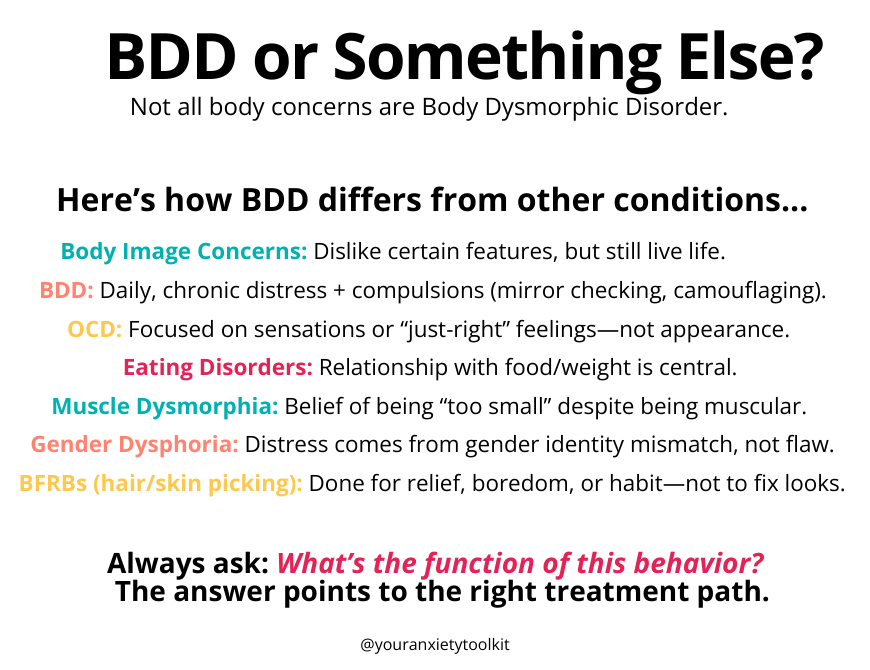
- Body Image Concerns: Common during life transitions (puberty, postpartum, aging). People may dislike certain features but continue to function—going to work, attending social events, maintaining relationships.
- BDD: The distress is constant, severe, and prevents people from living their lives.
💡 Key Strategy: Ask yourself, “Is this a passing concern, or does it dominate my life every day?”
BDD vs. OCD
OCD can sometimes look like BDD, especially when obsessions focus on the body. The difference comes down to function:
- OCD (Somatic or Just-Right Obsessions): Preoccupation with bodily sensations (blinking, swallowing, breathing) or symmetry/“just right” feelings. The goal is relief from anxiety, not fixing appearance.
- BDD: Preoccupation is about appearance and perceived flaws.
💡 Key Strategy: Always ask, “What’s driving this behavior? What am I hoping to achieve?”
BDD vs. Eating Disorders
This is one of the trickiest distinctions.
- Eating Disorders: The focus is on food, weight, BMI, or fitting into clothing sizes. Behaviors include restriction, bingeing, purging, or compulsive exercise.
- BDD: Food or exercise may be misused, but the motivation is tied to a specific body part (e.g., “If I lose weight, my jawline will look sharper”).
💡 Key Strategy: Look at the relationship with food. Is it about body part appearance (BDD) or weight/size control (eating disorder)?
Muscle Dysmorphia (a form of BDD)
- Common in gym culture and among young men influenced by “fitfluencers.”
- A relentless belief of being “too small” or “not muscular enough” despite evidence to the contrary.
- Can lead to rigid exercise routines, steroid use, and physical harm.
💡 Key Strategy: Ask, “Is my drive to exercise enhancing my life, or is it controlling me?”
BDD vs. Gender Dysphoria
- Gender Dysphoria: Distress arises from the incongruence between assigned sex at birth and one’s gender identity. Treatment involves gender-affirming care, which improves mental health outcomes.
- BDD: Distress is rooted in a perceived flaw or defect in appearance. Cosmetic surgeries often worsen mental health.
💡 Key Strategy: Affirming gender expression supports healing in gender dysphoria. Reinforcing appearance preoccupations worsens BDD.
BDD vs. Social Anxiety
- Social Anxiety: Fear of judgment, embarrassment, or unwanted attention. Example: covering up after developing earlier than peers.
- BDD: Avoidance is due to believing a body part is defective.
💡 Key Strategy: Explore “Am I avoiding people because of my appearance, or because of fear of judgment in general?”
BDD vs. Body-Focused Repetitive Behaviors (BFRBs)
Examples: hair pulling, skin picking, nail biting, cheek biting.
- BDD-related behaviors: Done to fix or camouflage a perceived flaw.
- BFRBs: Often done when bored, anxious, or in a trance-like state, and not necessarily tied to appearance.
💡 Key Strategy: Identify the function: “Am I doing this to change how I look, or because it feels soothing/automatic?”
Visible Differences: Scars, Alopecia, or Limb Loss
What about when a flaw is real and visible?
- Technically, DSM criteria for BDD focus on perceived flaws.
- However, there is a diagnosis code for OCD with BDD-like behaviors and visible flaws.
- These individuals still benefit from BDD treatment strategies: self-compassion, reducing safety behaviors, and exposures that build confidence in social settings.
The Golden Question: “What’s the Function?”
Kimberley and Chris return again and again to this crucial skill:
👉 Ask, “What’s the function of this thought or behavior?”
- Is it about avoiding judgment?
- Is it about changing appearance?
- Is it about reducing anxiety or discomfort?
This simple but powerful question helps clinicians—and those struggling—understand what’s really going on.
Why Differentiation Matters
Accurate diagnosis is essential because:
- BDD treatment focuses on ERP (exposure and response prevention), self-compassion, and reducing appearance-related compulsions.
- Eating disorder treatment emphasizes restoring healthy eating and repairing the relationship with food.
- Gender dysphoria treatment requires gender-affirming care.
- OCD treatment targets intrusive thoughts and compulsions unrelated to appearance.
Using the wrong treatment can worsen symptoms.
Hope and Resources
Both Kimberley and Chris emphasize this truth: people can and do recover. Even if you have more than one of these conditions, there are evidence-based treatments that help.
If you’re struggling:
- Explore resources at CBT School.
- Seek clinicians trained in ERP, eating disorders, or gender-affirming care depending on your needs.
- Remember: relief is possible, and you don’t have to navigate this alone.
✨ “It’s not about vanity. It’s about reducing the emotional suffering that comes from these struggles.” – Kimberley Quinlan
The podcast is made possible by NOCD. NOCD offers effective, convenient therapy available in the US and outside the US. To find out more about NOCD, their therapy plans, and if they currently take your insurance, head over to https://learn.nocd.com/youranxietytoolkit
Transcription: BDD vs Body Image vs OCD (with Chris Tronsden)
Kimberley: Yeah, welcome back everybody. I am so honored to have Chris Trosten here with me again doing almost what I would call a part two of talking all about Body Dysmorphic disorder.
But we’ve already gone through a lot about what is body dysmorphic disorder and how, what helps and what doesn’t help in a previous episode. Do go and check that out if you haven’t listened yet. Today we are now gonna talk about the difference between BD, D, body image, OCD, eating disorders, gender dysphoria.
Some of these names you may not have heard of before, body focused repetitive behaviors and how to tell the difference. So welcome back Chris.
Chris: Yes. Welcome, welcome. Thank you for having me. Well, I said welcome, like it’s not your show.
Kimberley: No.
Chris: hello. How are you doing? Thank you for having me back on. I always tell people like anything BDD related I could talk about for years. So
Kimberley: Yep.
Chris: two. And I’m excited. Actually, we were talking about it off camera, but this is probably this, the, the theme of this, uh, podcast. The number one thing I get asked in consultation from clinicians, uh, just about the different, um. You know, ways that certain things can show
Kimberley: Mm-hmm.
Chris: and there’s such a differential diagnosis and people will say, but I don’t know what it is. So
Kimberley: Yep.
Chris: really excited that we’re gonna go through this one.
Kimberley: Yeah. Thank you. Yeah, thank you so much. And again, for those who don’t know, Chris and I have recently recorded an entire course for clinicians who want to learn exactly the steps that Chris takes and that I take of treating people with BB, D. It is a deep. Deep dive and we go step by step of all the steps.
We even do some, um, we’re acting it out. Chris is showing me how to do some as if I’m the client. We’re doing some role play. Um, amazing, amazing training by you, Chris. I’m so impressed and so proud. And we also have a course for BDD Suffer is coming out as well, so that is so, so exciting.
Chris: Yes, I know. I’m excited for that one too. A lot of people around the globe cannot always access evidence-based
Kimberley: Yeah.
Chris: so to have something that is real quality, everything that CBT school puts out is absolutely top tier. Um, so I’m really excited that a lot of people that may not even be comfortable enough to leave their home to see
Kimberley: Yeah.
Chris: they may be isolating to that level, uh, can still get some help and get some relief.
Kimberley: Yeah, thank you. It’s such a mission of CBT School. If we can get, um, you know, for folks who don’t have the resources or are not, you know, in a place where they’re ready to start therapy, to sort of get them off the right start. So, yay. I am Again, if you’re interested and you wanna learn about that, head over to CBT School.
We have both courses there, so check that out. I’ll leave links in the show notes, but for now. Let’s talk about B, D, D, body image, OCD. So, so let’s sort of frame this, Chris. You, the listener or someone you know has a preoccupation with their body, or maybe they’re act doing these safety behaviors or actions that are very body focused.
Um, and let’s say you are not a trained clinician who knows how to tell the difference. Can, let’s talk about how to tell the difference here today and differentiate between them. So number one. Just to get really clear, can you please just give us a definition of what BDD is?
Chris: Yeah, so B, d, D also, same for body dysmorphic disorder. That’s when an individual has a preoccupation, a hyper fixation, uh, and strong disgust feelings around sometimes a specific body part. So the more classical showing A, B, D, D might be, you know, they’ve always been hyper fixated on their nose. Or it may be body parts, so they may have a few different body parts that they’re hyper fixated on, and there’s a general discuss and also a unsatisfied.
F uh, it’s putting it lightly and unsatisfactory about that appearance, uh, uh, part, that body part we say sometimes typically neck up, but it can affect the whole body. Um, now with that, the second part to the DSM, uh, diagnosis, uh, definition. Is at least an hour a day they’re spending on compulsive behaviors.
These may be mental or physical things such as mirror checking or camouflaging. And then obviously, you know, because it’s in the DSM, there has to be a disordered element. So this means that the person is struggling to, uh, enact in work, school, dating, general life functioning. and typically the other qualifier in DSM uh, diagnosis of BDD is there’s very low insight. Um, so often they feel that there’s actually an a problem with their appearance and it’s not a mental health condition.
Kimberley: So how might you tell the difference between someone who has. Actual diagnosis of BDD versus body image issues. I think about myself. You know, having had two babies and it changes your body and luckily I’ve had a lot of treatment in eating disorder, so I’ve, I knew how to adjust, but I know a lot of people who, let’s say they’re, maybe you’re going through puberty is another time where a lot of body image issues show up.
What would be the difference between someone with body image issues per se, and BDD?
Chris: Absolutely. I want to definitely start off by saying if somebody is feeling like they’re having body image concerns, or I think society has kind of started to call it body dysmorphia, sometimes those two terms can even be different. It does not mean that that’s not hard
Kimberley: Yeah.
Chris: difficult, so I never want people to think that I’m dismissing it. reason though, it is very important to separate that from BDD is, BDD is chronic. It’s an everyday experience. It does not change because somebody feels better or it’s not a short period of time, like they’re at the beach in a, in a swimsuit. BDD is consistent. body image concerns is where someone’s not too happy with parts of their appearance.
Maybe as they’re getting older, they’re noticing a little bit of sagging or some lines, or like you said, you know, for, for a lot of people after they have a child, they might think that certain parts of their body stretch, but it’s not as consistent and it’s also not as disordered. So what I mean by that is typically someone with body image concerns is still going to work. They’re still happy in their marriage. They may cover up a little bit in a bathing suit, but they’re still going to the beach. Pretty much. Their life is the same. They may start to explore, like looking at plastic surgery, or they may, you know, want to cover up, but it is not the primary focus of their day.
It is one of many things that they’re struggling with, and it may not come around all the time. They might be fine, et cetera, and maybe they have to go to a beach, uh, you know, party and then they. Think about it. So that’s the big difference, is it’s not as chronic as repetitive, as urgent, and it isn’t preventing people from living their life.
There’s not that disordered element. Somebody with B, D, D rather is having that experience. I would also say BDD is always gonna be more severe. So this person is really struggling for basic daily function where somebody with body image concerns, it’s not dominating the discourse of their life.
Kimberley: Yeah, I, I just come to mind a, a client, and I’m kind of changing some of the symptoms for their privacy, but, um, they had one area of their body where they had very distinct BDD. Symptoms. They could all like, they could also say, yeah, there are other parts of my body that I don’t love. I don’t, and they, I could be better.
I wish they were thinner or more sculpted. But there was, for them, they could even within their own body, they had areas that had body image concerns. And then there was that one body part where they had B, D, D. So I wanna also share to folks listening, you could have both. For different areas and that’s why there is often a lot of overlap.
Do you, do you wanna sort of, you know, anything you wanna say about that overlap?
Chris: Yeah, I, I wanna make a quick point. It was funny. I was, uh, down in San Diego with my family and my sister just had twins about a year ago, and my, one of my, uh, twin nephews was acting up and my sister was like, you better not treat me that way. I still have this. Stomach from carrying you. Right. Jokes about it.
Kimberley: Yeah.
Chris: know my sister is trying to lose the weight and it’s really hard after having twins, but it’s not like she still shows up. She wears a dress,
Kimberley: Yeah.
Chris: time. Right. whereas B, d, d people don’t wanna make jokes about it because
Kimberley: No,
Chris: hurtful and they don’t want people to look. But going back to what you’re saying, individuals with BDD typically have an overall disappointment and dissatisfactory with body image.
Rarely do I have a client that’s like IBDD on this. But I love my rocking body and my eyes and my teeth. You
Kimberley: right.
Chris: may have things that they’re more neutral about or don’t hate, so people can have both. And in fact, when we go through all these differentials, a lot of people have multiple ones. That’s why we’re doing this though, is because each of these conditions may have a slightly different or a majorly different treatment, and we just wanna start to lock down like what is causing what.
But absolutely people can have. Uh, BDD about one feature where they are not willing to let it go. They hate it. That’s all they think about. And they may have some dissatisfaction about other areas, but once again, it’s not, uh, as, as predominant and it’s not causing them to not leave the house because of their legs.
They don’t like, it’s the nose that’s really keeping them inside.
Kimberley: Right. Amazing. Um, Chris, this, I think your fan is hitting your mic.
Chris: Oh, it is.
Kimberley: Do you wanna just tilt it just a little, keep it on. I don’t want you to be uncomfortable. There’s just, you know, when there’s that little windy sound better. Better. Did you turn it off though, or, I don’t want you to be uncomfortable.
Chris: um, I moved it and
Kimberley: Okay.
Chris: it’s feels better this
Kimberley: Okay. Good, good.
Chris: out.
Kimberley: Amazing. All right. Sorry about that.
Chris: No, totally.
Kimberley: Okay, so that helps us to identify the difference between B, D, D and body image. What about body focused obsessions in OCD? What is the difference between BD, D and OCD?
Chris: Yeah, I think about the two. Um, I would say the second example I’m gonna give you is probably more confused for BDD, but the first one sometimes as well. So we know that there’s a subtype of B-D-D-B-D, uh, sorry, OCD rather, has a lot of different subtypes and one of those is going to be when people have, obsessions around the way that their body feels.
It might be, um, can we pause for a second? Sorry, the little part of the, the Lawsons got sucked in my throat. Sorry, can you start that question again? Sorry.
Kimberley: So, Chris, can you share what might be the difference for someone with BDD versus a body focused OCD or or an OCD that’s targeted somebody’s body process or their experience of their body?
Chris: Yeah, so there’s kind of two ways that I see OCD sometimes get confused with BD, D. Um, the second one, definitely more so. The first one is some people have hyper fixation on the way that their body functions, like you were saying. So it could be like the swallowing of their throat, it could be their breathing, it could be the way that they’re chewing, and because of that, they have a hyper fixation on that body part, but it’s for a different reason.
So typically what I hear from clients is they’re like. I will not be able to do well in school today. ’cause all I’m gonna notice is my blinking and it is really hard to focus on my work and focus on the the professor because I’m focusing on my blinking. Or they might have a fear, core fear that if I don’t take over my blinking, my eyes are gonna dry out and I’m gonna have some really soreness in my eyes.
Or if I stop controlling my breathing. My breathing will get to a point where I’ll, I’ll take, you know, strained breaths or now that I’m focused on these things, I can’t focus on anything else. So they are obsessing and focusing on a body part, but it’s not a dissatisfaction about the appearance to other people.
It’s noticing and. Fixating on something that’s typically, you know, autonomic, your body’s taking care of it yourself and Sure. I mean, yes, we can take over our own blinking and breathing, but typically that’s sort of done for us. And so you’re getting focused on these things that are automatic and sometimes a core fear of trying to take it over and doing it right.
So that would be the, the, the first way that OCD can be misdiagnosed because people will come in and say, I can’t stop thinking about this. My jaw. Well, a lot of people with BDD are focused on their jaw, but for this client, when they chew, it’s the way that their jaw clicks and they, they, you know, can’t focus on anything else. I would say the second part where people get really, really, uh, confused is some clients of perfectionists at OCD, that perfectionism goes beyond maybe like. Their reports at work or how they do at school, it’s how even their part is in their hair. It’s making sure that their teeth are white. It’s making sure that their clothes are properly pressed and everything looks good together.
They get a stain on the shirt. It’s not perfect. They want to go back home. Their grooming rituals are very compulsive. So I totally get that subtype and it’s, it’s confusing. So I wanna have absolute empathy for clinicians listening to this. No judgment. The difference once again, is that’s why an assessment is so important, is why are you bothered by this?
So a classic example of a client I had. Was younger than most people working in his field, at his office, and in his mind, if he could look the part, his, his beard was perfect, his mustache was perfect, his hair was properly cut and combed. His outfit was properly pressed and matched. He could give off this aura of like, I have it together.
I may be young, but I’m really good at my job. Right? He had no complaints about the way he looked. He didn’t care how he looked. It just needed to be perfect. So there’s not this idea that they have a flaw or there’s something inherently wrong with appearance. They just want to groom and look presentable.
Kimberley: Yeah.
Chris: those are the two subtypes of OCD that can typically get, can get. Uh, misunderstood. And then just in general, right? Like people with OCD have a hyper fixation on something and they do compulsive behaviors. We see something similar in BDD, but the big difference is it’s about their appearance, um, and the dissatisfaction with how it looks to themselves and to others.
Whereas when we just talk about OCD, there isn’t that component at all. The motive is different.
Kimberley: Yeah, and I actually just did supervision with some of my staff recently with a client who, they were brought to us for BDD, but we, when we sort of did an assessment, they sounded like it was more like a symmetry obsession. Like they didn’t, they. Care. They weren’t disgusted by the way their eyebrows looked.
It’s that it bothered them that there actually was some, as we all have asymmetry, and that bo that feeling just ignored at them and that they would do these compulsions to try and even them out. And another one is sort of the just right feeling too, I think.
Chris: Yeah.
Kimberley: Yeah. Go ahead. Do you wanna share.
Chris: No, no, no. I didn’t mean to cut you off, but it was so funny, like as you were talking, I’m like, oh, I didn’t mention just right.
Kimberley: Yeah. Yeah. Just, I mean, just the, the feeling that things need to be just right. Um, whether it be hair or, um, you know, body parts and where they sit and, and, and are. So do you have other examples of just right OCD.
Chris: I worked with a client that, um, was sent to me because they thought it was, and we started working together and we were doing the BDD treatment. And I think that’s. The great thing is a lot of times when you start to dive into a a treatment, people will quickly tell you like, Hey, this doesn’t feel like me. And as we were doing the education, and also obviously as clinicians, we’re consistently assessing, even if it’s not the first couple sessions, but as we kept going, it was definitely a just right.
Kimberley: Yeah.
Chris: it’s like things had to feel a certain way, be balanced in a certain way. It was supposed to be like this.
Um, you know, one of the things that they confused is like she would take almost an hour to make a ponytail. Um, and look, I have b, d, d, it used to take me hours to do my hair. The difference was, I was like, it’s so, you know, it needs to look like this. I need to have this. People are gonna notice this and that about it. For her, it was like my pony toss to feel just right. So she would just keep putting the hair in the ponytail, and as you know, it just, right, it was, some people, it is symmetry or like, okay, it looks a certain way. For her, it was just like. absence of anxiety and it’s like, oh, okay, OCDs giving me the green light.
What’s next?
Kimberley: Yeah.
Chris: why it’s so important is some of these subtypes of OCD, like just right can absolutely have clients doing things that people with BDD do, but for a whole different reason.
Kimberley: Yeah, just go back because I, I wanna make sure as we continue, we’re really clear. And you talked about this is, it is about understanding what the actual function of the behaviors are. Um, would you agree with that or do you have a better way of saying it in terms of. As a clinician, or if you are a loved one or someone who is suffering, how might you figure this out?
What is the questions you might ask?
Chris: I always say, what’s the driving force? What’s
Kimberley: Yeah.
Chris: What are you hoping that this change in behavior or thought pattern is going to achieve
Kimberley: Mm-hmm.
Chris: And so with this client, with the hair, it was like, if I could just get my hair in the ponytail. Without, with it being just right, I can stop worrying about it.
Or with the somatic obsessions, if I can just stop thinking about my blinking, I can finally be able to pay attention in class. When I’m talking about of behavior for a client, you know, I notice that your family’s getting frustrated that you’re always wearing a hat and pictures. What’s the function of the behavior? Oh, it’s because it covers what I perceive as a bald spot, or here would be a good difference between OCD, just right, and somebody with B. D. D. I’ve had clients with BDD spend an hour to put on a hat because they’re doing it strategically to look like it’s covering up parts of their hairline they don’t like, but they don’t want it to be too obvious.
Whereas the other client was like, I can’t stop putting on the hat until it feels right, and I have a good thought.
Kimberley: Yes.
Chris: two different
Kimberley: Mm-hmm.
Chris: the outside, both of these people are doing the same thing. So it’s the why.
Kimberley: Yeah.
Chris: function of this behavior, what is the motive behind it, and what are you hoping to achieve? That guides you as a clinician or a person with B, d, D, as to why you’re doing that behavior compared to something else.
Kimberley: Yeah. I always love Lisa Coy says, what the funk, which, which is what the function that, that’s, that’s your, like, I always laugh when I think of supervising my staff and we were always saying, what the funk, meaning like, well, what’s the function of this?
Chris: met her at the conference this year. I love her.
Kimberley: Yeah.
Chris: so cool. She came up to me and was like, I’m so excited to meet you. I’m like, no, I’m excited to meet you, but I love that I’m gonna, well, I’m not gonna steal it, but I’m gonna,
Kimberley: No. Use it.
Chris: I love that. What the funk.
Kimberley: What? The funk. What the funk? Yeah. So what the funk regarding eating disorders, Chris, what is, what, how might we dis differentiate, um, between b, d, D and eating disorders?
Chris: I, I’m gonna be biased in the sense to say this is probably the one people ask the most and is the hardest, um, because people do have b, d, d about their body parts, and so I think it’s so much more obvious if the BDD is around like. Feeling like their eyes are too close
Kimberley: Yes.
Chris: or feeling like their hairline isn’t even, that’s gonna, nobody’s gonna confuse that
Kimberley: Mm-hmm.
Chris: disorder. But, you know, I had a client that did eating disorder treatment for, it was like on and off for two years. What she didn’t like is when she smiled, she felt like her face was too wide. And so her thought was, if I just, you know, eat less, lose weight in my face when I smile, my face will look normal. So once again, it’s the what?
The funk. Right? So somebody with an eating disorder. Is trying to manipulate their weight or their BMI or some focus about their appearance, maybe the way clothes fits. Um, and they’re using food in like a maladaptive way. So this could be restriction of caloric intake. This could be, um, you know, binging, but then purging.
It could be purging. So somebody with an eating disorder. There’s a relationship with food, sometimes even with exercise, as you know, and they’re trying to, typically it’s to get their weight down. have a number on a scale. Sometimes it’s more on, on, uh, how they see themselves in clothing, how certain things fit, and so the whole relationship, food is a big part of that.
Either, you know, not eating at all or what they eat. We, you know, I know you’ve done stuff on Orthorexia. I experienced it when I worked at a gym, so sometimes it’s that if I eat all healthy foods, I’ll shed, you know, certain weight and stuff. People with B, D, D if they’re going to use food or exercise compulsively.
Typically exercise. We see that in the only qualifier in BDD, uh uh, another disorder under the BDD umbrella. In the DSM, which is muscle dysmorphia, is where a person thinks that they are not muscular enough typically. We see that in gym culture where people start to experiment with steroids, uh, trend, like all these different kind of things that they’re taking to try to get more muscular.
Yet despite the amount of muscle they have, it’s never good enough. Um, but that person may. Compulsively have a relationship with food in the sense of overeating, but it’s very focused, like a lot of protein, cutting certain foods to try to look bigger. Right? Um, but in the case of an eating disorder, the person’s relationship with food, when, when I’ve worked with clients that have both b, d, d, and an eating disorder. You know, I had a client that we had to, unfortunately she had to go back to, to treatment ’cause she was only eating a bagel a day and the goal was to just lose weight. So once again, going back to the function, people with BDD sometimes do, you know, have a different relationship with food, but it’s because like, they think they look very, uh, unproportionate.
So if they look thinner, they think they look better, they can cover up better. Sometimes it’s, you know, somebody who. Like a guy doesn’t think his jaw line is masculine enough, so if he eats less, his jaw will now be more emphasized, which will make him look more masculine to women. So if there is a component of food and B, d, D, it’s because the body part that they’re specifically hyper-focused on, they think that the, the change in their relationship with their caloric intake will cause that part body part to look better.
If it’s more about all overweight or like BMI or fitting into a certain clothing size. Because of food, then we’re gonna diagnose that as a eating disorder.
Kimberley: Right.
Chris: like we were talking earlier, people absolutely do have both At the conference, the number is that they were talking about about 30%. So if somebody is trying to overall lose weight through
Kimberley: Yep.
Chris: in, in, in eating, and they’re hyper fixated on a certain body part and trying to do something for that, you can have both.
Absolutely.
Kimberley: Yeah, and I’ll add here, um, as someone who had an eating disorder, is I had an eating disorder, but I did not meet criteria for BDD. It was more about wanting to control my food, to feel powerful, to feel in control of my emotions. I didn’t like my body, but I also didn’t hate it. It was more around perfectionism and so forth.
However, I have met. So many people and talk to so many people who will say that maybe it started with B, D, D. There was a part of their body, like you’ve mentioned, that they hated and they thought if I could just lose some weight, then that part would look better. But then once they started restrict.
Sting and they, or they started purging or they started using laxity of something clicked in that and that became an a pa an an additional component. And then that’s where the eating disorder, this need for over all over body thinness and the need to restrict can sort of spread. So I think what we can identify here is it could be both.
It could be one leading to the other, um, so that it’s sort of like a chain reaction. Um. It, it, again, it depends on the what the funk, what’s going on underneath, what’s the fueling that behavior. Um, so I love that. And, and again, I think it’s also important just for the sake of really being thorough here, is um, there are fo folks who have an eating disorder who are in larger bodies.
And,
Chris: absolutely.
Kimberley: and so I think then if they do have BD, d, um, people dismiss them as having BDD saying, you can’t because you’re in this larger body, like you’re, maybe they binge and purge it. It depends. So I, I think that is again, where a thorough, thorough assessment is required to differentiate between these conditions.
Chris: Yeah, I think about it in my own journey. I don’t always talk as much about it, but I mean, when, when I went through a breakup, my first relationship, I fell into a, a horrible depression. I actually was 60 pounds lighter than I am right now. I got down to like. 150 or so, which
Kimberley: Uh,
Chris: healthy for, I’m, I’m almost six one. Um, and I could not eat, I was eating only about, honestly, I was only eating raisin bran in the morning for
Kimberley: yeah.
Chris: was all I could eat. And I remember everybody thinking I had an eating disorder. I didn’t have an eating disorder. I was so depressed, I was
Kimberley: Yeah,
Chris: I, you know, the relationship wasn’t healthy, but it was my first, and there’s just a lot of, uh, stuff going on. So I just couldn’t eat. I didn’t have an appetite. It wasn’t like I was liking how I looked, and in fact, I could tell I was looking sickly. If I would’ve gone to eating disorder treatment, it wouldn’t have helped.
Kimberley: no.
Chris: trying to lose weight, et cetera. When I got into Orthorexia, when I was running a gym, to me it was less about how I looked.
And there was just such a culture of health in
Kimberley: Yes.
Chris: to a level that is not healthy. I could
Kimberley: No.
Chris: it now. So it was like almost frowned upon to eat a donut once again, not about weight gain, but it was like, why would I eat a donut? I’m living a healthy lifestyle. I need deep greens. I need to eat
Kimberley: Yep.
Chris: and almonds and avocados, skim milk.
You know, it was just such a focus. Um, and then BD, D didn’t even feel like the same category
Kimberley: Yeah.
Chris: experiences. So people can experience different things at different times, and that’s why I really tell clinicians like. Nobody loves the assessment phase, both the client or the clinician, but I love it for the fact that a lot of these things can appear the same.
You really wanna make sure you’re doing the right treatment for the client.
Kimberley: Yeah. Yeah. Amazing. All right, so let’s talk about, as we talked about at the beginning, muscle dysmorphia and big auryxia.
Chris: Yeah, so the idea behind, uh, muscle dysmorphia is one of the things that I’m seeing more and more now is there’s such a gym culture. We call it gym talk. On, um, on, you know, not me personally, but that’s what it’s called on, on TikTok. A lot of influencers now are gym influencers. People like David Laid is like worshiped.
He’s this guy, you know, that’s in great shape. Uh, there’s a lot of belief around, if I look a certain way, I’ll get the respect at the gym. I’ll get women and stuff. So the problem that’s happening is now these 15, 14, 13-year-old boys that could never get the same body as a 28-year-old, they are, are striving to get that and sometimes putting themselves in unhealthy situations. They’re overworking out and they could potentially, you know, tear a muscle, it can impact growth. Um, and now people too are experimenting with different things. Some things like steroids, but there’s a lot of other things on the market that don’t fit into the category of steroids. And I saw that running gems.
I mean, I would see people taking things. A lot of different supplements aren’t even, uh, you know, flagged by the FDA and people can get ’em from. I worked with a client with Muscle Dysmorphia who’s getting all of his stuff from Russia sent over. So the idea behind muscle dysmorphia is when, like we were saying, is somebody feels like they have to go to great lengths. A lot of times to them it doesn’t feel like great lengths. But they go to great lengths to try to get bigger, more muscular. That’s the problem too, is because of the gym culture, they don’t think they’re doing anything wrong. And often what’s so unhealthy sometimes about gym culture is they see everybody else who’s not involving themselves in the same. Level of exercise is just like basic people. Like your mom doesn’t get it. You know, I’ve had clients that won’t, you know, uh, like miss a workout. I mean, they’ll be on a trip and they’ll have a workout and not go, they’re in Greece and they won’t go see the Parthenon because they’re in their hotel room doing a workout.
I had a client once with muscle dysmorphia that. Canceled their trip early because the hotel gym was being remodeled and they didn’t have a gym and wanted the gym. So muscle dysmorphia is where you’re going out of kind of those normal bounds, that normal range of, of, of behavior because you want to get bigger sometimes.
Big auryxia, that that was a term that, you know, people used to use for, uh, muscle dysmorphia. But muscle dysmorphia is the actual clinical term. Um, but bigorexia is where people wanna be bigger. They think they’re too small. and they’re trying to get larger and more muscular.
Kimberley: Yeah, I’ve seen folks with, uh, muscle dysmorphia where I think they look lean.
Chris: Okay.
Kimberley: And healthy. But what they see that perception piece is they see this strangly string bean little guy. And even if someone, a medical professional or clinical professional or their loved one says like, no, you’re, you’re within a lean, healthy body.
Their visual, their way of viewing themselves is as if they are just. Emaciated almost. And, and that’s again, I think again, where we kind of have to look at like is it both? Is there a component here of both? And I think that’s something that we can continually assess for or seek consultation for.
Chris: Yeah. I think what’s so hard about Muscle Dysmorphia specifically too is like the, like, like with Orthorexia, right? We’re telling people to eat, well, get exercise, get movement, um, and it’s getting reinforced. I mean, you, you, like you were saying, working at a gym is like, when I worked there, you know, I ran gyms for. say the name of the gym because, uh, didn’t wanna give ’em free promo. It wasn’t my funnest, my funnest years, but I think it was, it was almost three years of running gyms for them, and it was like the, the atmosphere. Sure. For a lot of people the atmosphere was healthy. Like,
Kimberley: Yeah,
Chris: know, people are coming in to do racketball and there’s a lot of people with injuries swimming. But the people, especially the people that were there during the daytime and they’re, you know, working out and lifting weights and bodybuilding, I mean, there was like, it was never enough.
Kimberley: no.
Chris: what happens with people with muscle dysmorphia, they get a compliment. It, it’s not like, oh, people think I’m big, great, I can now be okay.
It’s like it feeds that. So, um, you know, with muscle dysmorphia, it’s really getting a client to recognize like, hey, you’re starting to put yourself in situations that are rigid and sometimes you’re pushing yourself. I have a client I’m working with right now. Who had a injury and the, the, uh, doctor, he, he, he had a injury and the doctor was like, you can’t work out, you know, for four weeks.
He went and worked out the next day and I was like, look, we gotta do this. You could permanently damage yourself, but that urgency to, to not lose. Uh, any of his gains overrode the doctor’s advice. So
Kimberley: Yeah.
Chris: been kind of struggling and battling with, is how can we find a balance? If you’re not gonna completely give it up, is there some activity you can do that won’t make the body part that’s injured worse?
So
Kimberley: Yeah. Okay.
Chris: of those, those specific features. So it’s not necessarily. Different than BD, D ’cause it is a qualifier and people with muscle dysmorphia can also have B, D, D. But it’s different in the sense that the focus is all about not being built, built enough and big enough and muscular enough versus like a body part. I will say though, sometimes the way I see the blend a lot is when somebody with muscle dysmorphia is starting to like do shows, starting to do bodybuilding, competition, starting to put themselves on social media. Then they start to say like, Ooh, okay. I don’t like the, uh, symmetry of my body. I
Kimberley: Yes.
Chris: body was more sym, symmetrical, or, you know, I really like my body.
It’s starting to get big, but my face doesn’t look right. My face has too much baby fat. I wish it was more muscular. Things like that. Or going back, we were talking in the last podcast about body parts and private parts. Sometimes my clients will say, okay, I really like that. I’m getting bigger, but my private area doesn’t grow from the gym, so now it looks like too small compared to my body.
So. All of that starts to kind of blend, but you wanna make sure that you’re recognizing what’s the, the function of the behavior.
Kimberley: Yeah. Yeah. And I think it’s really hard for all of these conditions, um, especially b, d, D and, and muscle dysmorphia is they’ve been clearly told by doctors that the surgery that they’re going to have. Could have severe repercussions or very bad recovery options, but they’re so distressed that they’re still willing to go through and take that risk.
Um, and I think, I think again, it’s, it’s not a vanity metric that they’re going for often. They’re just. Desperate to try whatever it will be to get them to not have to suffer with this disgust or, you know, embarrassment that they feel. Um, so I, I just wanted to mention that, just to kinda again, bring it to the reality of they know the risk.
They know that the surgery might be incredibly painful, but, you know, I’ve had clients who’ve were. Ver one step away from getting leg lengthening surgery, which I hear is probably the most painful surgery you can have. But they were, if it meant that they wouldn’t have to have this emotional agony, they, they, they would do it.
Um, very, very painful.
Chris: no, I mean, you hit the nail on the head is, is they’re getting. Most doctors, as always, right? When you go to get any procedure, they’re very clear on the wrist. And people with BD, d tune that
Kimberley: Mm-hmm.
Chris: ’cause all they hear is that there can be an improvement in looks. The leg length thing you want is very dangerous.
It’s very painful. But people think, Hey, if I don’t get it. No woman would ever want to date me.
Kimberley: Yeah,
Chris: take me seriously. It’s that rigid, black or white thinking I need to get it to get all my dreams met.
Kimberley: yeah,
Chris: get it, my world is gonna fall apart.
Kimberley: yeah.
Chris: will get chin surgery, which people don’t realize, like it’s a whole movement.
I mean, it’s, it’s a lot of these surgeries aren’t, you know, these little nips and tucks. It’s
Kimberley: No.
Chris: So unfortunately, the rational part that recognizes the danger gets nullified because the BDD is so dominant in the conversation.
Kimberley: Yeah. What about gender dysphoria? Can you, um, help us understand what gender dysphoria is and how it’s fundamentally different from BD. D?
Chris: Yes. This is another what the funk, because this is something that a lot of the ways that people with gender dysphoria may outwardly do. You know, behaviors can absolutely be misread as. As as BD, D. So when we look at what the DSM five says about gender dysphoria, so this is that incongruence between the gender expression, the person wants the gender expression, the person is experiencing what they’re feeling and the gender they were assigned at birth.
So that distress, and you know of that incongruence, causes the impairment, causes the discomfort, and that could be a desire to want to change some of those primary or their secondary sexual. Characteristics because they have a strong desire to be treated as a different gender. The gender they feel that they are versus the one that they were assigned at birth. I always kind of note that not everybody who’s transgender or gender diverse is going to experience gender dysphoria. I think that’s something sometimes like cis people or heterosexual people kind of misunderstand is that everybody has gender dysphoria. But no, so when I’ve worked with clients with gender dysphoria, may be covering up. But they’re not covering up because they have a, a, a body part that they are perceiving as a flaw. I have a client that’s non gen, uh, that’s um. Gender non-conforming rather. Um, but there’s certain features on their body that they think makes them look more feminine. And so when they get misgendered or when they look in a mirror and see themselves at certain features as being too feminine, which they don’t, don’t, uh, associate or identify as, that’s where the dysphoria comes in.
There’s that incongruence from what they were assigned at birth to the gender expression that
Kimberley: Yes.
Chris: And so that is a very different reason behind why somebody may be covering up getting a certain hairstyle. Uh, appearing a certain way versus BDD. With BDD, there’s a disgust about that body part because they think there’s something inherently wrong with it and that it’s flawed.
Whereas en gender dysphoria, someone is saying, Hey, this feature is not making me look a, you know, androgynous or, um, I identify as female. Yet this feature people are, are saying, makes me look masculine and misidentifying me So. That’s the real difference. Now, the reason that this one is so important to understand the function is when we look at the research about what works in gender dysphoria, it’s gender affirming care.
When people get that gender affirming care are able to, you know, express their gender properly, unfortunately. There’s a lot of families out there that don’t always let their under, you know, their children express their gender properly and are forcing them to wear a dress or a skirt or get a haircut a certain way. But when they do have that understanding, that love from the family, that gender affirming care, their mental health is better. Point blank. Right? in b, d, d, it’s very different. If you were to allow the person with BDD doing everything they want to do to change their appearance, they’re actually gonna feel worse.
The, the research is very clear about. Altering your appearance to getting surgeries, to getting certain haircuts, to getting your eyebrows redone, redone, redone. So that’s why that one is so important to be able to tell the difference between these two is because if you were to do BDD treatment on gender dysphoria, the mental health will be worse, right?
If you were to affirm the person’s concerns with their appearance in BD, D, it’ll be worse. So that’s why this one’s important, is making sure that somebody gets proper care.
Kimberley: Yeah, I had a client once who had, um, breasts and they did not, um, they did not feel that they were, they would, they were born in a female body, but they did not feel a relationship with that. It didn’t align with the way they, they saw themselves. And so they wanted to have their breasts removed and their family had brought them in for a B, D, D treatment.
And they said, it’s not that I have a problem with my breast, I just. I don’t identify with that being my gender. And I think that was very helpful for the family to understand because they had misunderstood their wishes. Um, and so that would be just another example of what that might look like in, in making sure we assess it correctly.
Chris: Absolutely. And like we talked about earlier, individuals can have both. I’ve worked with plenty of clients that have both. I was working with a client who got sent to me, um, for BDD treatment, but um, I could quickly tell we built a close relationship. Um, they use they, them pronouns and they identified certain parts of their features, like you said, that are very feminine features and made them feel very feminine.
That’s not how they felt, and so they didn’t have a relationship with that. So some of the camouflaging and the way that they were talking and the way that they were addressing, uh, was to feel more aligned with their, their, their gender. And they really, really didn’t like their nose and that had nothing to do with the nose, makes me look masculine or
Kimberley: Mm-hmm.
Chris: or, or makes people, you know, perceive me in a specific gender.
It was simply just like they were of a certain ethnicity. They felt like that ethnicity, the noses were different than here in America. They didn’t like it. They wanted a nose job. So we, what I always tell clients that is sometimes confusing when they have both is why as a clinician am I. Supportive in one aspect, but not supportive in the other.
And as I explained, I’m like, you identify as non-binary. That’s who you are. I want to champion that and be supportive of that, and that’s gonna make you feel validated and loved. But nobody says anything about your nose. I don’t see what you see. Your family doesn’t see what you see. We have in this room right now a different, you know, impression of what we see in the mirror.
I see the nose as not having any distinct features that you are identifying. And it’s almost like we’re looking at two different noses. And when I see something completely different than the client that is a ding, ding, ding at DD having to have that conversation with a client that, Hey, this is why we’re treating this differently. Um, and usually they understand that and, and, um, are supportive of that.
Kimberley: Yeah. One thing we didn’t talk about, but I’ll just tell a story ’cause you just reminded me, is I used to have a, uh, my grandmother, we called her granny and she was an amazing um, seamstress. When I was about 12, I developed much quicker than my friends. Um, and I was very big busted comparatively. And she, um, made me these brass, she sewed them that would push them so far up against me.
They were so tight, but she designed them and she would make them for me so that no one would notice. Now, I wasn’t doing that because I had BDDI was doing it because I was, had social anxiety about it. I’d been, boys had called me out for having bigger breasts and, and it was very, very humiliating. And I also wanted to sort of bring in that I think social anxiety plays a role here too.
Some, some people are so afraid of being judged for their body, especially if your body is different to the average, um, that they may. Isolate or manipulate their body parts for that reason. Um, again, it’s not BDD, it was more from a function of social, you know, distress and social anxiety.
Chris: Absolutely. That’s a, another one that gets confused. A lot of times when I have younger female clients that were misdiagnosed with BDD, it’s because what you said, they developed a lot earlier than their, uh, counterparts in school, their peers. They’re getting a lot more attention sometimes, unfortunately, from older men. I’m just this, it’s not always fits in this
Kimberley: Yes. Yes.
Chris: what I typically see clinically. And then they’re getting all this attention from men, so now they’re covering
Kimberley: Mm-hmm.
Chris: They don’t like to go to school, has nothing to do with BD, D. They
Kimberley: No.
Chris: something is deformed or
Kimberley: No.
Chris: or different in their appearance than other people. It’s just like a lot of times. You know, because of birthdays and cutoffs, sometimes somebody might be in seventh grade who’s 13 and somebody’s in seventh grade who’s like 11, turning 12.
Kimberley: Yeah.
Chris: so they’re developing first. And then there’s this embarrassment of like, oh, now I’m getting attention. I didn’t want, um, I’m standing up in front of the class and there’s certain body parts that other people don’t have and they’re staring and boys are snickering. And so that’s why it’s so important. the difference right. In BDD, we don’t like the, uh, appearance. We really think something’s wrong with it. In social anxiety, we don’t want the attention from people, or sometimes that has nothing to do with appearance. It might be with, you know, I’m gonna say something and people will think I’m weird or strange or different, or judge me or.
Kimberley: Yeah.
Chris: So both parties may not like to go out in public and might not like to speak in front of a class, but one of them thinks it’s because of a feature on their appearance or features
Kimberley: Yeah.
Chris: is disfigured looking, et cetera. Whereas the other person doesn’t like the attention they’re getting either too much attention for the reasons we talked about, or negative judgment.
So once again, if we do assessment, and as we’ve been saying all podcasts along, people can have, both.
Kimberley: Yeah.
Chris: not like their appearance and think that people are gonna deem them weird or
Kimberley: Mm-hmm. Yeah. And up until now I think we are safe to say you could have all of what we’ve talked about. Right? It unfortunately, that’s a lot to take, but there are folks out there who are managing all of those. We have one more to go. Um, tell us a little bit about bfr b’s body focus, repetitive behaviors, and um, what are some common examples of that and how may it differ from BDD related behaviors?
Chris: So this is, uh, definitely what is the function because people with b, d, D do have BRBs, but there is a different reason behind it. Um, so I had A-B-F-R-B-I was a, uh, skin picking, but it wouldn’t be considered BFRB. It was considered BDDI used to take. fun that I used to do this, but I used to take those acne pads ’cause my BBDD was focused on acne at the start.
And I’d put an acne pad over like parts that I thought were bumpy or pimples. And then I took tweezers and I would scrape the, my skin with this acne pad to try to get the acne pads juice down in my skin to get rid of a a a pimple. somebody is doing anything around their skin like that, or sometimes people with BD, D think they have too much body hair, so they’re plucking hairs to try to get rid of body hair, um, or they think their eyebrows aren’t even enough, so they’re picking up their eyebrows to try to even them out.
But compulsively, the motive behind it that function is because they think that it’s going to improve or camouflage behavior, we’d consider that BDD. Now somebody is gonna have skin picking and hair pulling with A-B-F-R-B. But it could also be other things like nail biting, cheek biting, et cetera. When I work with clients with BFRB, some people do it out of anxiety. Um, I was a cheek biter, so I technically do have A-B-B-F-R-B, but growing up I caused a lot of damage. It’s gross ’cause I can still feel where I was a cheek biter ’cause there’s dead skin and my
Kimberley: Mm-hmm.
Chris: me it’s gonna be there forever. Um, but I used to do it when I was anxious, but. also used to do it when I was bored. And so a lot of times people with BRBs, it could be distressing emotions, it could be boredom. I have a lot of clients that pull their hair or um, pick out their skin and they’re just laying on the couch watching tv.
They’re just not very stimulated. So if. There isn’t sort of this like motive to improve, enhance, or cover up an appearance in A-B-F-R-B. It has to do with a lot of other stuff, like we said, with sometimes anxiety or sometimes boredom. Sometimes it felt good, you know, feels good for clients to have a client that has A-B-F-R-B with his leg hair and he, it feels good to him.
He likes that feeling right. Um, he doesn’t like the outcome of it, that’s why he’s here in treatment, but he doesn’t, he likes the feeling in the moment. is going to be why somebody may be doing A-B-F-R-B. Whereas in BDD it’s thinking that it’s somehow enhancing or improving skin, so they may look alike.
I’m sure there, when I’ve talked about my, you know, BD, d people with BRBs have been like, oh, I’ve done that too. But they did it for a very
Kimberley: Yes.
Chris: I did it because I thought, uh, you know, I, I have to clear up my skin. Um, so we want to know in, in that one, it’s a lot more about motive behind the behavior.
Kimberley: Yeah. Yeah. And I think a lot of folks with B uh, bfr, bs, they may spend a lot of time in the mirror. They may spend a lot of time comparing. They may spend a lot of time engaging in treatments and stuff, which. Looks a lot like BD, D, right? So I think, again, it’s really understanding what is it that you’re trying to, like we talked about what the funk, I think too for BFRB, um, uh, just for those who maybe you’re new to that term, a lot of people when they are doing that BFRB, they’re not doing it from a place of distress.
Sometimes they go into a trance-like, like mode in their head where all their emotions and all their problems go away and they’re in completely in a trance. By this action and this repetitive behavior. And it’s not coming from a place of like, there’s something wrong with my skin and I have to get out of it.
And so again, exploring that piece might be helpful in, in determining which is which.
Chris: And I do want to add something. One thing that sometimes happens, which can confuse it even more, is somebody may be wearing pants to cover up their legs. But it’s because they have, um, scarring from, from hair pulling from A-B-F-R-B. So Somebo, a clinician may say, oh, they have B, d, D, they’re covering up their legs, they’re hiding it.
No, there is a visible. Condition going
Kimberley: Yes.
Chris: There is bruising, there is scarring, there is bleeding on their legs, but it’s because of the BFRB. So the
Kimberley: Hmm.
Chris: wasn’t originally designed because they didn’t like their leg hair. They didn’t like scabs on their legs, right? It wasn’t to enhance and prove to to change or alter their appearance.
It was simply because they have A-B-F-R-B. Um, but now because of the scarring or the bruising, et cetera, now they’re covering their legs up because they’re embarrassed or they don’t want people to know that they did it. There’s a, a, I don’t know her last name off the top of my head, but there’s a organization called the Picking Me Foundation. Lauren who, um, is the, the founder of it. She’s been very open about her experience and she’s covered a lot of her parts up. Um, I worked with a woman with A-B-F-R-B and she would wear kind of caps and different things ’cause she had parts of her hair missing. She wasn’t pulling her hair for A BBD, D reason. But she was embarrassed about the patches missing. So she would wear wigs or wear things to cover up. So sometimes if that person is coming into treatment for that, you wouldn’t diagnose that as BDD. That’s A-B-F-R-B, and that’s an outcome of the BFRB. And that’s the, that’s some of the shame the person might hold because of the the, um, noticeable. You know, hair loss, et cetera. So, once again, really understanding the difference between why, and like I said, I’ve had clients that have BFRB, they pick their, their leg hair and they have b, d, D about their forehead size. So, you know, people can have both.
Kimberley: Yeah. Last question before we, we finish up. I’m just thinking about folks who have. Let’s say alopecia or they have a skin condition, um, or they have, um, had an accident where there has been, maybe they’ve lost a limb or they have a lot of scarring or so forth. Um, would, and, but they’re very embarrassed and have a lot of shame about, let’s say they’re alopecia or whatever it may be.
How would you determine. To when that person meets criteria for BDD.
Chris: I’m so glad you asked this ’cause this was the one thing I didn’t think of when I was brainstorming for our, our, our podcast. But this is also like one of the top questions I get, so I’m like, oh my God, that’s perfect. People would’ve watched this whole thing and been like, they didn’t even answer that question. Yeah. So what do you do, right? Like what if you do, if somebody has some scarring, they have a facial burn, um, they’re missing a limb, they have alopecia. Like what if there is something that is noticeable, right? Because when we look at the, the textbook, the DSM Diag, uh, diagnosis criteria, it has to be a perceived flaw.
It’s either something that’s not even there at all, or it’s so minor and minute that only the person can see it, right? Well, that’s not gonna be true if somebody has facial scarring or has a. Big birthmark and they’re covering it up and hiding and won’t leave the house. So is my answer technically.
Do they meet criteria for BDD? No. If we’re being, if we’re being DSM absolutist? No. The cool thing is, as we remember, BDD is an OCD related disorder. There is a diagnosis code, and it’s OCD and it’s BD, D like behaviors. With visible flaw. So there is a DSM diagnosis code, um, for that. So if somebody’s utilizing insurance and a clinician is very, uh, wants the person to get help, there is a diagnosis and that I, I don’t have that code.
I have all the other codes that I use memorized. I. That one’s rare. It’s not
Kimberley: Yes. I’m glad you mentioned that.
Chris: with it, but it’s not usual. But, but definitely the DSM in my, you could probably see it behind me on my book code. So there’s, I have it bookmarked, but, um, so there is that code. Here’s the thing, people deserve.
Treatment
Kimberley: Yes.
Chris: have B, d, D, but it is impacting them and they do have something visible, right? Like they are missing some of their hair or maybe they do have a larger nose, right? And kids are making fun of them and they come to you. Please as a clinician, don’t say, sorry, you don’t meet DSM criteria for BDD.
Go somewhere else, right? They’re still in pain. The other thing I do as a clinician, I mean, I’ll never understand what they’re going through specifically, but I try to think like, what do I believe other people with similar. You know, larger nose or larger bodies or you know, burns and stuff, how do they function?
How
Kimberley: Yeah.
Chris: seize the day? If that person has that same d, you know, that disordered component? So they’re not living, they’re not dating, they’re not traveling, they’re not living their life. Then the cool thing is a lot of the treatment of BDD can be absolutely helpful. I would say the one caveat, anything that I talk about, the dis dysmorphic part where they are seeing something different than I’m seeing. I just don’t include that. You know, and that’s so important in people with BD, D ’cause they have to know that what they see in the mirror is different than what everybody
Kimberley: Yeah. Yep.
Chris: comes into your office and you do notice it, and other people have said something to them and their families and people have made comments, right? Telling them that they have BDD is gonna almost be insulting
Kimberley: Yeah.
Chris: like, everybody tells me I have this. But taking those parts outta treatment, the rest of the treatment will help.
Kimberley: Yes.
Chris: components, them seeing themselves differently in pictures and not focusing on that part. They don’t like in the mirror, the self-compassion, the improvement of internal self-talk, engaging in exposures.
But that would look like getting a job, going out, being with people. So the really cool thing is BDD treatment is so effective that we can use it for, for that. Um,
Kimberley: Yeah.
Chris: have something that people see as like a flaw or is
Kimberley: Yes.
Chris: what other people have, you just wouldn’t use the dysmorphic component.
Kimberley: Yeah, they still need that response prevention piece of reducing those safety behaviors that they’re engaging in, um, around the body part. So thank you for, for helping me talk about that. ’cause I feel like that is a, a huge like question that a lot of people have. Chris, you are amazing.
Chris: Oh, thank you. Well,
Kimberley: Thank you.
Chris: so great at doing this and so it’s fun to talk to
Kimberley: Oh, it’s so good.
I feel like we got through so much. This could have been literally a seven hour course in and of itself, but I’m just so grateful that we got through that. I hope that for the people listening, you have some clarity now and you feel very validated that, that it doesn’t have to be one or the other. It could be more than one.
Um, and that you are validated if you feel like you’ve been misdiagnosed or mistreated in in the past. Um. Tell us where people can hear about you and know more about you. We will put all the details in the show notes as well.
Chris: Yes. Real quick, I wanna say the only other thing that sometimes gets misdiagnosed is generalizing dietary disorder and depression. Major depressive disorder. I will say, however, most clinicians can see the
Kimberley: Yes.
Chris: and typically somebody with BDD is experiencing. Anxiety and depression from the
Kimberley: Okay.
Chris: Um, but I think people have enough material in this podcast to really tell the difference. But mean, where they can find me, I’m first and foremost gonna be bragging about CBT school. So if you are a clinician wanting to learn more of how to differentiate, we go into more depth in the training. Um, please head over to CBT School.
For those experiencing B, D, D, and especially experiencing multiple co-occurring conditions. We’re doing a training for people with BD, D so that you can get that relief and really understand why it’s important as somebody with both OCD and BDD who’s experienced eating disorders as well. It’s similar, but it’s important to know them.
Well. I, I call it like different languages, right? Because how you would treat it, but also how you would experience it as a person and what treatment you would seek out is so different. Um. I’m on the board of directors for the International OCD Foundation and for one of their affiliates, OCD SoCal. I lead the, uh, affiliate, um, advisory Council, uh, for the I-O-C-D-F and run some of their, uh, special interest groups alongside other great people.
So the BDD Special Interest Group, I do it alongside GaN as Alu and Scott Granite and Catherine Phillips, and some amazing people. Um, but you can find me. My name Chris Troon on all social media. Um, definitely check me out there and then in the show notes we’ll have the boring things like my email, where I currently work and things like that.
But definitely reach out, um, if your clinician needs help with some consultation, if you’re a person looking for treatment. And I always tell people, even if I can’t see you, ’cause sometimes ’cause of state lines and countries and stuff, um, the BDD community, treating community is pretty small, so I can try to help you. Find the care, but I think ultimately going to CBT school, there’s gonna be a lot of really good resources that are gonna help you at least get out of the deep dark places that we get mentally with having BDD.
Kimberley: Yeah, and hopefully we can train some therapists to, to get them to be more, um, educated.
Chris: the goal. That is the goal. I mean, we already struggled to, to get people paired up with an OCD therapist, but at least if we could get as many therapists out there treating BDD as OCD, I think a lot of people. didn’t talk about it, but there’s high suicidality rates and sui, you know, uh, in BDD there’s a lot of isolation, a lot of depression. So if we can get some people linked up with b, d, D providers who are really gonna help people improve their mental health, that’s the dream. It’s the
Kimberley: It is. It is. Thank you, Chris. I love you so much.
Chris: Love you more. Thank you for always being open, um, about your own experiences. Super helpful and
Kimberley: too.
Chris: all that you do. You
Kimberley: Thank you.
Chris: podcast. People check out all the different episodes as well.
Kimberley: Thank you. All right. Have a great day everybody.
Chris: Take care.
