5 Mental Health Priorities for a Calmer, Stronger 2026 | Ep. 466
In this episode of Your Anxiety Toolkit, Kimberley Quinlan shares five science-backed mental health priorities to help you build a calmer, stronger, and more compassionate relationship with anxiety in 2026.
What you’ll learn in this episode:
- Why attention training is a game-changer for breaking free from rumination and mental overload
- How self-compassion can reduce shame and help you stay steady during uncomfortable emotions
- The surprising impact digital boundaries have on anxiety, sleep, and emotional resilience
- How to gently face fears you’ve been avoiding without pushing yourself too hard
- What “real rest” actually looks like—and why it’s essential for long-term mental health
Five Mental Health Priorities for a Calmer, Stronger 2026
As a new year approaches, it’s easy to feel pressure to fix yourself, improve everything at once, or finally become someone who “has it all together.”
But what if 2026 wasn’t about becoming better — and instead about becoming more intentional, more compassionate, and more supported?
In this episode of Your Anxiety Toolkit, Kimberley Quinlan shares the five mental health priorities she is personally committing to in 2026 — and invites you to join her. These priorities aren’t about perfection. They’re about building skills that help you live a fuller life even when anxiety shows up.
Let’s walk through each one.
Content
A Different Way to Think About the New Year
Before diving into the tools, Kimberley offers an important reframe:
The new year doesn’t need to be about fixing yourself.
It can be about choosing what actually matters.
Rather than letting anxiety dictate your goals, this is an invitation to ask:
- What kind of life do I want to build?
- What skills will help me show up for that life — even when it’s uncomfortable?
With that intention in mind, here are the five priorities.
1. Attention Training: Learning to Gently Take Your Focus Back
The first — and foundational — priority is attention training.
Attention training is a mental skill that strengthens your ability to notice where your attention goes and gently bring it back to what matters. It’s commonly used in metacognitive therapy and is especially powerful for rumination and worry.
What Attention Training Looks Like in Real Life
Imagine you’re washing dishes.
- You notice the warmth of the water
- The texture of the sponge
- The sound of the suds
Then your mind pulls you away:
- What if something bad happens?
- Why did I say that earlier?
- What if I lose my job?
Attention training isn’t about stopping those thoughts.
It’s about noticing you’ve drifted — and coming back.
Over and over again.
Without judgment.
With patience.
That moment of returning is the skill.
Why This Matters for Anxiety
Rumination feeds anxiety by hijacking attention.
Attention training gives you a way to reclaim choice, even when thoughts feel loud.
This skill is central to reducing worry, managing emotional overload, and staying anchored in your values — and it’s one Kimberley plans to teach even more deeply moving forward.
2. Compassionate Mind Training: Replacing Self-Criticism With Support
The second priority is compassionate mind training, drawn from compassion-focused therapy.
This practice involves making a conscious shift away from harsh self-talk and toward kind, curious awareness — especially in moments of struggle.
What Compassion Sounds Like
Instead of:
- What’s wrong with me?
- I shouldn’t feel this way.
Compassionate responses sound like:
- This is really hard.
- I’m doing the best I can.
- What do I need right now to get through this?
This isn’t about pretending things are easy.
It’s about refusing to abandon yourself because they’re hard.
The Deeper Commitment
Compassionate mind training means deciding:
There is no emotion that will make me turn against myself.
Shame, fear, uncertainty, sadness — none of these become reasons to be cruel to yourself.
In 2026, the goal isn’t to avoid discomfort.
It’s to build a supportive internal relationship that can hold it.
3. Digital Boundaries: Protecting Your Attention and Nervous System
The third priority is one many people are quietly struggling with: digital overload.
Short-form content can be helpful — but it can also:
- Drain attention
- Increase comparison
- Disrupt rest and sleep
- Pull us away from presence without us noticing
Kimberley shares a relatable moment: opening Instagram before bed and losing 40 minutes without realizing it.
What Digital Boundaries Can Look Like
This isn’t about quitting social media.
It’s about intentional use.
That may include:
- Curating your feed so it supports (not pressures) you
- Reducing consumption — even of “helpful” content
- Setting time limits or app blockers
- Creating tech-free times or zones, especially before bed
- Choosing connection, play, and presence offline
Digital boundaries aren’t restrictive — they’re protective.
4. Facing Fears You’ve Been Avoiding (With Kindness)
The fourth priority is a recommitment to facing fears gradually and intentionally.
Avoidance shrinks life.
Facing fear — slowly, skillfully, and with support — expands it.
How to Start
Rather than beating yourself up for what you didn’t do last year, Kimberley encourages you to:
- Gently list the things fear stopped you from doing
- Choose one area to work on
- Create a step-by-step plan that increases exposure gradually
This process works best when it’s:
- Structured
- Compassionate
- Aligned with evidence-based treatment
Facing fear isn’t about forcing yourself.
It’s about building trust in your ability to handle discomfort.
5. Rest Like a Machine: Real Recovery, Not Just Numbing Out
The final — and most important — priority is rest.
Not scrolling rest.
Not numbing rest.
But true, nervous-system-restoring rest.
The Machine Metaphor
Machines don’t run forever.
They’re powered down.
They cool off.
They’re maintained.
High-performing humans need the same.
Athletes train hard — and rest hard.
And if you want to show up fully for your life, rest isn’t optional.
What Real Rest Might Include
- Stillness
- Solitude
- Gentle movement
- Time in nature
- Creativity
- Reading
- Playing with pets
- Quiet rituals like tea or music
The key question is:
Does this actually slow my nervous system down?
In 2026, the invitation is to schedule restorative rest daily — not as a reward, but as a requirement.
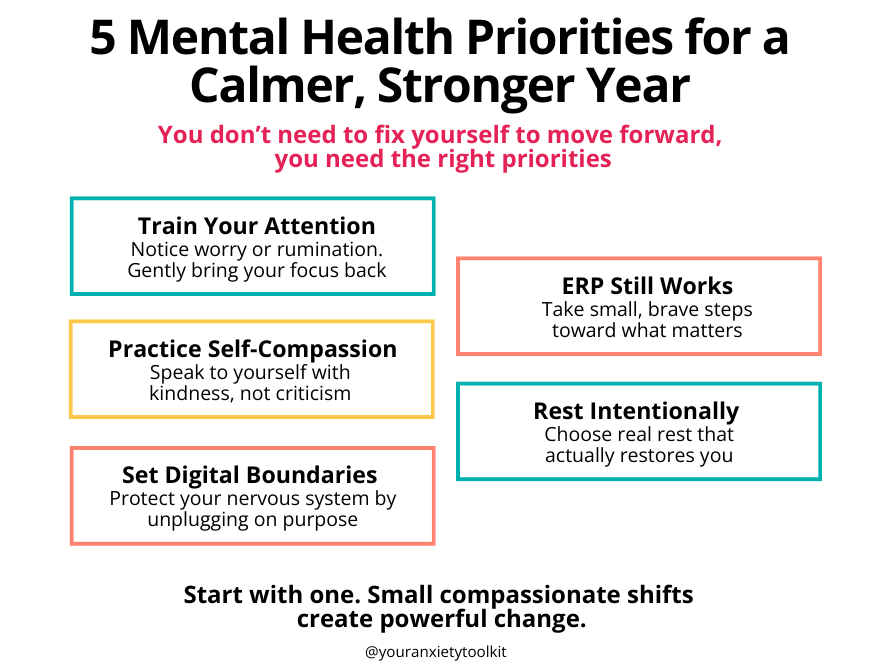
Your Homework: Start With One Thing
You don’t need to do all five priorities at once.
In fact, you shouldn’t.
Choose one:
- One skill
- One shift
- One small step
Small changes lead to meaningful change.
Final Reminders as You Move Forward
- The past year likely held both wins and losses
- Growth happens in small, consistent steps
- You are allowed to go gently
- Doing hard things with kindness is still brave work
Today — and every day — is a beautiful day to do hard things.
The podcast is made possible by NOCD. NOCD offers effective, convenient therapy available in the US and outside the US. To find out more about NOCD, their therapy plans, and if they currently take your insurance, head over to https://learn.nocd.com/youranxietytoolkit
Transcription: 5 Mental Health Priorities for a Calmer, Stronger 2026
Welcome to your Anxiety toolkit. I’m your host, Kimberly Quinlan. This podcast is fueled by three main goals. The first goal is to provide you with some extra tools to help you manage your anxiety. Second goal to inspire you. Anxiety doesn’t get to decide how you live your life. And number three, and I leave the best for last, is to provide you with one big fat virtual hug because experiencing anxiety ain’t easy.
If that sounds good to you, let’s go. Today we’re talking about five mental health priorities for a calmer, stronger 2026. Here is my question for you. If you want to get into tip top mental health shape in 2026, I’m going to take you through my five top prior. For my own mental health and what I would encourage you to do to follow me, and so let’s get to it.
As we step into the new year, I want you to consider what matters most. What is my purpose and how can I not let anxiety stop me anymore? The new year can bring a lot of pressure so that this pressure to like do better and fix ourselves. I wanna reframe this. Let’s get really clear on the skills and priorities I want us to focus on.
So let’s go over the agenda. I’m gonna teach you five powerful shifts that can help you prioritize your mental health in 2026. I’m gonna help you do it with intention. They are gonna be science backed tools, and you’re gonna do it with. Self-respect. So let’s get started. Welcome to your anxiety toolkit.
This is a podcast where I teach you all of the science back skills to help you live your biggest fullest life and manage your anxiety. My name is Kimberly Quinlan. I am an anxiety specialist. I am a therapist, and my personal goal is to help you suffer less. It’s as simple as that. So today we always go through what I call an anxiety toolkit, a specific set of skills that you’re gonna take, and I’m gonna give you five of those today.
So let’s go to number one. It’s attention training. As a lot of you know, last year in December, I created a whole course called the Rumination Reset, and I teach you a specific skill called attention training. To help you manage rumination and anxiety, and this is going to be the core skill I wanna teach you from now on.
So let’s talk about what is attention training Now? Attention training is a mental exercise. It’s a strength or a skill, and they use it a lot in metacognitive therapy, which is a type of cognitive behavioral therapy, more on the cognitive side. And now it is designed to help you. Prove your intentional control so that you can kind of stay, you know, with what matters to you.
It helps you to reduce worry and rumination, right? And it helps you treat emotional disorders or even just general strong emotions by teaching you to focus and control your attention to what matters. So what I wanna do is give you an explanation here. So let’s say that you are washing the dishes. Now as you’re washing the dishes, follow my little arrow here.
So as we’re washing the dishes, you’re focusing on the suds and the warm water and the tiredness of the plate and the softness of the sponge, and you’re focusing on that. But then your brain comes out away from that focus and he’s thinking about, oh my God, bad things might happen. And oh my gosh, you know what that I said that thing.
And what if I had that thought? And what if I wanna do that thought And attention training is observing all this mess here. We get ourselves into and bringing it back to the focus of washing the dishes and the warmth of the water and the feeling of the suds, right? And we’re gonna stay here and we’re slowly staying our attention in this line.
Then our brain’s gonna bring us over here and be like, oh, what if you hurt your parents? And what if you, you know, they judge you and you lose your job, and you go to jail and all these things, and your job is to note that you’ve gone and your attention is off track, and it brings it back to washing the dishes.
And the warmth of the suds or the smell of the suds or the feeling of the sponge, then your brain’s gonna come over here and do it all over again. Come on back. This is attention training and my goal this year is to go deeper into teaching you about that. Now you can also go to the rumination Reset at CBT School and learn more skills there, but know that this is going to be a priority of mine and I hope it’s a priority of yours in 2026.
Now number two is Compassionate Mind Training. Now this is a specific training of Compassion. Now, compassionate Mind training is under the umbrella of a type of treatment, which is a cognitive behavioral therapy treatment called compassion focused therapy. I am a compassion focused therapist. I practice that in addition to cognitive behavioral therapy.
Now, what that means is we. Practice replacing self-criticism with kind, curious awareness. It kind of, again, goes under the umbrella of mindfulness. It is a commitment that we make to kindness and respect. That’s supposed to say respect and warmth, right? So it’s the commitment to really committing to I am no longer gonna beat myself up.
Under any condition, I am going to hold space for myself and for the fact that it’s hard and that I’m doing the best that I can. It’s also going to be using warm statements like, this is hard and I’m doing the best I can. There you go. It’s gonna be saying, wow, this is a difficult moment. What do you need to succeed in this moment?
Yeah, it is really hard. This is really hard for you. How can I support you? That is compassionate statements and it’s also going to be used to target difficult emotion like shame. Guilt, anxiety and sadness and uncertainty, right? We really double down on these skills, and I want you to use 2026 to get really good at feeling uncomfortable emotions.
It doesn’t mean you want those emotions, it just means that you’ve made a commitment that there is no emotion that you could have. That will cause you to abandon yourself. That there is no emotion that you could have where you are going to respond in a brittle mean way. That’s the work we’re doing here now.
Number three is digital boundaries. As I end out 2025, I am coming to realize and I’m reading the research that short form media. Reels, shorts, TikTok are really not good for our brain. And I was telling my kids and my husband last night that I literally lost 40 minutes. The other day I went to bed, I opened on Instagram, and before I knew it, 40 minutes of my life had disappeared and I have no idea where they went.
And it made me realize. That short form media can really take you away. Now, I love short form media. I make short form media. I’m not against it, but I wanna really work at setting digital boundaries this year. And what that might look like is curating your feed with intention, so not following people that don’t make you feel good.
Okay? So if you are looking for effective OCD or BFRB treatment that’s covered by insurance. I’m thrilled to announce to you this week’s sponsor no cd. No CD provides live face-to-face video sessions with licensed therapists who specialize in OCD and related conditions. Through exposure and response prevention therapy, a highly effective treatment designed specifically for OCD, their therapist can tailor a plan just for you.
OCDs treatment approach is clinically proven to significantly reduce symptoms with an app that helps you stay connected to therapists and peer communities in between sessions, so you’ll always feel supported. No CD is available in all 50 states and even internationally, and accepts most insurance plans, making care affordable and accessible.
If you think you might have OCD or a struggling to manage symptoms, there is hope. Book a free call@nocd.com. You don’t have to struggle alone. Big hugs. And now let’s get back to the show. Right. And also being really curious, like, let me tell you a story. I follow these wonderful couples, therapists, um, the, the account is Meet the Freemans.
I love them. They have the most amazing relationship advice. I strongly encourage you follow them, and I’m not like sponsored by them or anything. I love their staff. But I found that they’re constantly talking about the sort of the right way to communicate. And I even started to notice that if my husband and I aren’t communicating that way, I will get bummed out and be like, oh no, and I should be doing this.
And I was like, whoa, this is not healthy. Okay. Maybe I need to slow down in consuming so much of their stuff, even if it’s helpful. We sometimes have to reduce our consumption. It also means sending time limits, which I’m going to do. I’ve ordered a brick. I’m gonna get the brick and put it on. Again, not sponsored by brick, but I’m gonna put that on my phone because I really think that I want something to alert me that it’s.
Time to shut them down, especially before bed. And I really, with my kids, I wanna create tech-free zones or times, uh, where we can be more present and play uno and play clue and categories in the games we love to play. I’ve noticed games, like actual board games, we’ve played less of them this year because we’re on digital tech more.
So I wanna. Now number four, our goal together is to face the fears that have been holding us back and we wanna recommit to that ’cause I’m committed to that last year and the year before that and the year before that, we are recommitting. Now what does this mean? It means I want you to do an order of the things you did not do last year.
Do to fear. Be gentle. We’re not here to beat ourselves up. I want you to commit to a plan to face. Those fears, and it obviously needs to be done in a hierarchical step-by-step way. So we, we want to deal is create a strong strategy for gradually increasing those exposure. Now, as you know, we have all types of coauthors at.
CBT school that can help you with that. If you have OCD, we have a complete start to finish treatment plan for folks with OCD called your OCD toolkit. We also have your anxiety and panic toolkit. If you have generalized anxiety or panic disorder. We have overcoming depression. If you want a step-by-step process on how to manage depression, we have your BDD toolkit with that I did with.
Chris Truden, again, a start to finish treatment plan and course to show you how to do that work and overcome your BD, D. And last of all, BFRB school, which is for hair pulling and skin picking. Now they are there for you if you want to dive deeper than the sort of shorter educational content that I provide for free.
So you can head over to CBT school if you’re interested and pick what’s. Whatever would feel best for you, whatever’s most helpful. Okay. Now number five is the most important. I want you to rest like a machine this year. My goal is to rest like a machine. I have huge goals for 2026. Career wise, I have huge goals for me, really doubling down on the mission of CBT score.
But in order to do that, I’m going to have to learn to rest like a machine literally. And what I mean by that is machines. Like I think of a machine where like something that can power through and it doesn’t have an emotions and it can just get things done. But what do you do in a factory? At the end of the day, you turn the machine off and it actually growly rests.
It cools down, the electricity stops, and they actually rest. So for those of us who want. To really succeed in many, many ways, or even in a small way, you’re gonna have to learn how to rest like an Olympic role athlete. And what I mean by that is they train hard, but they rest hard. And that’s what I want us to focus on.
Actual real rest, not rest. Where you just are scrolling on Instagram and you’ve lost track of 40. Not rest where you’re just staring at the TV or numbing out on alcohol or food, all those things are fine. I’m not saying that you know, I’m judging you. I’m not judging you in any way. But truly check in with yourself.
What is truly restful? Honor your nervous system with rest, not with just sleep, but stillness. Solitude, gentle movement, creativity, reading, nature, pets copies, a cup of tea, whatever actually slows your nervous system down. I want you to schedule restorative rest every single day. Okay? All right, so here’s your homework.
I want you to pick one of those things. Start there. Just one, not all of them. I don’t want you to try and tackle all this at once. I will not be tackling all of this at once. We will do this gradually and compassionately. Now, here’s the points I want you to remember as we move forward for today. Number 1, 20 25 was rough, right?
There was some ups and some downs We won, had some wins and we had some losses. I think that’s true for everybody. Remind yourself that small changes lead to big changes. So we are going to start baby, baby steps. Remind yourself that you are growing and that every step you take matter. Right. Be kind to yourself.
You are doing brave hard things that deserve deliberation, and remember, today is a beautiful day to do hard things. We’re gonna keep that going into 2026, even if you’re listening to this in 2027. These all apply. These are gonna be major priorities I have for 2026. Okay? As always, thank you so much. So honored that you are spending this time with me.
I know your time is valuable. I cannot wait to see you next episode. Alright, I’ll see you then. Please note that this podcast or any other resources from cbt school.com should not replace professional mental health care. If you feel you would benefit, please reach out to a provider in your area. Have a wonderful day, and thank you for supporting cbt school.com.
